Get in Touch with BOSHIYA

BTX Aromatics: A Technical and Buying Guide

BTX aromatics refers to the related product families benzene, toluene, and xylenes. Conveniently using an acronym to cover the entirety of an offering masks considerable differences. For example, a client doesn’t purchase “BTX” in general. The purchase must identify the molecule or xylene isomer, grade, test methods, delivery form, and end-use limits.
Contents
show
This guide follows that decision path. It explains where BTX comes from, what recovery steps accomplish, how the molecules enter different derivative chains, and which evidence belongs in a supplier review. Product availability and quotation requests belong on BOSHIYA’s petrochemical and chemical supply page; this article stays focused on technical understanding and purchase preparation.
What BTX Aromatics Include, and What the Acronym Hides
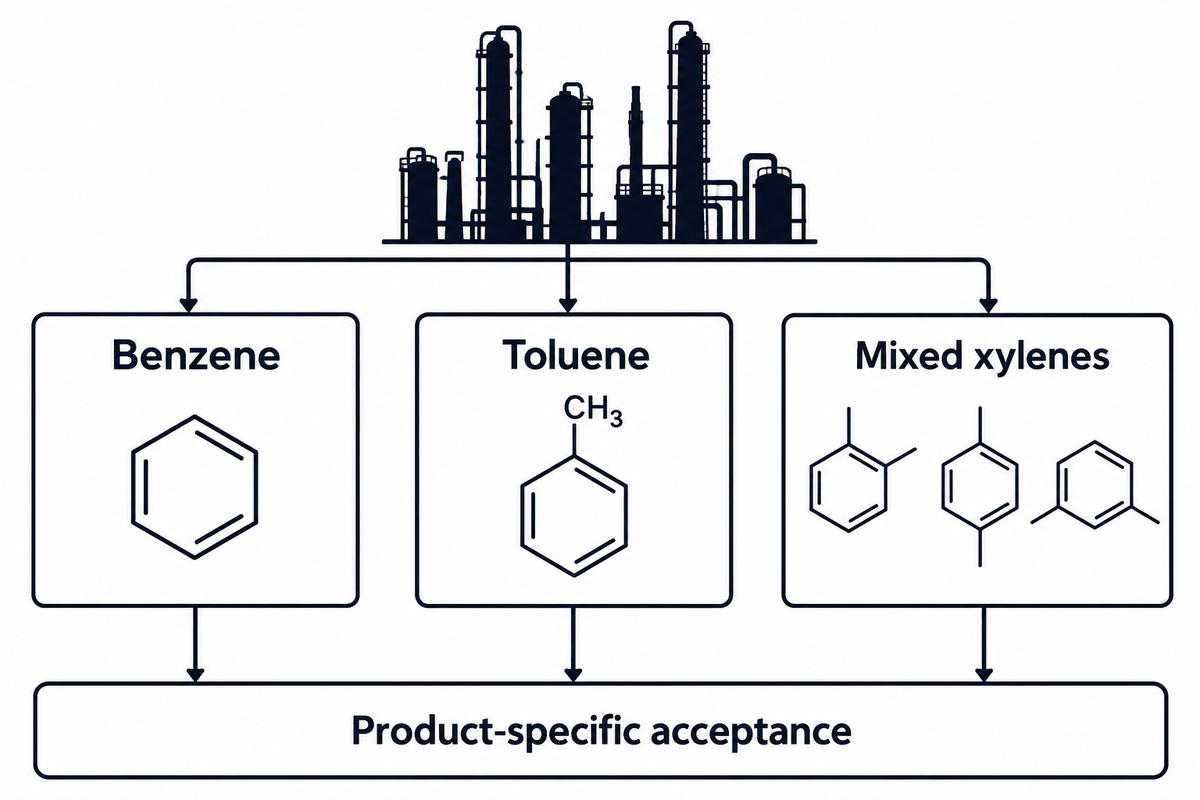
BTX refers to benzene, toluene, and xylenes; the expanded search phrase “benzene toluene xylene” describes the same family, but each molecule is purchased as a distinct product. “Xylenes” may mean a mixed-xylene stream or a specified para-, ortho-, or meta-xylene isomer. A purchase request should therefore name the exact molecule or mixture rather than use “xylenes” alone. See the product-specific benzene overview.
| Product | Commercial distinction | Representative downstream chain | First buyer question |
|---|---|---|---|
| Benzene | Single aromatic compound; grades differ by assay and impurities | Ethylbenzene/styrene, cumene/phenol, cyclohexane/nylon | Which grade and impurity limits does the process accept? |
| Toluene | Used directly and as conversion feed | Solvents, chemical intermediates, disproportionation or transalkylation feed | Is the purchase for direct use or further conversion? |
| Mixed xylenes | C8 aromatic mixture that can include ethylbenzene | Feed for isomer recovery and conversion | What is the full isomer and ethylbenzene assay? |
| Para-xylene | Specific xylene isomer | Purified terephthalic acid and PET | Which isomer purity and trace impurities are controlled? |
| Ortho-xylene | Specific xylene isomer | Phthalic anhydride | Does the certificate report the required assay method? |
| Meta-xylene | Specific xylene isomer with more limited isolated-product use | Selected specialty intermediates | Is isolated meta-xylene actually required? |
The Chemical Abstracts Service number should be included with the name of the product in specs, orders, labels and certs. This prevents a shorthand such as BTX from being mistaken for a different analytical or safety scope.
Where BTX Comes From: Reformate, Pyrolysis Gasoline, and the Recovery Handoff
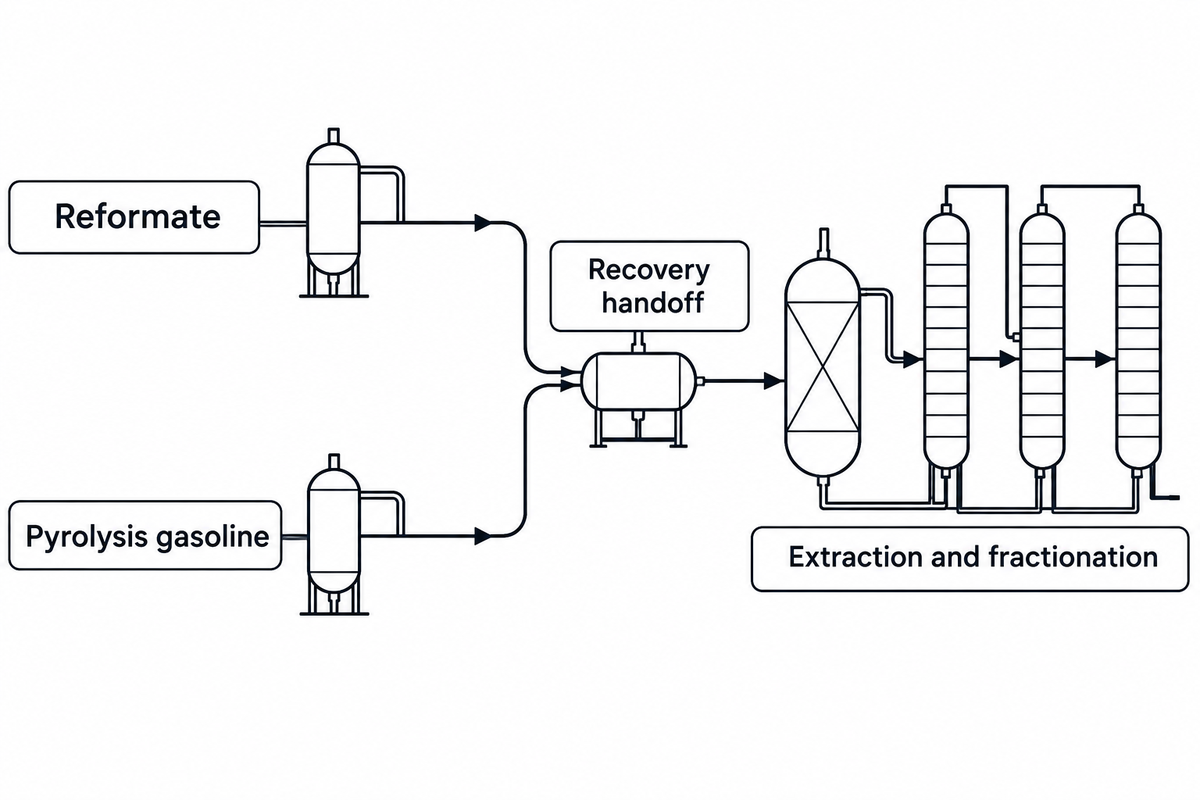
Two important source contexts for aromatics production are catalytic reforming and pyrolysis gasoline. In a refinery, a catalytic reforming unit converts hydrotreated naphtha into high-octane gasoline blendstock and hydrogen while increasing aromatic content. A steam cracker processing liquid feed can produce pyrolysis gasoline along with ethylene and propylene. Neither source stream is automatically a finished BTX product, but each can feed an aromatics recovery route.
The problems solved by the source unit and the recovery train are different. The BOSHIYA catalytic reforming guide covers reformer chemistry and catalysts and reactor arrangements. Its steam cracking guide covers furnaces, feedstocks, olefin production, and cracked-gas separation. The handoff described here begins when an aromatic-rich liquid must be conditioned, separated, analyzed, and routed into saleable products.
- Characterize the feed and determine aromatic and non-aromatic composition as well as olefins, sulfur and nitrogen, water, and other process-sensitive constituents.
- Condition the stream as required by its measured contaminant profile and the selected recovery technology; do not assume hydrotreatment is required without that project-specific basis.
- Recover the aromatic fraction. Aromatic and non-aromatic families can be separated through solvent extraction or extractive distillation.
- Fractionate aromatic products. Subsequent columns and polishing steps allow further separation of aromatic fraction into benzene, toluene and xylene cuts.
- Manage the C8 slate. Separation and isomerization routes depend on the target product, installed technology, and the catalyst or zeolite system.
Compare Reformate and Pyrolysis Gasoline as BTX Feed Sources
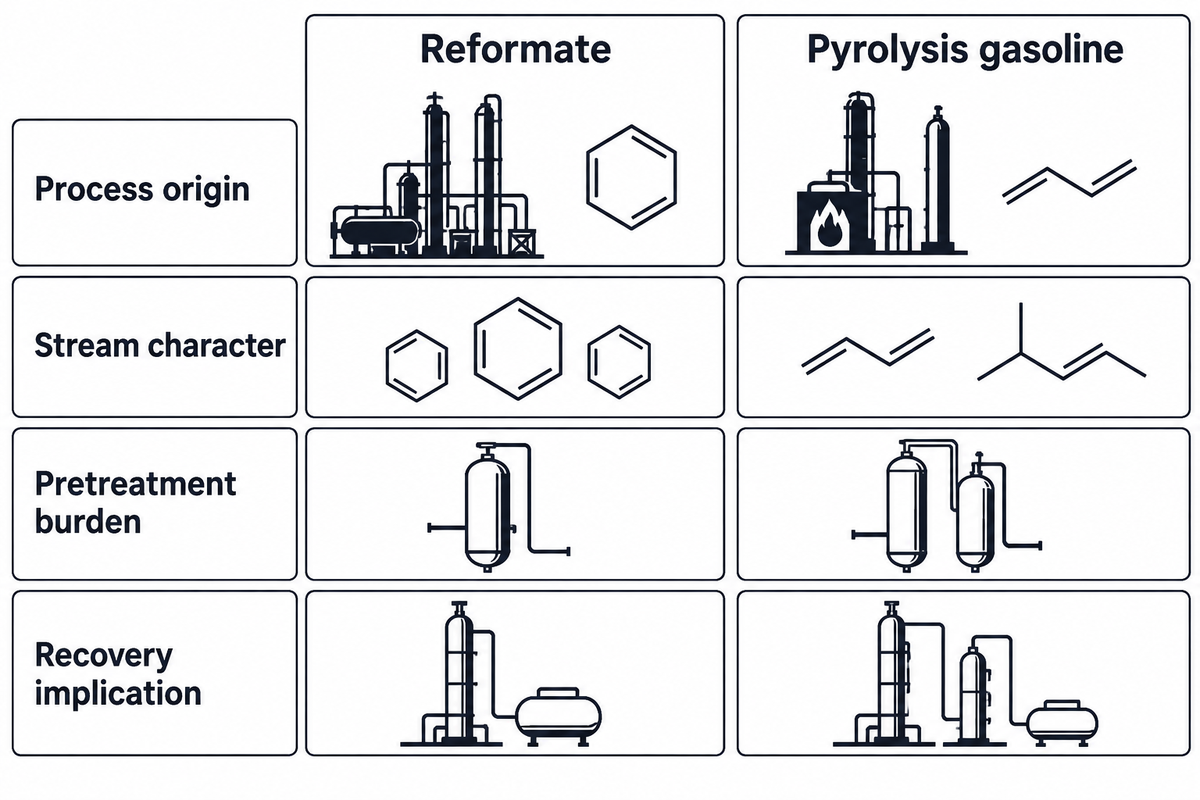
Reformate and pyrolysis gasoline can both feed an aromatics complex, but their names don’t necessarily specify a given aromatic composition. Crude source, feed cut, unit severity, pretreatment, and operating history all influence the assay. A better comparison starts with recent laboratory data rather than handbook assumptions; a current BTX and hydrogenated pyrolysis gasoline safety data sheet also shows why the exact stream identity matters.
| Decision point | Catalytic reformate | Pyrolysis gasoline | Evidence to request |
|---|---|---|---|
| Origin | Treated naphtha through catalytic reforming | Liquid-feed steam cracking coproduct | Source-unit and feed-cut description |
| Composition | Aromatic-rich gasoline-range mixture | Aromatic-rich cracked liquid with feed-dependent unsaturates | Full hydrocarbon assay, not BTX total alone |
| Conditioning | Depends on recovery design and contaminants | Define from feed analysis and the licensor’s recovery sequence | Relevant contaminant and stability data |
| Recovery choice | Technology and product slate determine the train | Technology and pretreatment determine the train | Licensor design basis and current feed envelope |
| Commercial conclusion | No universal BTX yield | No universal BTX yield | Mass balance tied to the actual feed assay |
The contrarian lesson is simple: a stream with more total aromatics isn’t automatically the better commercial feed. Pretreatment duty, solvent load, utilities, recovery, product mix, and available separation capacity can reverse the apparent advantage. A refiner should compare aromatics yield and net saleable products, not a single inlet concentration.
How Mixed Aromatics Become Saleable Products
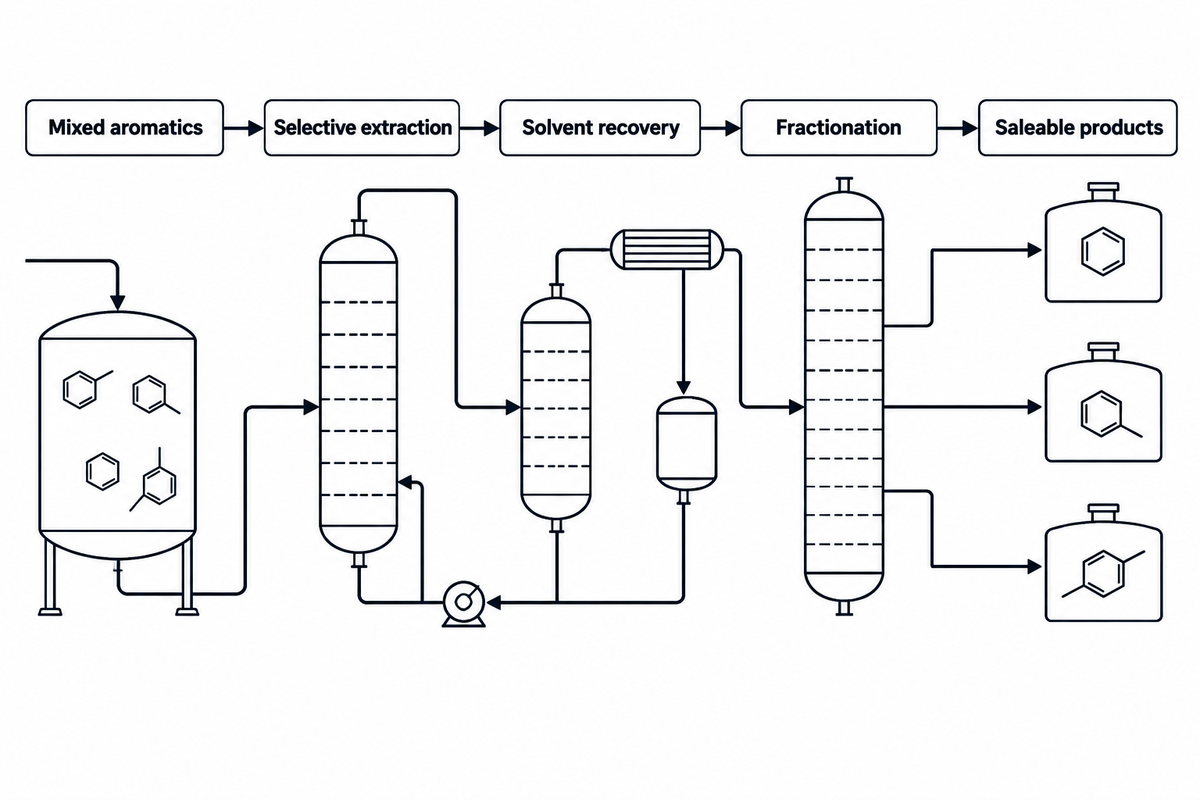
Ordinary fractionation alone may not cleanly separate every close-boiling aromatic and non-aromatic component in a mixed stream, so a recovery scheme may add solvent extraction or extractive distillation. Review one documented pure-aromatics recovery configuration. A practical BTX production process combines feed conditioning, family-level separation, fractionation, conversion, recycle, and laboratory analysis. Fractionation separates target product cuts from lighter and heavier components.
- Hydrogenation or stabilization protects later operations by addressing reactive components where the feed requires it.
- Aromatic and non-aromatic families can be separated by aromatics extraction using selective solvent behavior or an extractive-distillation design.
- Solvent recovery allows solvent to be returned to the process and reduces solvent carryover to product streams or effluent.
- Fractionation supports the production of benzene, toluene, and heavier aromatic cuts after family-level separation.
- Product polishing and analysis confirm that the resulting stream meets the named grade rather than merely a broad purity target.
One trade-journal case study reports aromatic purities of 99.999 wt% and yields of more than 99.9 wt% for a particular integrated aromatics arrangement built on a proprietary extractive-distillation process; those figures belong to that configuration and are not a prediction for other cases. The defensible question is whether the proposed technology has a mass balance, utility basis, solvent-loss basis, and product specification tied to the buyer’s feed assay.
A process flow diagram should therefore show the feed boundary, conditioning step, extraction or extractive-distillation section, solvent loop, fractionators, conversion reactors, recycle streams, and product sampling points. This lets operations, finance, and quality teams test the same design basis instead of optimizing isolated equipment.
How Conversion Changes the BTX Slate
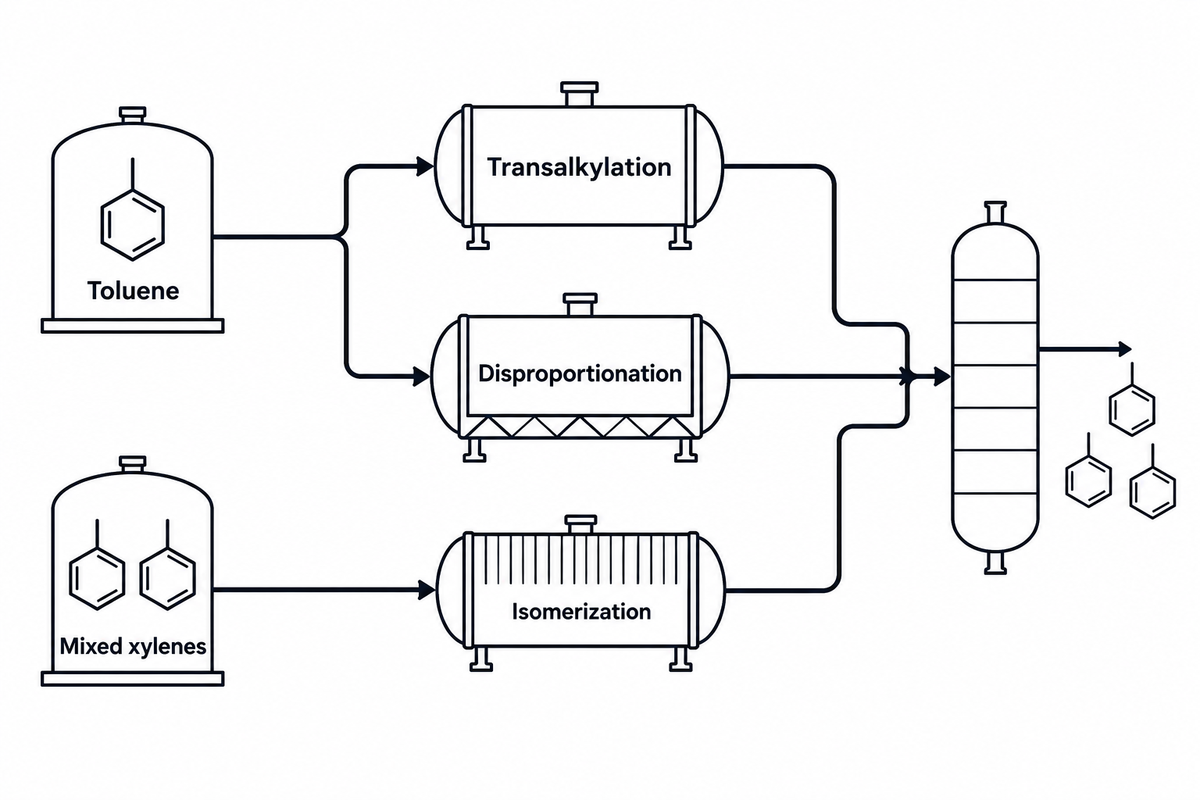
An aromatics complex can separate product cuts and also shift the product slate through conversion. Transalkylation transfers alkyl groups between aromatic molecules, while xylene isomerization promotes equilibration of a C8 mixture after a desired isomer is removed. Toluene disproportionation can assist the production of benzene and xylenes.
Not all molecules in these routes are equally valuable. Para-xylene demand can justify repeated separation and recycle, while ortho-xylene may be recovered by a different separation step. A UOP patent illustrates the underlying limitation: reformate-derived C8 aromatics contain three xylene isomers plus ethylbenzene, and its described scheme leaves meta-xylene in the recycle rather than isolating it. This is an example of a process scheme, and isn’t a general design rule.
Before conversion options can be reviewed, required inputs include the production target, feedstock characteristics, available utilities and hydrogen, catalyst and separation constraints, product and byproduct splits, and the licensed performance basis. A simplistic target, such as “maximize BTX,” doesn’t help define a process for engineering and procurement purposes.
Fluid catalytic cracking naphtha is an alternate feed context; one review notes that FCC gasoline usually contains about 30% aromatics. Chemical recycling or circular BTX concepts may use plastic or biomass-derived feed. These routes have different contaminants, carbon accounting, readiness, and economics, so compare them with conventional reforming and aromatics recovery on feed assay, mass balance and product specification before treating them as equivalent.
Map BTX into Its Major Derivative Chains
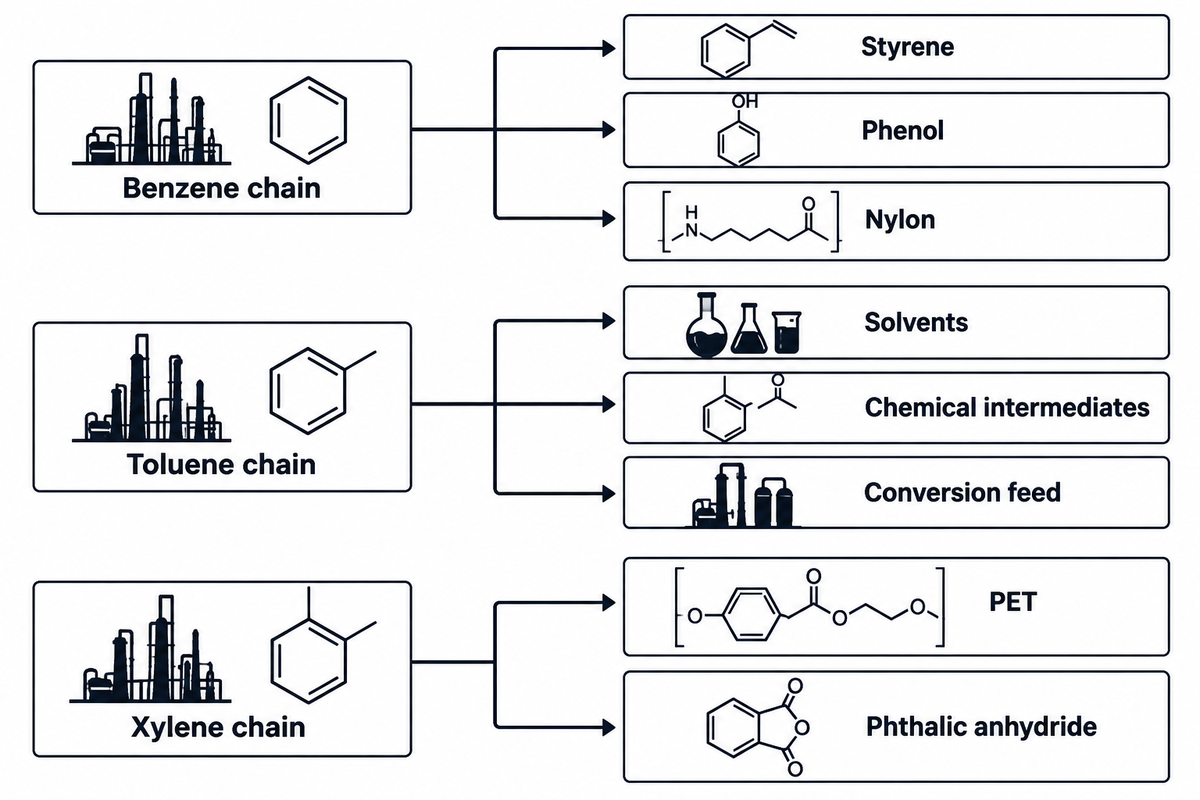
Derivative demand helps determine how an aromatics complex separates and rebalances its BTX product slate. Benzene feeds ethylbenzene and styrene, cumene and phenol, and cyclohexane-based nylon chains. Toluene serves as solvent, intermediate, or conversion feed. Para-xylene links to purified terephthalic acid and PET polymer production; ortho-xylene links to phthalic anhydride. These chains connect refining and petrochemical industries without defining a universal product specification; see the toluene overview for one derivative-chain example.
The name of a derivative shouldn’t replace the specification of a feed. A styrene producer, a solvent formulator and a polyester chain may all ask for aromatic materials, but their sensitivities to impurities and acceptance methods will vary. The end-use process owner must translate reaction, catalyst, color, water, and contamination constraints into measurable purchase limits.
Read a BTX Specification and Certificate of Analysis
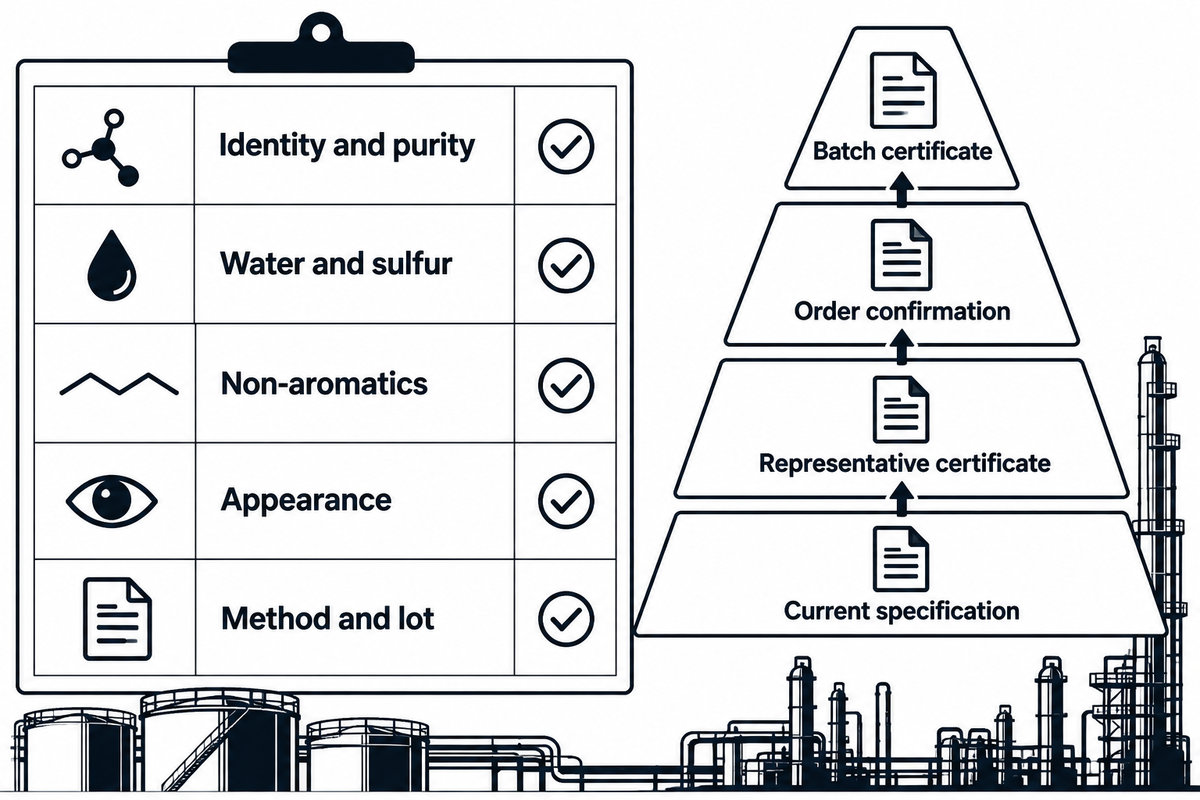
A specification provides the test methodology, limits and acceptance criteria. Review the ASTM D4734 refined-benzene specification. ASTM D4734 for refined benzene-545 shows why “high purity” is incomplete: its property list includes benzene assay, sulfur, thiophene, toluene, non-aromatic hydrocarbons, nitrogen, acid-wash color, bromine index, water, appearance, and solidification point. This list is valid for the stated grade of benzene; it is not a broad spectrum definition for other BTX products.
| Evidence Type | What it proves | What it does not prove |
|---|---|---|
| Website portfolio statement | The supplier discusses a product family | Current grade availability or batch conformity |
| Current product specification | Offered limits and named methods | The result for a particular shipment |
| Representative certificate | Expected certificate format and fields | Conformity of the ordered batch |
| Order confirmation | Agreed grade, quantity, packaging, and commercial terms | Final measured batch results |
| Batch certificate of analysis | Reported results for the identified batch | Suitability beyond the agreed specification |
| Safety data sheet | Supplier hazard and handling information for the named product | Site-specific risk controls or transport approval |
| Technical data sheet | Typical or specified technical properties | Batch conformity unless explicitly stated |
| Traceability record | Links the shipment, container, and batch identity | That every measured property passed |
| Change notification | Defines how a material or process change will be communicated | Automatic acceptance of the changed product |
The Supplier Evidence Ladder moves from a broad capability statement to a current specification, a representative certificate, an order confirmation, and batch-specific test results. Confirm product identity, grade, batch number, issue date, units, test methods, specification limits, and reported results. For xylenes, review the results for assay of mixed xylenes and individual isomers and ethylbenzene. Agree on sampling and retest methods, rounding, disputes and change notifications before shipment.
Handle Safety, Storage, and Transport as Product-Specific Decisions
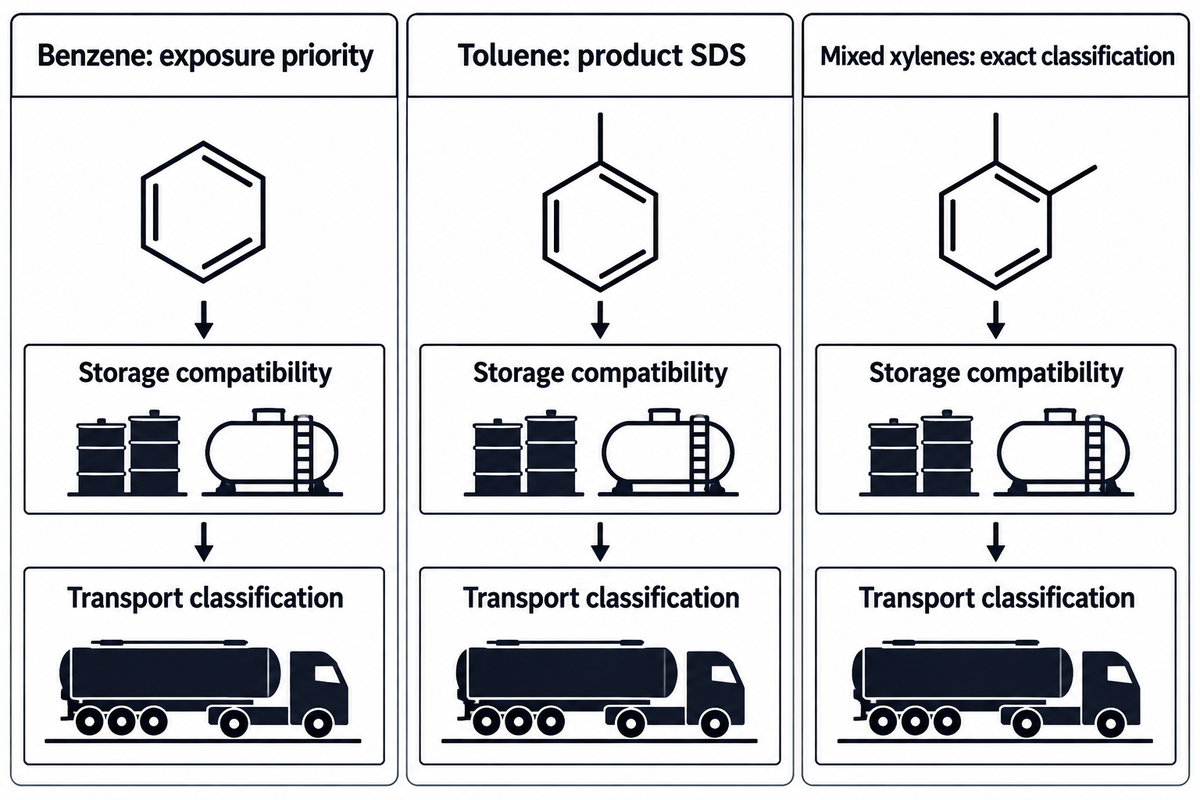
Don’t replace compound-specific review with a single BTX handling rule. Benzene has stringent workplace requirements. In the United States, OSHA 29 CFR 1910.1028 sets a 1 ppm eight-hour time-weighted average and a 5 ppm fifteen-minute short-term exposure limit for covered occupational exposure. The standard states that odor is not a sufficient warning signal.
Those numbers are not a global transport classification or a site operating procedure. Use the current supplier safety data sheet, applicable jurisdictional rules, route requirements, tank and seal compatibility, ventilation design, exposure assessment, fire protection, unloading procedure, and emergency plan. Verify the exact product because mixed xylenes and individual compounds can have different classifications and controls.
For site integration, also assess whether gasoline production, hydrogen production, and hydrotreating demand, along with vapor-control constraints, compete for limited capacity. Reid vapor pressure may be relevant to a gasoline pool, but it isn’t a universal acceptance criterion for a purified BTX product. Keep controls for final chemical specifications separate from controls for the refinery pool.
Use a Buyer-Ready BTX Aromatics Checklist
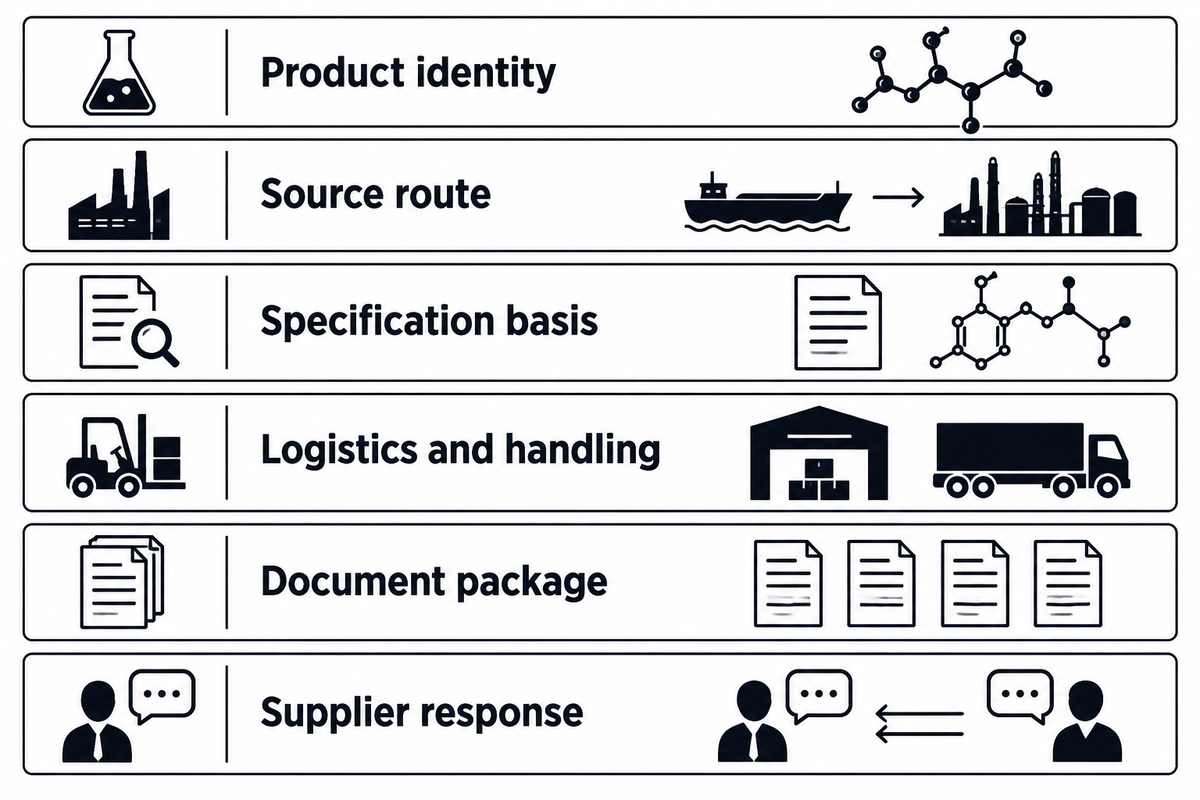
A clear request for quotation separates technical acceptance requirements from commercial logistics. This prevents a polished portfolio claim from being mistaken for proof about the ordered batch.
- Product: molecule, xylene isomer or mixture, grade, Chemical Abstracts Service number, end use, and required quantity.
- Quality: assay, individual impurities, water, color or physical-property limits, test methods, sampling, and acceptance rule.
- Evidence: current specification, representative certificate, batch certificate, safety data sheet, technical data sheet, origin, and traceability.
- Packaging: Tank, ISO tank, drum, or other agreed package; material compatibility, cleanliness, seals, and unloading connection.
- Logistics: route, dangerous-goods documents, Incoterm, delivery window, storage limits, and contingency plan.
- Commercial controls: minimum order, change notification, shelf or retest period where relevant, claims procedure, and retained sample.
BOSHIYA states that the petrochemical portfolio can be supplied with batch certificates plus safety and technical data sheets. Treat that as the starting point for an order-specific review. Verify the current product specification, packaging, route, and batch documents for the specific request.
For related plant context, buyers can also review BOSHIYA’s oil refinery overview and technical service capabilities. Those pages support facility and service evaluation; they don’t replace the BTX product documents described here.
Frequently Asked Questions
What are BTX aromatics?
BTX aromatics are benzene, toluene, and xylenes, a commercially important group of aromatic hydrocarbons. The “X” may refer to mixed xylenes or to ortho-, meta-, or para-xylene. Buyers therefore need the complete product name, grade, isomer composition where relevant, specification, and intended use rather than relying on the acronym alone.
How is BTX produced?
BTX molecules occur in aromatic-rich streams, like catalytic reformate and pyrolysis gasoline. Those streams may require conditioning, extraction, solvent recovery, fractionation, conversion, isomer handling, and product polishing before individual aromatics are saleable. The actual train depends on feed composition, target products, licensed technology, and integration with the rest of the site.
How do reformate and pyrolysis gasoline differ as BTX feedstocks?
Reformate is obtained from catalytic reforming of treated naphtha, and pyrolysis gasoline is associated with steam cracking of liquid feed. Their composition can differ widely: one review’s table of typical aromatics content lists benzene at 3–12% of reformate gasoline but 25–34% of pyrolysis gasoline. Use the latest feed analysis and a process mass balance to assess BTX yield for a specific stream.
Which xylene isomer is used to make PET?
Para-xylene is predominantly used in purified terephthalic acid and polyethylene terephthalate (PET) chains. Mixed xylenes and other isomers aren’t replaceable with para-xylene. Confirm isomer assay, purity, sensitive impurities, test methods, and the downstream process specification; a generic “xylene” label is not enough for polyester production.
What should a BTX certificate of analysis include?
It should identify the product, grade, batch, issue or sampling date, measured results, specification limits, units, and test methods. Product specific fields may include isomer composition, water, sulfur compounds, color, distillation indicators or other named impurities. Acceptance must follow the agreed purchase specification rather than a generic certificate format, and the batch identity should match the shipping and traceability documents.
How should I evaluate a BTX supplier?
Describe the exact product, grade, end use, volume, packaging, route and acceptance specification. Request a current specification, a representative certificate, safety and technical data sheets, traceability details, order confirmation and the batch certificate supplied with delivery. Then compare documents, change control, logistics and claims handling, as well as price. Treat web site statements as preliminary, screening information and verify every order-related requirement in controlled documents.
References and Sources
- OSHA, 29 CFR 1910.1028 Benzene
- ASTM International, D4734 Standard Specification for Refined Benzene-545
- NIOSH, Manual of Analytical Methods by Chemical Name
- Digital Refining, Recovering Pure Aromatics
- Google Patents, US5472593A, BTX from Naphtha Without Extraction
Reviewed against the cited public technical sources and BOSHIYA’s published product information. Project specific engineering, safety and purchase acceptance remain the responsibility of the buyer.