Get in Touch with BOSHIYA
Mini Mill vs Integrated Mill: A Constraint-Led Guide

Steelmaking Route Guide
Contents
show
The mini mill vs. integrated question is not simply large vs. small or scrap vs. ore. A useful comparison is following the complete route stack from metallic charge and energy supply through casting, finishing, environmental controls and maintenance.
Mini Mill vs Integrated Mill: The Short Answer
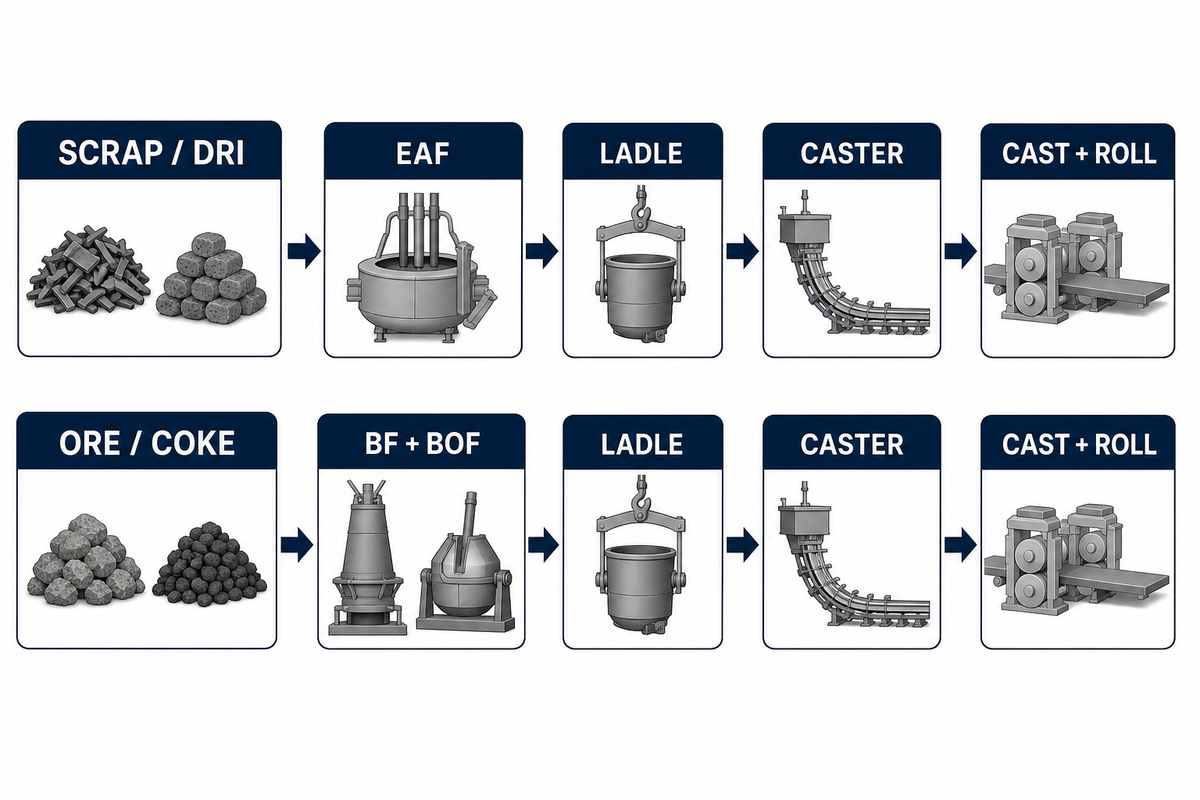
An integrated mill normally reduces iron ore in a blast furnace and converts hot metal in a basic oxygen furnace, while a mini mill normally melts scrap and other metallics in an electric arc furnace. The practical choice is less about the historical label and more about feedstock availability, energy, product, utilization, and site conditions.
Decision boundary: This guide is a screening framework. A project still needs site-specific mass and energy balances, metallurgy tests, environmental assessment, capital and operating cost estimates.
The steel industry also uses several spellings, e.g. “mini mill,” “mini-mill,” and “minimill,” for the same broad production concept. “mini steel plant” does not mean a hobby machine tool. It means industrial steel production, which is electric melting, usually using scrap steel or other scrap metal, with a smaller upstream footprint than an ore-to-steel complex.
Follow the Route Stack, Not the Label
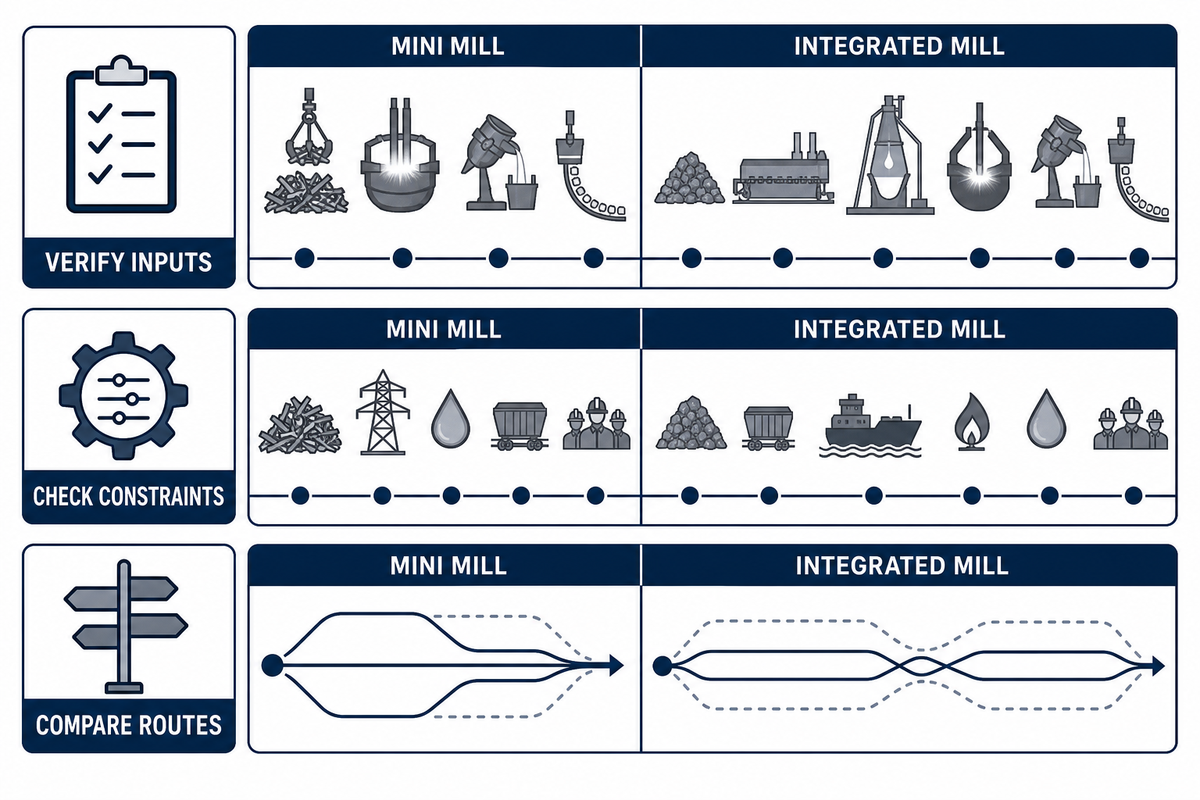
A steel plant should be classified by the modules it operates and the metallic charge it processes, not by whether someone calls it “mini.” Modern EAF plants can be large, highly automated, and capable of sophisticated flat products, while an integrated group may add EAF capacity or buy DRI and HBI.
An exemplary integrated stack may consist of ore preparation, coke making, sintering or pellet handling, blast furnace iron making, hot metal transport, BOF steel making, secondary metallurgy, casting, rolling and finishing. An exemplary mini-mill stack may start with scrap or ore based metallics, an EAF, and a compact rolling route.
Integrated BF-BOF
Ore reduction and steelmaking are connected through hot metal, gas, oxygen, water, and material-handling systems.
Scrap-EAF
Melting relies heavily on scrap quality, high-voltage power, furnace consumables, off-gas treatment, and cooling-water reliability.
DRI-EAF Hybrid
Ore-based metallics reduce scrap dependence but introduce reduction gas, iron-ore quality, logistics, and possibly hydrogen interfaces.
Common mistake: equating EAF with 100% scrap. The World Steel Association’s raw-material overview states that EAFs can use recycled steel, DRI or hot metal, so the furnace name does not define the entire route.
Mini Mill vs Integrated Mill Comparison Table
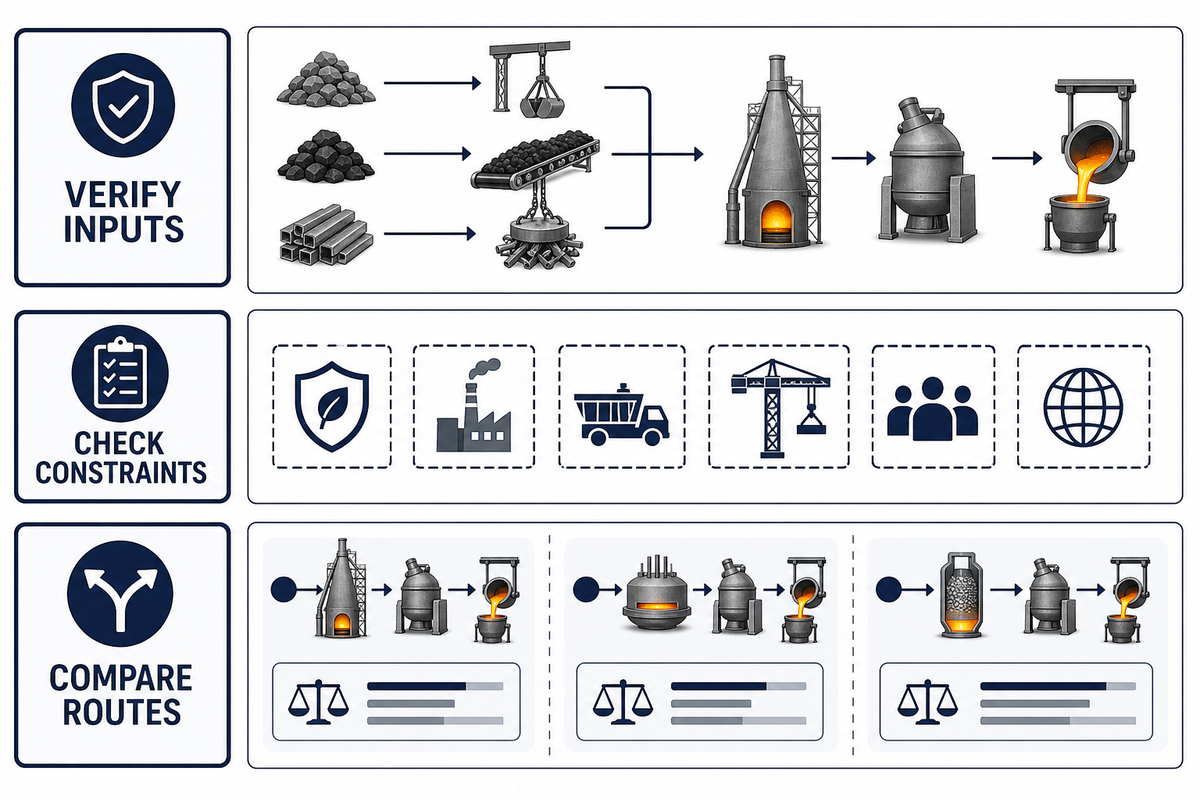
The clearest comparison separates the usual configuration from the exceptions.
| Decision category | Typical mini mill / EAF route | Typical integrated / BF-BOF route | Limitation to check |
|---|---|---|---|
| Metallic input | Scrap, DRI, HBI, pig iron, or blends | Iron ore, coke or reductant, fluxes, and some scrap | Quality, price, and secure volume by location |
| Primary energy exposure | Electricity; gas rises with DRI and reheating | Coal/coke, process gases, oxygen, electricity | Contract structure and hourly availability matter |
| Operating rhythm | More furnace-level start/stop flexibility | Long campaigns and tightly coupled continuous assets | Caster, utilities, labor, and contracts can restrict flexibility |
| Product capability | From long products to advanced flat products, configuration-dependent | Broad flat and long product capability, configuration-dependent | Secondary metallurgy, casting, rolling, and finishing are decisive |
| Environmental profile | Often lower for scrap-EAF under comparable boundaries | More direct reduction and coke-related sources in a classic route | Power mix, DRI source, slag, dust, water, and boundary can change the result |
| Investment pattern | Fewer upstream modules in a scrap route | More upstream and shared-service assets | Brownfield reuse can reverse a simple greenfield comparison |
| Ironmaking module | None onsite for scrap; optional DRI/HBI supply | Blast furnace and associated preparation | Imported metallics can move impacts outside the site |
| Maintenance network | Electrical, cooling, off-gas, refractory, caster | Ironmaking, gas, oxygen, hot-metal, BOF, caster | Shared utilities transmit failures across modules |
| Expansion path | Additional melting, casting, rolling, or DRI modules | Debottlenecking, relining, retrofit, or parallel EAF | Existing permits and downstream capacity set the ceiling |
Feedstock Security Is the First Screening Step
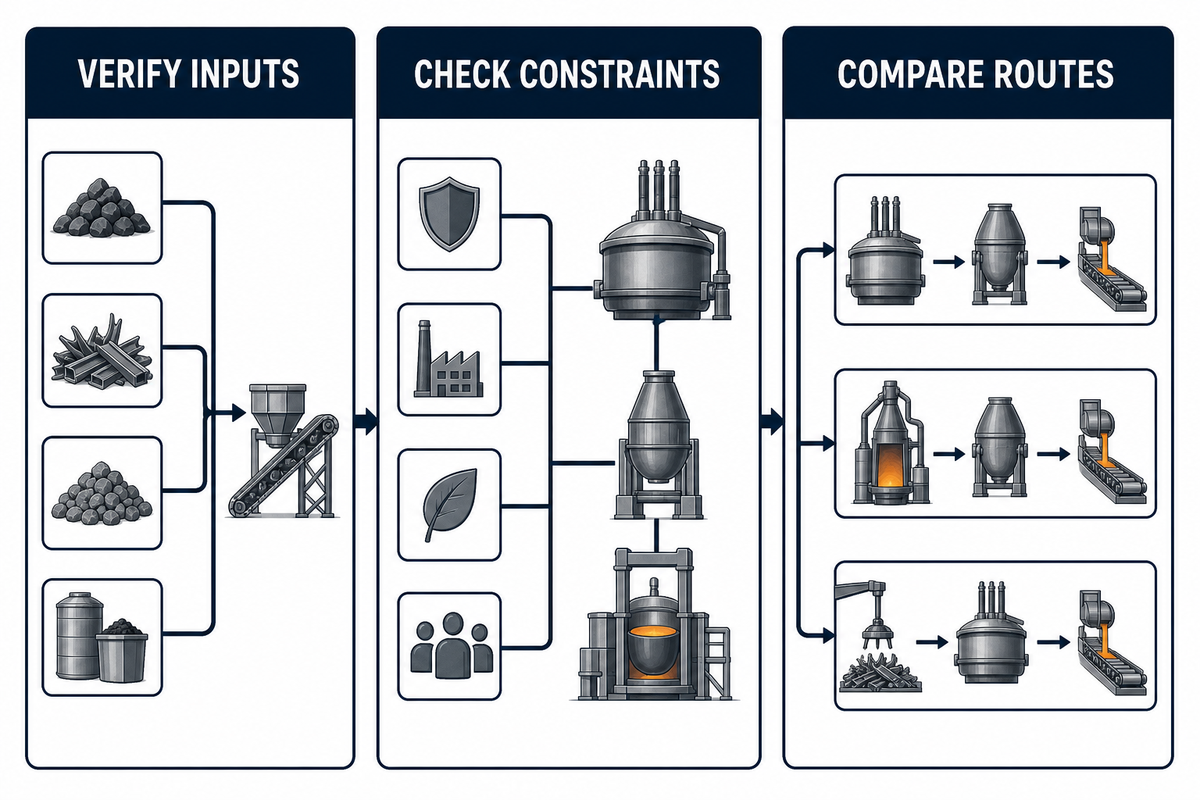
A project should test availability, the behavior of prices, the risk of delivery, the preparation required and the chemistry prior to assuming scrap or ore create an immediate advantage.
Scrap is not a homogeneous material. As normal oxidation does not remove all elements, copper, tin and other materials can accumulate. As a result, sorting, purchasing discipline and charge modeling can affect the EAF grades.
Worldsteel puts global EAF output at about 30% of steel production and cautions that the global scrap supply is not sufficient to satisfy all steel demand. Thus, primary iron units and recycling complement one another.
Product Mix Depends on More Than the Furnace
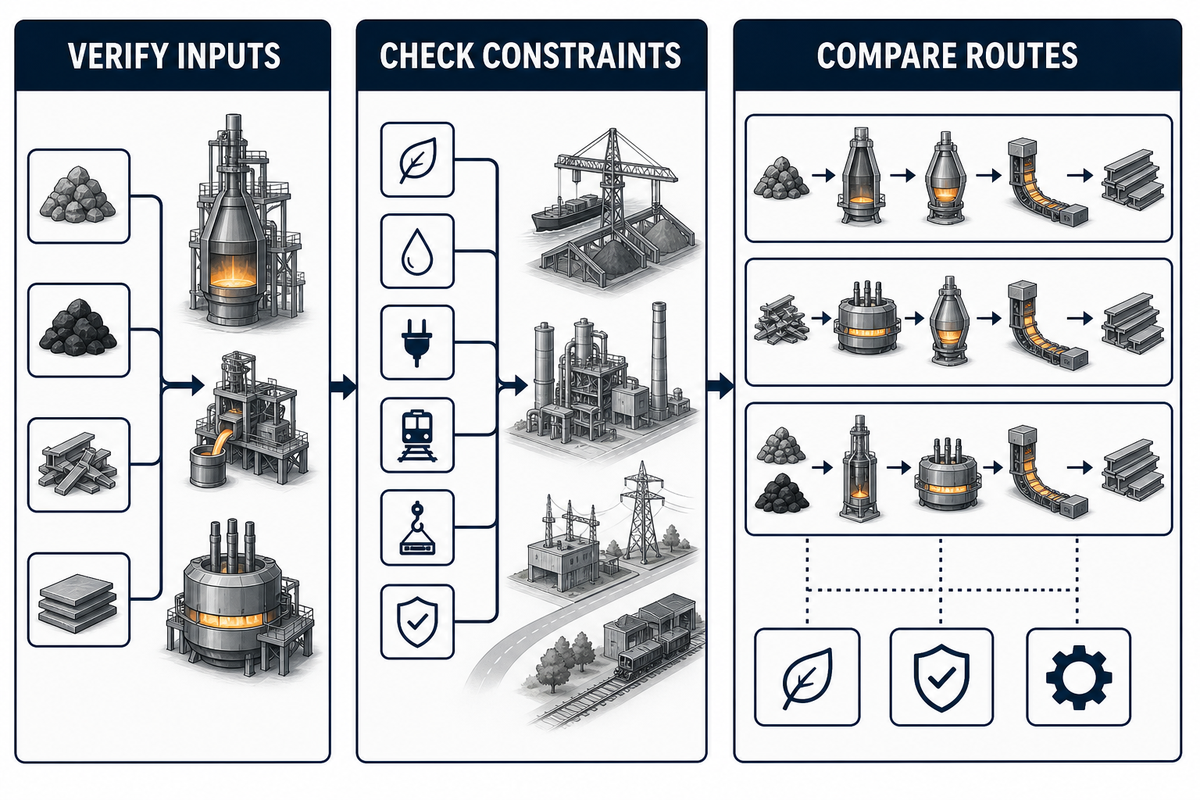
Melting affects chemistry and cost, but the furnace does not dictate the final product. Ladle treatment, vacuum degassing, inclusion control, casting and rolling, and annealing can be as important as process control to make higher quality steel products.
Therefore, “integrated equals premium” and “mini mill equals commodity” are both too broad to use as rules. The correct assertion is whether the process chain as a whole can harbor the required cleanliness, chemistry, surface, dimensional and mechanical properties. The related continuous casting process guide follows process control through solidification.
- Long products: confirm billet quality, grade mix, rolling schedule, and residual tolerance.
- Flat products: confirm clean metallic supply, slab route, surface control, gauge capability, and finishing.
- Special grades: confirm refining, vacuum capability, alloy practice, traceability, and inspection.
When not to make decisions based on furnace type: If the buying specification is stated in product properties, compare certified process capability and delivered consistency. A route label is not a qualification plan.
Capital and Site Infrastructure: Compare the Enablers
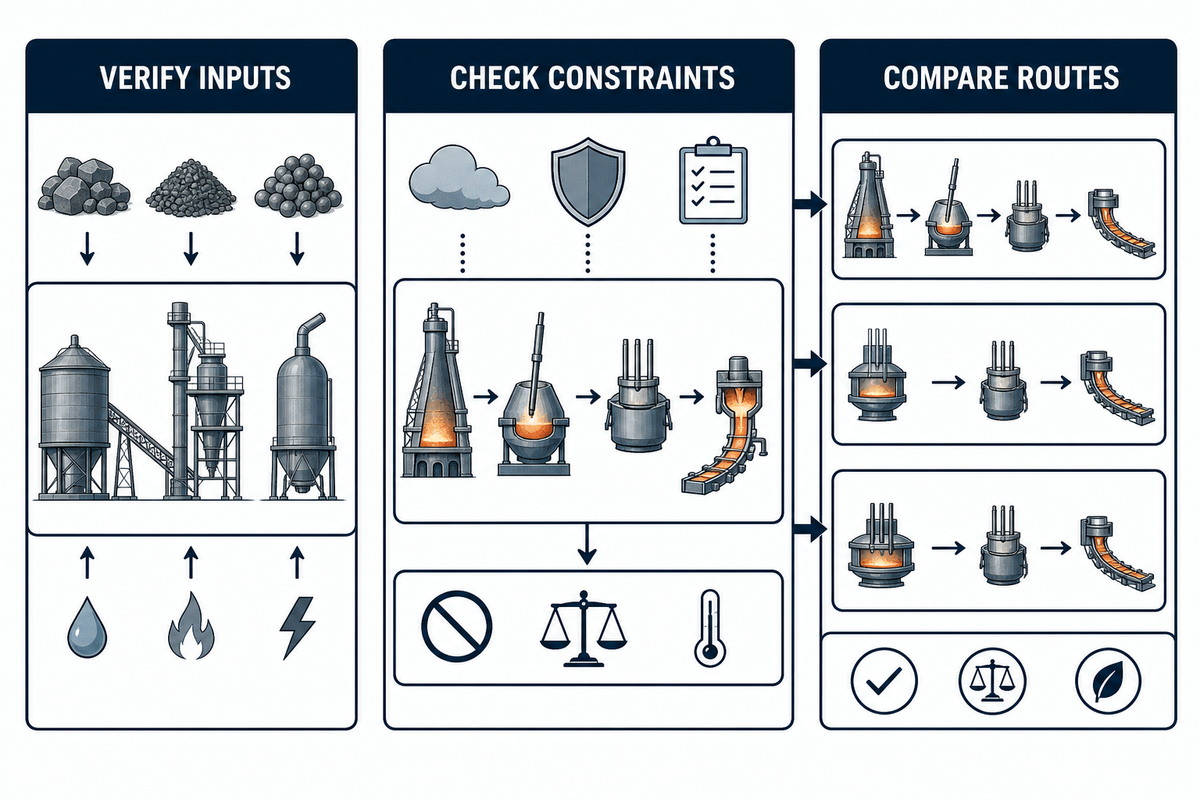
An EAF project normally avoids many upstream units in a typical integrated works, but cost of a furnace alone is not a feasibility answer. Grid connection, oxygen, gas, water, scrap yards, rail or port access, off-gas systems, slag handling and refractory service, and downstream mills can dominate the real site program.
Greenfield and brownfield decisions also behave differently. An existing integrated site may have valuable utilities, logistics, permits, labor skills and rolling assets, while a new EAF site may face a long transmission upgrade and/or inadequate scrap collection infrastructure.
For teams translating a route decision into systems and plant interfaces, BOSHIYA’s steel and metal plants article supplies the commercial equipment context, and this article strives to remain at the route level of screening.
Energy and Emissions Need a Boundary Check
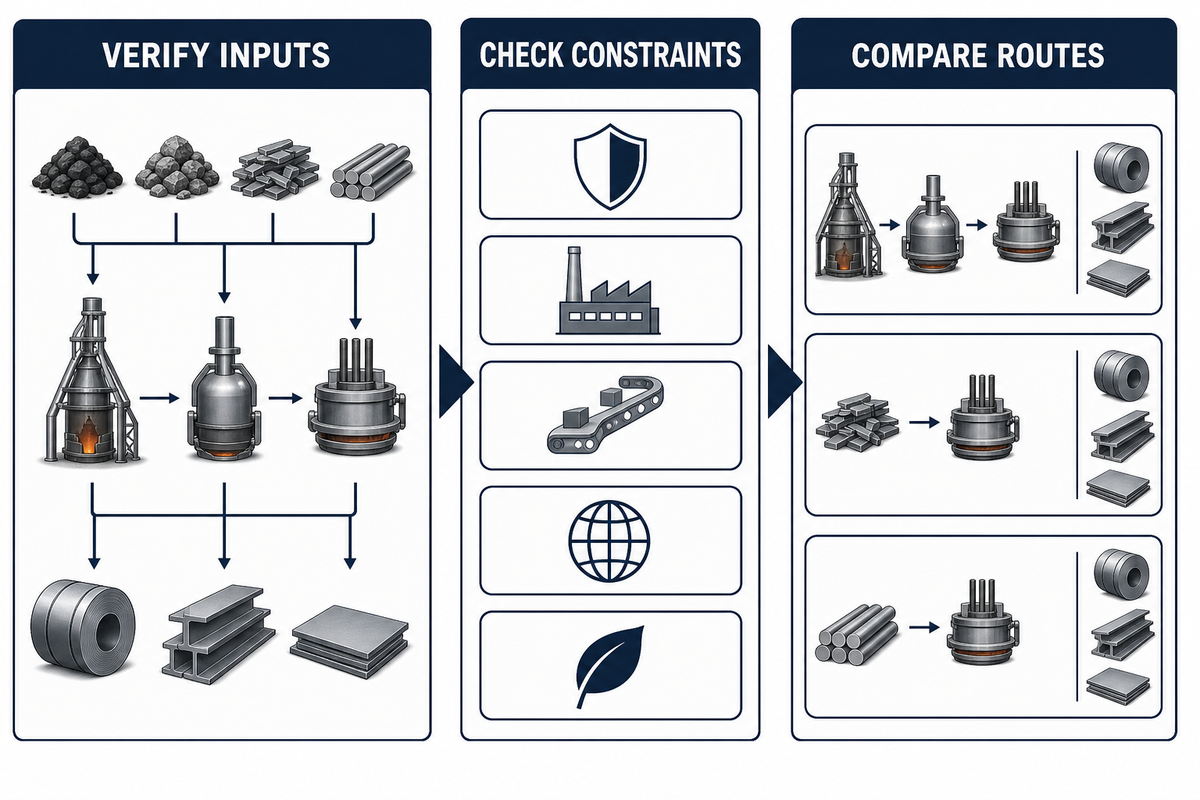
Producing scrap-EAF is generally more energy efficient and produces lower direct emissions than ore-based BF-BOF production. However, “EAF” is not a complete emissions category. A comparison has to consider metallic charge, electricity mix, onsite versus imported DRI, the scope of the product, geography, year, and if upstream emissions are included. The separate steel decarbonization roadmap provides a sequencing framework for these elements.
“Remelting steel scrap in Electric Arc Furnaces uses less than half the energy” compared to ore-based BF-BOF production.
The quotation is deliberately narrow: it describes scrap remelting. An EAF charged heavily with gas-based DRI has a different energy chain, and hydrogen-based DRI shifts more of the system toward electricity and hydrogen production.
| Boundary check | Question | Why it changes the answer |
|---|---|---|
| Metallic charge | Scrap, DRI, HBI, pig iron, or hot metal? | Iron reduction can sit inside or outside the plant boundary. |
| Power | Which grid, contract, and hourly mix? | Purchased-power emissions can dominate an electric route. |
| Process scope | Crude steel, hot coil, cold coil, or coated product? | Downstream treatment changes energy and yield. |
| Non-carbon impacts | Dust, slag, water, air pollutants, and local rules? | Lower carbon does not settle disposal or exposure obligations. |
ISO 14404-3:2024 explicitly includes boundary definition, material and energy flows, and emission factors for EAF sites with DRI facilities. The EPA Subpart Q overview likewise shows that reporting can span furnaces, direct reduction, coke-related units, and stationary combustion.
Flexibility, Utilization, and Market Exposure
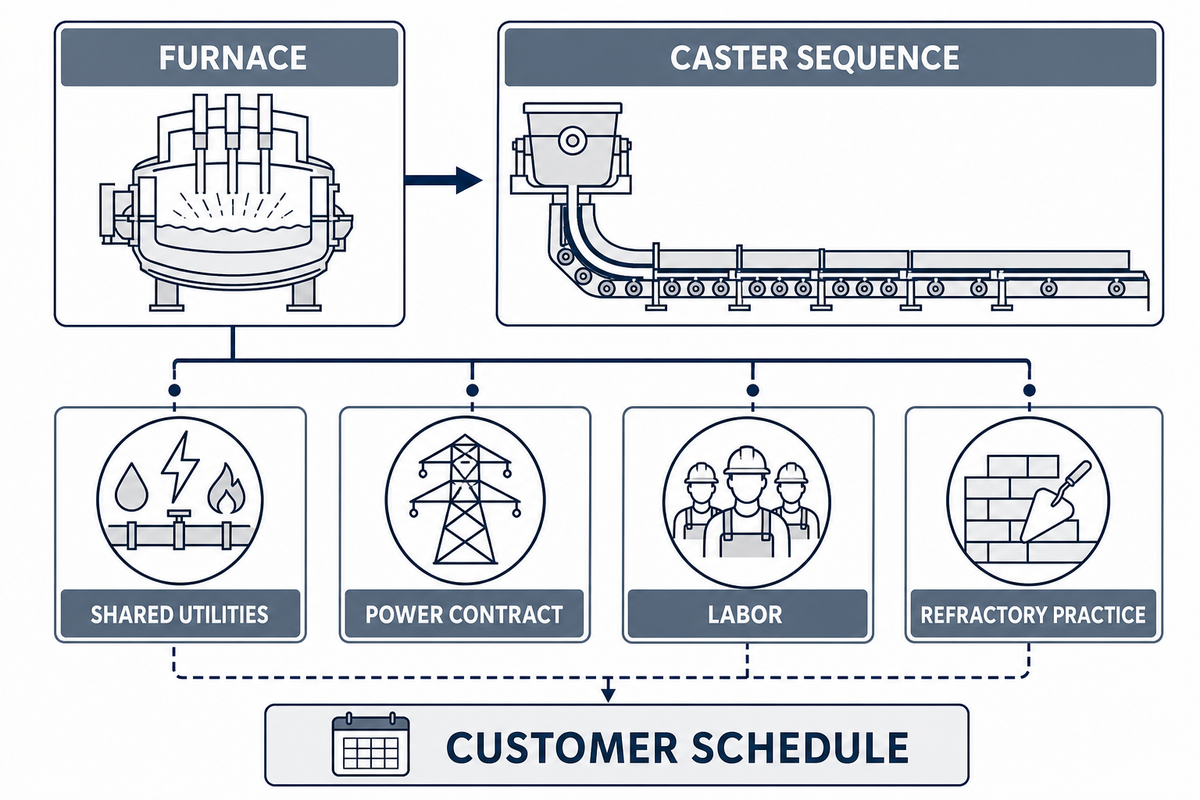
An EAF can adjust melting activity more readily; however, the same flexibility does not exist at the blast-furnace campaign level. Casting sequence, shared oxygen and water systems, labor, electrode and refractory practices, demand charges, storage, and customer schedules can restrict when production moves.
Integrated plants tend to be more heavily penalized for low utilization since many connective assets, as well as fixed services, must remain stable. They may also have established internal energy recovery as well as logistics which may be longer-standing and better established, which a simplified comparison may overlook.
Maintenance Exposure and Shutdown Scope
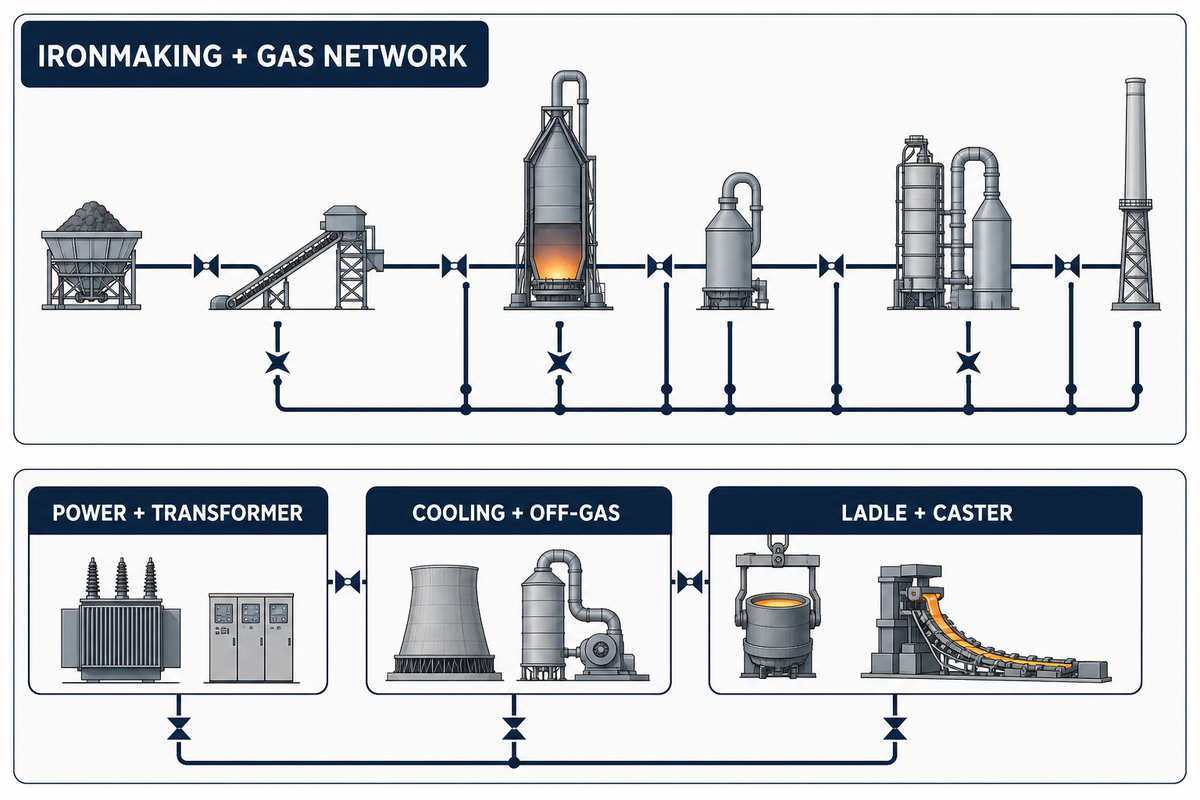
Maintenance exposure depends on asset dependencies, not on the number of furnaces. Integrated routes add long, coupled ironmaking and gas networks, while EAF routes concentrate risk in electrical supply, transformers, electrodes, refractory, furnace cooling, off-gas, ladle metallurgy, and caster continuity.
Integrated dependency chain
Raw materials → coke/sinter where present → blast furnace → hot metal → BOF → secondary metallurgy → caster, with gas, oxygen, water, and logistics crossing the chain.
EAF dependency chain
Metallic preparation → power and transformer → furnace shell and cooling → off-gas → ladle treatment → caster, with maintenance concentrated but still tightly sequenced.
Hybrid dependency chain
DRI supply or onsite reduction adds ore, gas or hydrogen, heat recovery, storage, and material-temperature interfaces to the EAF chain.
A maintenance plan must show isolation boundaries, energy sources, spare strategy, water and gas continuity, controlled cooldown, restart sequence, and downstream inventory. Estimate scheduled downtime from the site’s configuration and failure scope, not from the route label.
Hybrid Routes Make the Old Binary Incomplete
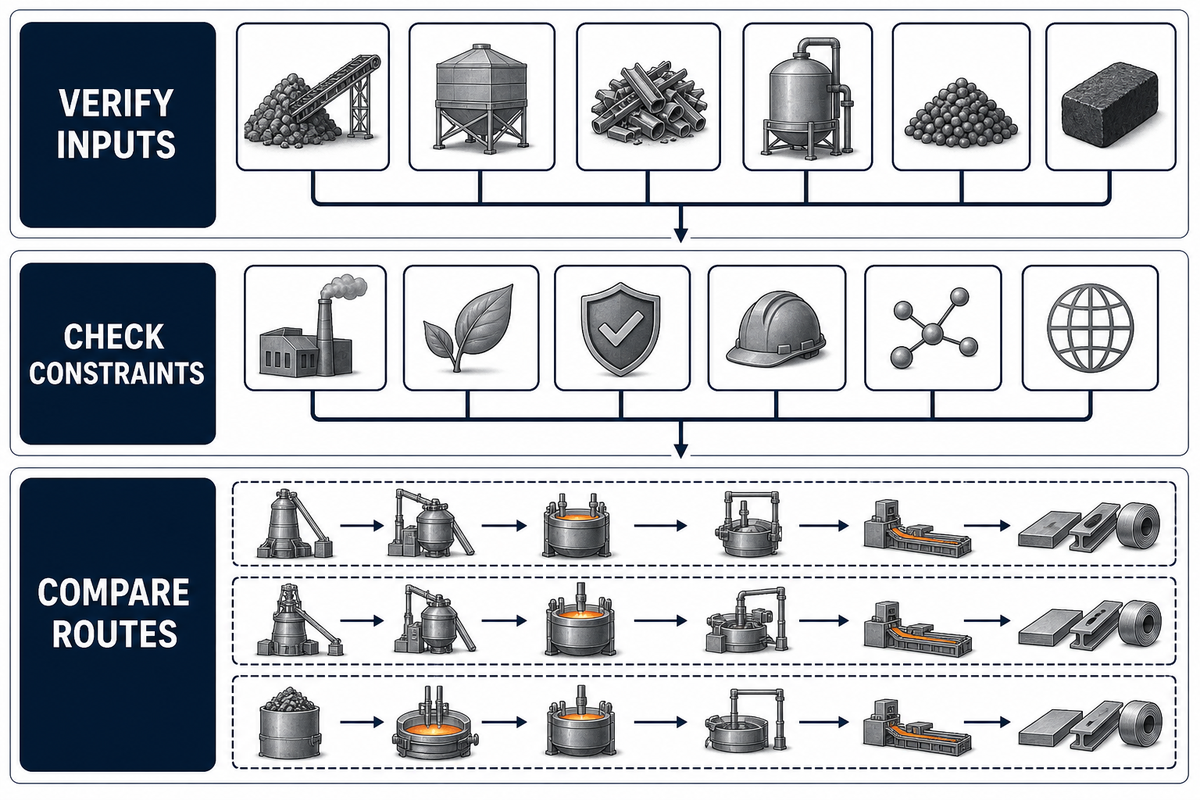
DRI and HBI allow EAF operators to use higher-purity ore-based iron units, control residuals, and lower reliance on local prime scrap. Thus, a DRI-EAF complex is neither a traditional scrap mini mill nor a classic BF-BOF integrated works. The reduced iron process guide provides more details on the upstream mechanism.
The 2025 steel Assessment by the IEA suggests that, in certain regions, the use of DRI-EAF processes with low-emission hydrogen is an emerging option. This assessment recognizes the high cost of hydrogen, as well as its regional variation. This is why route selection should treat affordable clean power, reduction gas or hydrogen, ore quality, and infrastructure timing as separate constraints.
Technology development also targets tighter integration. For example, WO2020245070A1 describes connecting DRI, EAF heat recovery, steam or hot water, electrolysis, and hydrogen reuse; BOSHIYA’s green steel hydrogen guide provides additional route context, while the patent remains a direction signal rather than proof of commercial performance.
Use a Five-Constraint Decision Grid
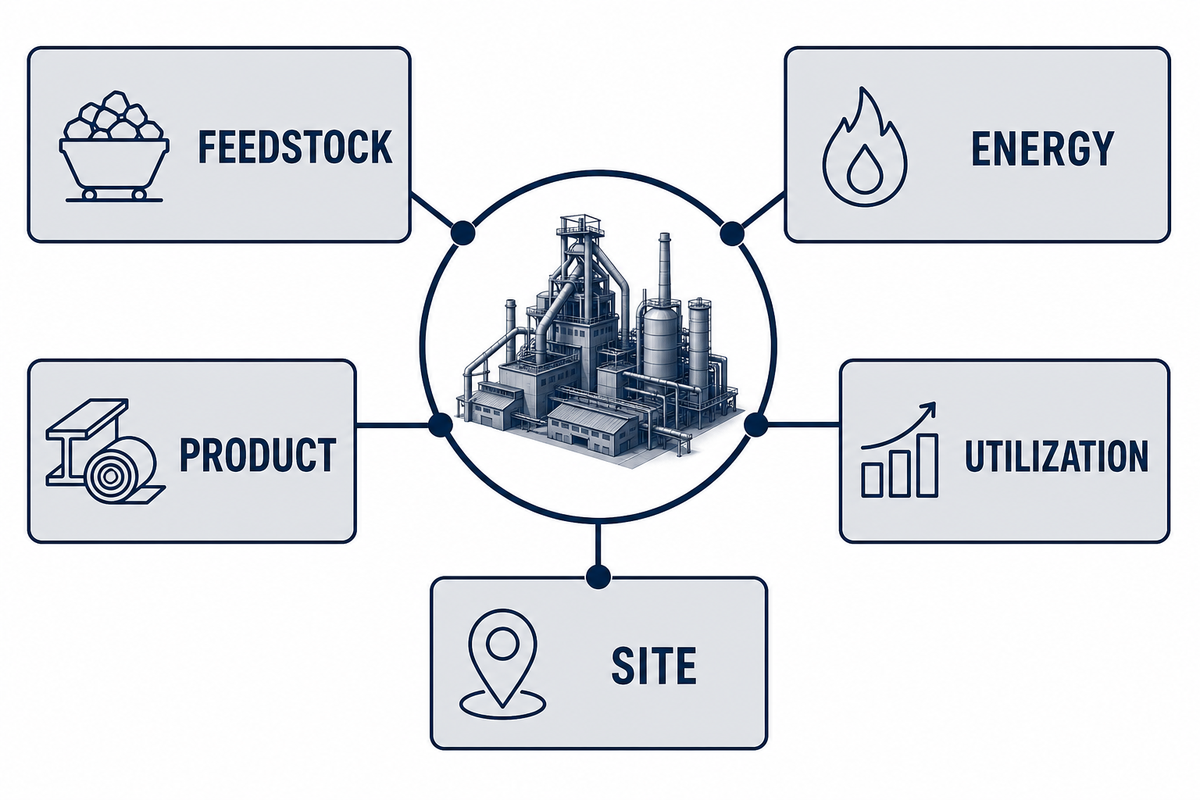
The Five-Constraint Decision Grid identifies weak assumptions and uses defined system boundaries to screen alternatives before detailed engineering studies. It produces no “universal winners” and should not be used in lieu of feasibility, permitting, metallurgy, grid, or finance studies.
| Constraint | Questions to answer | Signal favoring scrap-EAF | Signal favoring BF-BOF or ore-based hybrid | Not sufficient by itself |
|---|---|---|---|---|
| 1. Feedstock | Volume, chemistry, logistics, volatility? | Reliable suitable scrap pool | Ore/DRI advantage or scrap-quality deficit | Annual tonnage without chemistry distribution |
| 2. Energy | Firm power, gas, hydrogen, oxygen, price shape? | Strong grid and manageable load cost | Advantaged reductant or existing energy network | Average electricity price alone |
| 3. Product | Grades, residuals, surface, dimensions, finish? | Qualified full-chain capability | Primary iron or installed finishing advantage | Furnace type without process capability |
| 4. Utilization | Demand cycles, campaign length, schedule flexibility? | Variable demand and useful operating windows | Stable high throughput and asset integration | Furnace turndown without chain constraints |
| 5. Site | Land, permits, water, grid, rail/port, waste routes? | Compact compatible site and connections | Valuable brownfield infrastructure or captive logistics | Greenfield equipment list without enabling works |
Minimum feasibility handoff
- Freeze the target product and annual operating scenarios.
- Build metallic-charge cases with chemistry and delivered-cost ranges.
- Obtain grid, fuel, oxygen, water, and logistics connection evidence.
- Define environmental boundaries for air, carbon, water, dust, slag, and noise.
- Map process and maintenance dependencies, including controlled restart.
- Run capital, operating, sensitivity, and brownfield reuse cases.
Consider constraints when choosing a route. Bottom line: If a constraint is eased, a formerly less preferable route can become better. It is premature to declare a route decision when that route is viable only under one scrap price, one power price, or one emissions constraint.
Frequently Asked Questions
What is the main difference between a mini mill and an integrated steel mill?
A traditional mini mill uses an electric arc to smelt scrap and other metallics. A traditional integrated mill uses a blast furnace to reduce iron ore and converts hot metal to basic oxygen furnaces. Modern projects can mix these modules, so metallic charge and process configuration are more reliable identifiers than size.
Is a mini mill always smaller?
No. “Mini mill” is a historical industry label, not a modern EAF capacity benchmark. Modern EAF facilities can operate at large scale and include advanced casting, rolling, and finishing systems; feasibility depends on the full route stack and site constraints.
Can an EAF mini mill make high-quality flat steel?
Yes, when these systems meet product requirements. Producers like Nucor have shown the route is not restricted to basic long products. Scrap residuals can still require high-quality scrap, DRI, HBI or pig iron to manage chemistry.
Is EAF steel always lower carbon than BF-BOF steel?
Scrap EAF steel is usually lower in energy use and emissions within comparable boundaries, but “EAF” alone is not enough information. The outcome depends on electricity, share and source of DRI or HBI, upstream iron production, yield, product scope and if purchased-power and upstream emissions are included.
Which route is easier to stop and restart?
An EAF typically offers more furnace-level scheduling flexibility than a blast furnace running a long campaign. Actual plant flexibility can also be restricted by caster sequences, shared utilities, power contracts, and labor as well as refractory practice, downstream schedules and the cost of lost production.
When does a hybrid DRI-EAF route make sense?
DRI-EAF becomes attractive when a project needs ore-based metallics for chemistry or scrap security and has competitive gas, hydrogen, electricity, ore, and logistics. It should be studied as a separate route because its energy and carbon impacts, as well as capital and operating costs, are very different from a classic BF-BOF route and a scrap-based EAF route.
References & Sources
- World Steel Association — Raw materials
- World Steel Association — Energy use in steelmaking
- U.S. Department of Energy — Iron and Steel Manufacturing
- International Energy Agency — Breakthrough Agenda Report 2025: Steel
- U.S. EPA — Subpart Q Information Sheet
- ISO 14404-3:2024 — CO2 intensity for EAF and DRI facilities
- AIST — EAF cooling and maintenance collaboration