Get in Touch with BOSHIYA

Green Steel Hydrogen: How H2-DRI-EAF Changes Steel Plant Decisions

Hydrogen-ready steel plant decisions
Contents
show
green steel hydrogen isn’t a label you can add to any steel product. It’s a plant-route choice: you need renewable hydrogen to cut iron ore, renewable low-carbon power to melt the reduced iron, and the buyer still has to verify ore characteristics, power, emissions boundary, product grade, and project economics.
What Does Green Steel Hydrogen Mean?
Green steel hydrogen often means a steelmaking route in which green hydrogen replaces carbon monoxide as the reducing agent for iron ore. Reduced iron then flows to an electric arc furnace, where it is melted with scrap and low-carbon power. That route is commonly abbreviated as H2-DRI-EAF: hydrogen direct reduced iron plus electric arc furnace steelmaking.
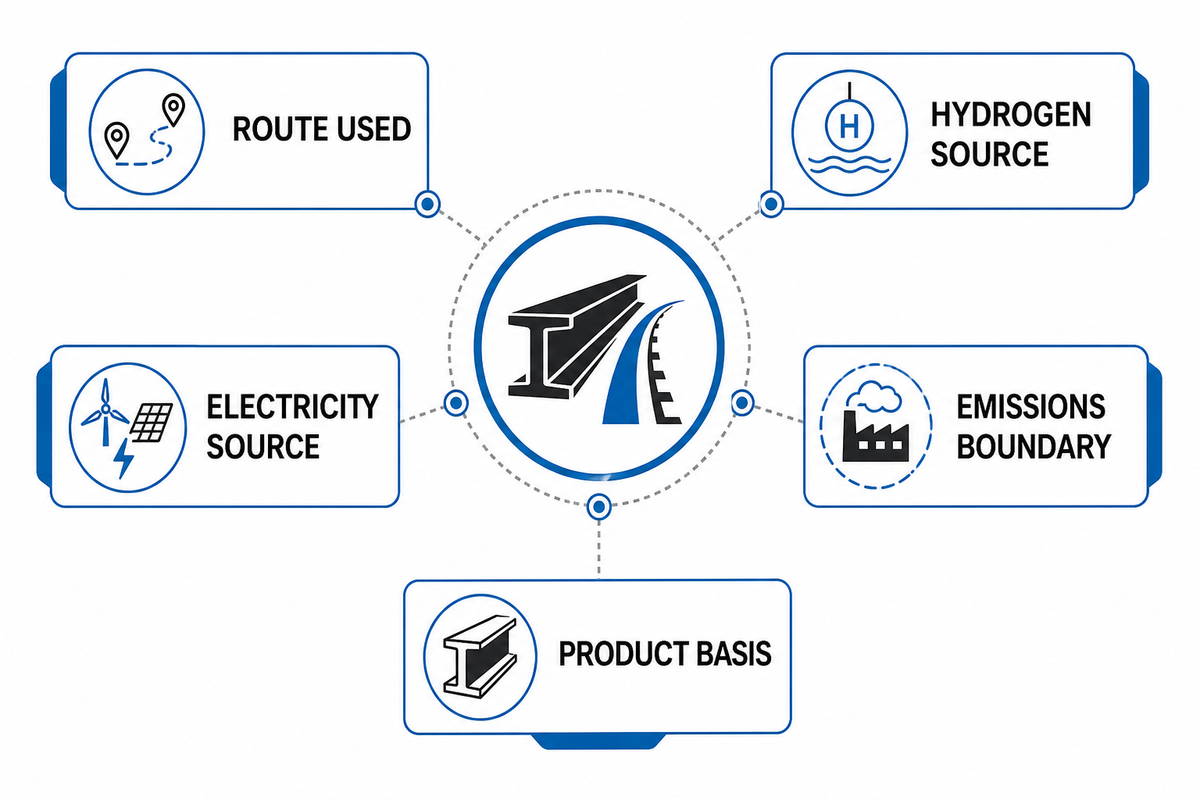
This distinction matters because green hydrogen, green steel, green iron, DRI, HBI, and low-carbon steel are all quite different. Green hydrogen is the input. Direct reduced iron is the intermediate iron product. Green iron can be traded before final steel production. Low-carbon steel is the claim about emissions, and it needs a boundary. Serious buyers should ask which route was used, where renewable electricity came from, whether carbon dioxide emissions include upstream hydrogen production, and what chain-of-custody system supports the claim.
Answer-first rule:
Green steel hydrogen is credible only when the supplier states the ironmaking route, hydrogen source, electricity source, emissions boundary, and product basis. Without those five details, the phrase is marketing language, not a procurement specification.
Why Hydrogen Belongs in Ironmaking Before the Furnace
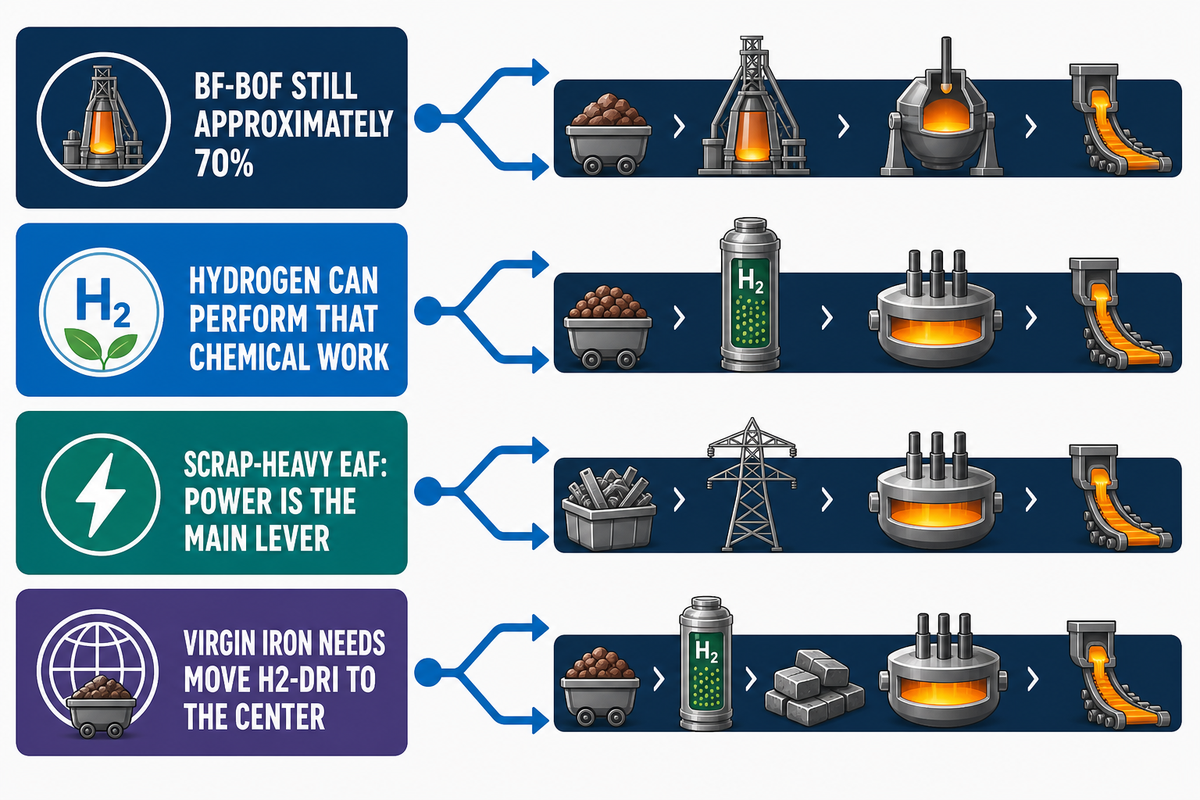
The deepest emissions cut comes before the electric arc furnace. In a conventional blast furnace vs electric arc furnace route comparison, carbon does chemical work: it helps strip oxygen from iron ore. The International Energy Agency reports that BF-BOF still accounts for approximately 70% of world steel production, which is why replacing the reduction chemistry is a bigger leap than changing one burner fuel.
In a direct reduction shaft furnace, hydrogen can perform that chemical work. It reacts with iron oxide and produces water vapor rather than the carbon-heavy route used in coke-based ironmaking. That’s why hydrogen-based direct reduction is central to many green steel production schemes. Blast-furnace hydrogen injection can help at the margin, but it doesn’t change the route as deeply as H2-DRI followed by EAF melting.
For buyers, the decision is simple: the more primary iron a project needs, the more important the hydrogen route becomes. If a mill mainly melts scrap steel, the electric arc furnace and renewable electricity are the main levers. When a mill needs virgin iron units for flat products, high-cleanliness grades, or limited scrap markets, hydrogen direct reduction and iron ore quality move to the center of the RFQ.
The H2-DRI-EAF Route in One Plant Flow
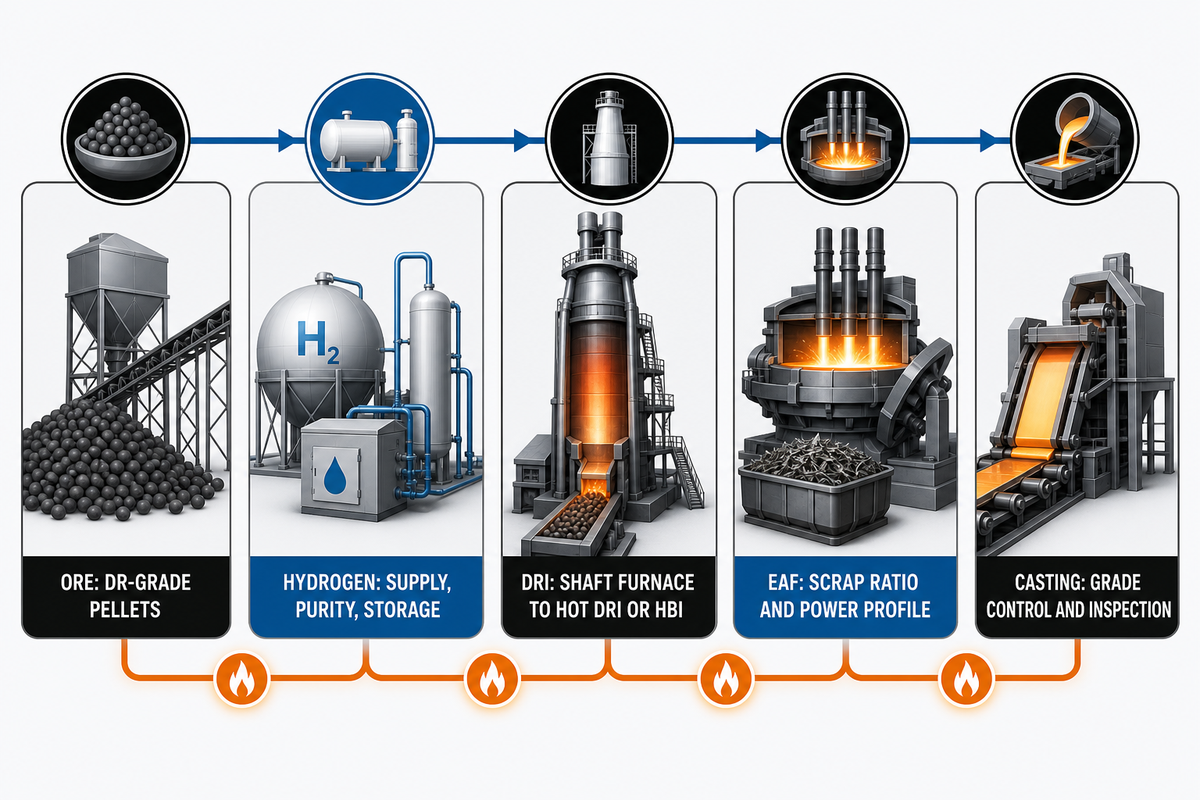
A hydrogen-ready steel plant is not one machine. It is a chain of linked systems. Iron ore pellets enter a direct reduction shaft furnace. Hydrogen, or a hydrogen-rich reducing gas, removes oxygen from the ore. Output becomes direct reduced iron process material, sometimes hot charged into an EAF and sometimes cooled or briquetted as HBI for storage and transport. EAF melting then combines DRI with scrap, makes chemistry adjustments, and sends liquid steel to casting and rolling.
1. Ore
DR-grade pellets with suitable Fe content and impurity limits
DR-grade pellets with suitable Fe content and impurity limits
2. Hydrogen
Green hydrogen supply, purity, compression, storage, and backup plan
Green hydrogen supply, purity, compression, storage, and backup plan
3. DRI
Shaft furnace, metallization target, hot DRI or HBI decision
Shaft furnace, metallization target, hot DRI or HBI decision
4. EAF
Scrap ratio, power profile, slag practice, alloy and carbon addition
Scrap ratio, power profile, slag practice, alloy and carbon addition
5. Casting
Grade control, cleanliness, downstream rolling and inspection
Grade control, cleanliness, downstream rolling and inspection
The EIB project sheet for H2 Green Steel, now Stegra, shows why this route is treated as a commercial reference point: a 2.5 million tonnes per year integrated primary steel plant, large-scale electrolysis, hydrogen-based DRI, EAF steelmaking, and around 90% or more abatement compared with traditional blast furnace steelmaking. The route also fits the IEA’s low-emissions steel framing, but it is still a project record. Local hydrogen, electricity, ore, water, permits, logistics, and product mix still need separate verification.
How Much Hydrogen and Renewable Power Does a Green Steel Plant Need?
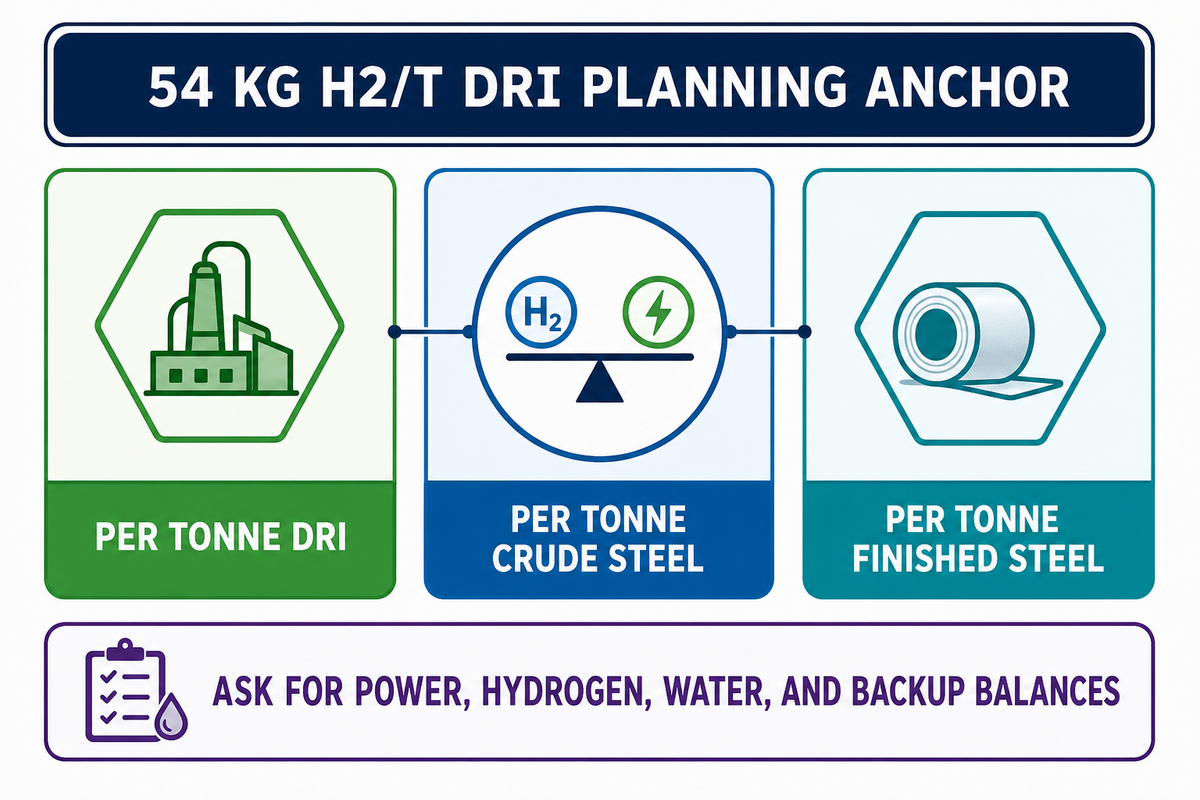
Every hydrogen demand figure must state its basis. SteelWatch reports that current DRI technology needs at least 54 kg of pure hydrogen to produce 1 tonne of direct reduced iron, while peer-reviewed RSC cost work shows why hydrogen price and basis assumptions drive the economics. That is not the same as hydrogen per tonne of crude steel or per tonne of finished product. Final steel basis changes with metallization, DRI share, scrap share, yield, carbon addition, and downstream losses.
Renewable electricity has two jobs. It powers electrolysers for green hydrogen production, and it feeds the electric arc furnace. It may also support oxygen production, water treatment, compression, handling systems, casting, rolling, and plant utilities. For that reason, a hydrogen steel plant should not be evaluated from a single H2 figure alone. Ask for a power balance, hydrogen balance, water balance, backup fuel plan, and annual operating profile.
| Question | Why it changes the answer |
|---|---|
| Is the number per tonne DRI, crude steel, or finished steel? | Each basis includes different yield losses and scrap ratios. |
| Is hydrogen made on site or purchased? | On-site electrolysis ties the plant to renewable electricity, water, storage, and electrolyser uptime. |
| Is DRI hot charged, cooled, or briquetted? | Thermal state affects energy use, logistics, handling, and EAF melting practice. |
Cost Reality: Where the Green Premium Comes From
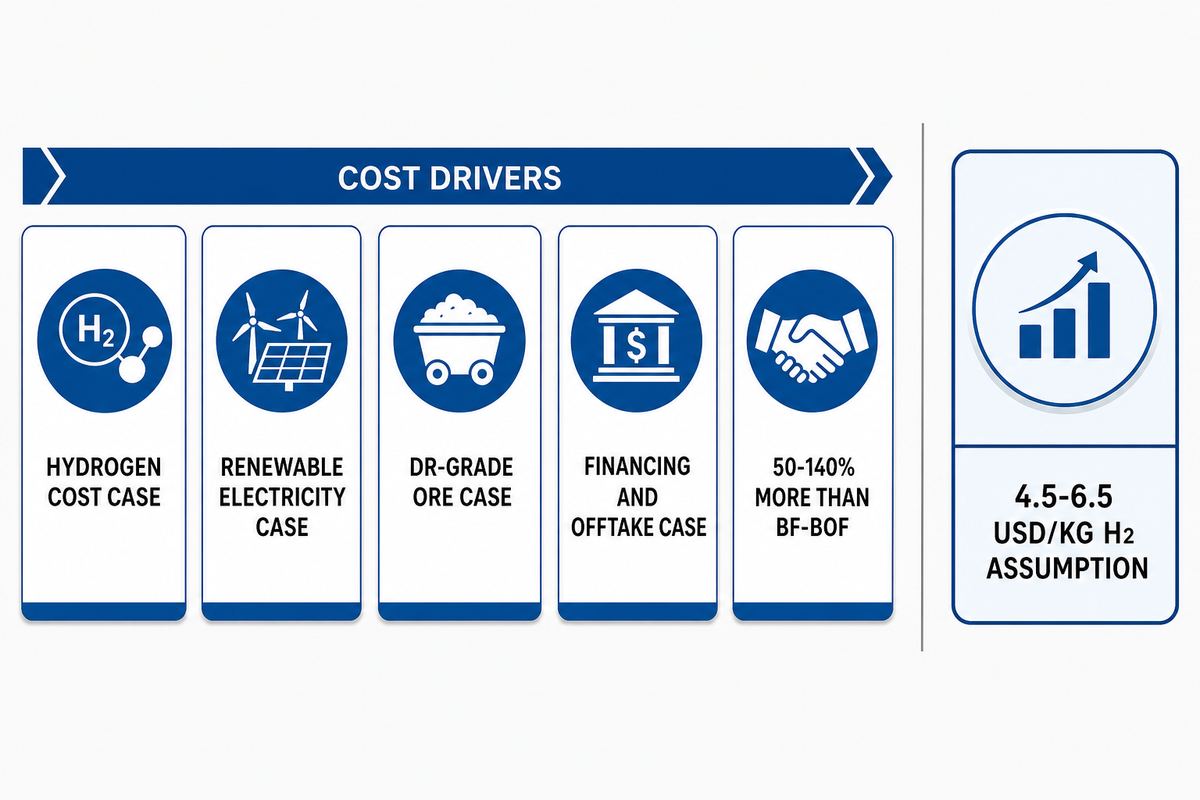
The IEA’s 2025 steel chapter reports that early commercial plants using 100% hydrogen blends were estimated to cost 50-140% more than BF-BOF plants, with the range changing by region. This does not mean H2-DRI-EAF is uneconomic everywhere. It means the business case is local. Hydrogen cost, renewable electricity, electrolyser utilization, DR-grade ore, carbon policy, grid fees, logistics, financing cost, and offtake contracts all move the final result.
IEEFA’s 2024 H2-DRI-EAF analysis placed renewable hydrogen cost around 4.5-6.5 USD/kg, with lower expected ranges toward 2030. RSC techno-economic work also points to break-even hydrogen price sensitivity. For a steel buyer, the practical point is not the exact number from one study. Instead, the hydrogen price assumption must be visible. If a supplier quotes low-carbon steel without a hydrogen cost case, power case, ore case, and carbon boundary, the premium cannot be tested.
Steel-sector climate targets will not be met by changing labels alone. Ironmaking, power, and logistics still need CO2 emissions cuts while steel demand continues. In reducing iron, hydrogen can replace a fossil-fuel role; in clean energy procurement, renewable energy has to be real enough that the plant does not simply emit elsewhere through the grid.
Bankability test: A green steel hydrogen project becomes more credible when hydrogen supply, renewable power, DR-grade ore, permits, financing, and offtake are already tied together. It becomes weaker when only the process name is announced.
What 2025-2026 Project Signals Really Say
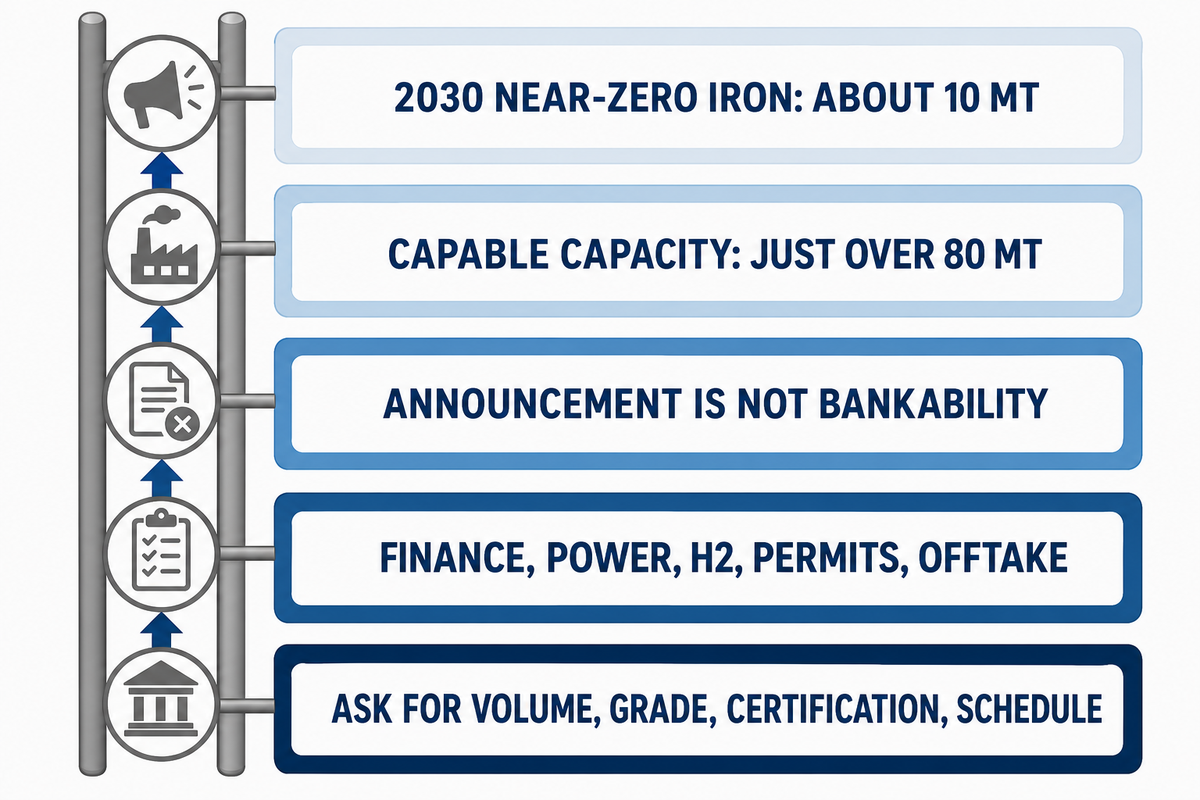
Project signals are improving, but the pipeline is still young. In its 2025 steel chapter, the IEA says capacity for near-zero emissions iron by 2030 is about 10 Mt, while near-zero emissions capable capacity is just over 80 Mt. Much of that capable capacity does not yet mean full near-zero operation, because some projects may start on natural gas with unclear timelines for moving to hydrogen.
Buyer language needs discipline here. When EIB finance, power contracts, hydrogen generation, permits, and offtake are present, the signal is different from an announcement. When natural-gas DRI equipment can later accept hydrogen, the signal is different from a plant supplied by green hydrogen today. When a product claim is backed by chain-of-custody documents, the signal is different from a generic green steel label.
The commercial lesson is not that hydrogen-based steel is too far away. RFQs should ask for evidence: project phase, volume, product grade, certification route, emissions boundary, hydrogen source, electricity source, contract term, and delivery schedule.
Ore, Scrap, EAF, and Product-Mix Constraints
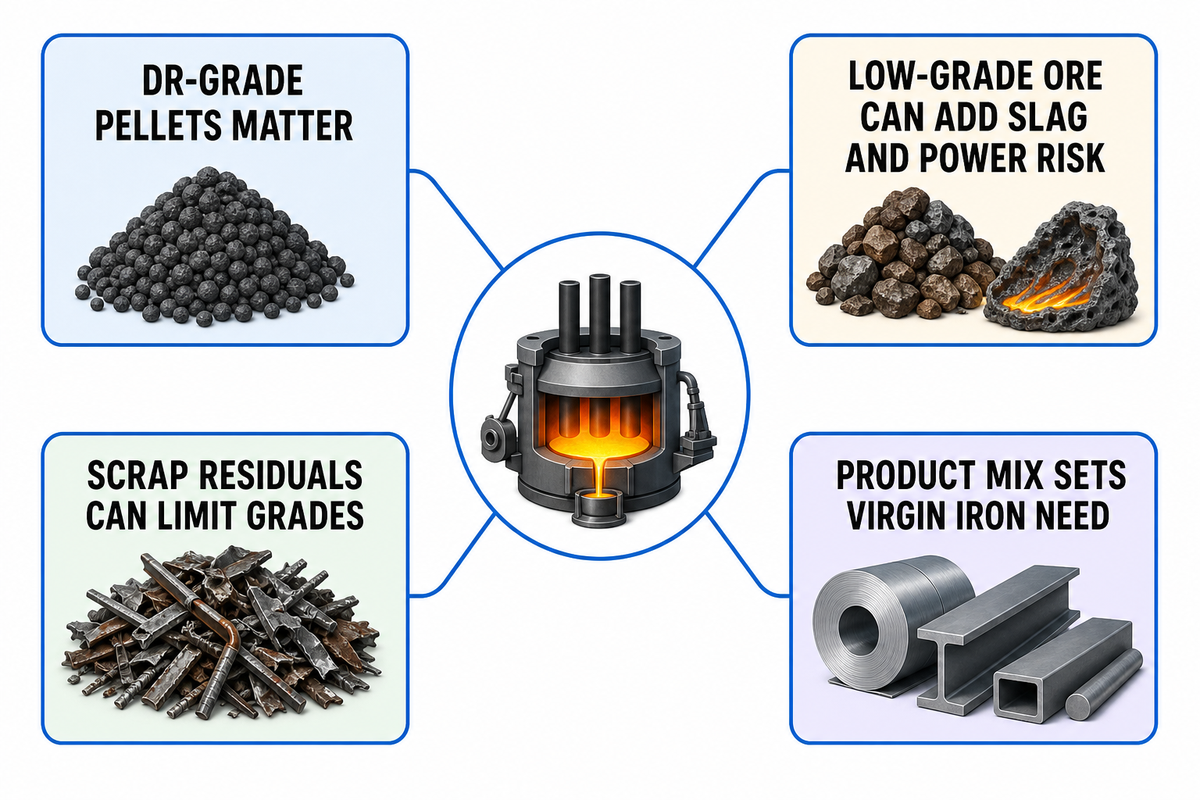
Hydrogen does not erase metallurgy. IEEFA has warned that insufficient DR-grade iron ore can become a headwind for green steelmaking. Many H2-DRI routes need high-quality ore or pellets, often discussed around high Fe content and low impurity levels. Lower-grade ore can add beneficiation needs, yield loss, slag burden, power demand, or product-quality risk, and hydrogen DRI process records show that reactor and melting configuration remain part of the engineering problem.
Scrap also matters. Electric arc furnace steelmaking can use scrap, but scrap is not always clean enough for every grade. Residual copper, tin, chromium, nickel, molybdenum, and other elements can be hard to remove once they enter the melt. That is why forum discussions among engineers often question simple claims about steel purity. For buyers, the right question is not only “is this EAF steel?” The better question is “what DRI-to-scrap ratio and melt practice can meet this grade?”
Product mix decides how much virgin iron a plant needs. Long products with flexible residual limits can have a different path from automotive sheet, electrical steels, exposed surfaces, or high-cleanliness grades. Check the green hydrogen route against the product family, not only against an emissions target.
When Natural-Gas DRI Is a Bridge and When It Becomes a Lock-In
Natural-gas DRI can be a practical bridge in regions with existing gas infrastructure and limited green hydrogen supply. It can help a plant move away from coal-based steelmaking while preparing for higher hydrogen blends later. The IEA steel pathway discussion treats hydrogen-based routes as regional decisions rather than universal swaps, which is why gas-to-hydrogen transition timing matters.
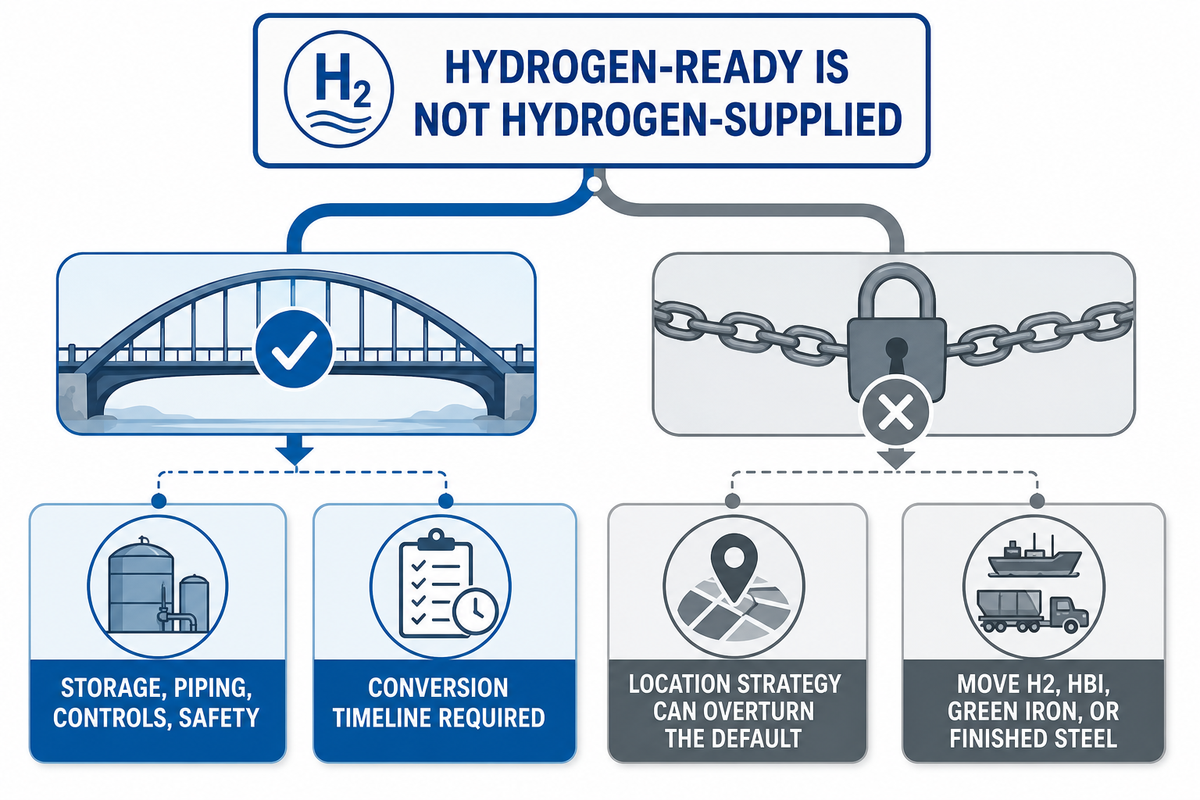
The risk is confusing “hydrogen-ready” with “hydrogen-supplied.” A DRI module may be designed to accept hydrogen later, but that does not prove the site has low-cost renewable hydrogen, storage, piping, burner compatibility, controls, safety systems, power procurement, or a conversion timeline. Hydrogen readiness should be a design claim with documents, not a loose promise.
Logistics can also overturn the default assumption. IEEFA argues that for some regions it may be better to use green hydrogen domestically to make green iron, rather than exporting hydrogen over long distances. Location strategy can therefore become part of the steel plant decision: move hydrogen, move HBI, move green iron, or move finished steel.
BOSHIYA Decision Framework: BF-BOF, EAF Mini-Mill, or Hybrid DRI-EAF?
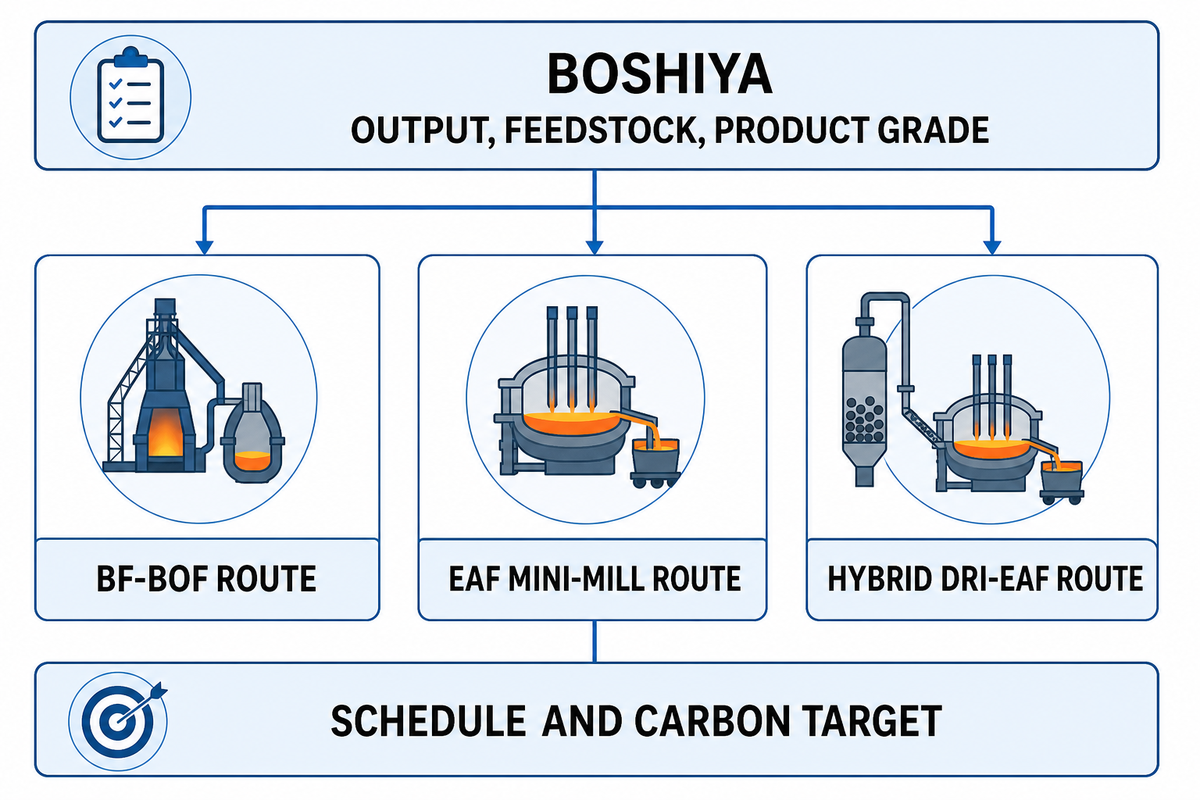
Buyers do not start with a slogan. They start with output, feedstock, product grade, carbon target, location, energy supply, timeline, and capital band. BOSHIYA’s steel and metal plants page compares BF-BOF, EAF mini-mill, and hybrid DRI-EAF pathways. Use that route comparison as the bridge from public green steel evidence to a plant-specific RFQ.
| Route | Best fit | Hydrogen question |
|---|---|---|
| BF-BOF | Large integrated capacity where ore/coke route is already locked in | Can partial hydrogen or carbon capture help, and is a deeper route change planned? |
| EAF mini-mill | Scrap-based steel, shorter build cycle, lower capital intensity | Is scrap supply clean enough, and is renewable electricity available? |
| Hybrid DRI-EAF | Primary iron needs with a pathway from gas DRI to hydrogen DRI | Is the plant hydrogen-ready by design and hydrogen-supplied in practice? |
BOSHIYA’s role should also be clear. BOSHIYA should not be used as the source for global emissions numbers. Public sources such as the IEA steel chapter, EIB, IEEFA, SteelWatch, and peer-reviewed literature do that work. BOSHIYA is the project intake and configuration discussion: route, output, feedstock, product grade, schedule, carbon target, and steel plant configuration selector scope.
Buyer Checklist for a Hydrogen-Ready Steel Plant RFQ
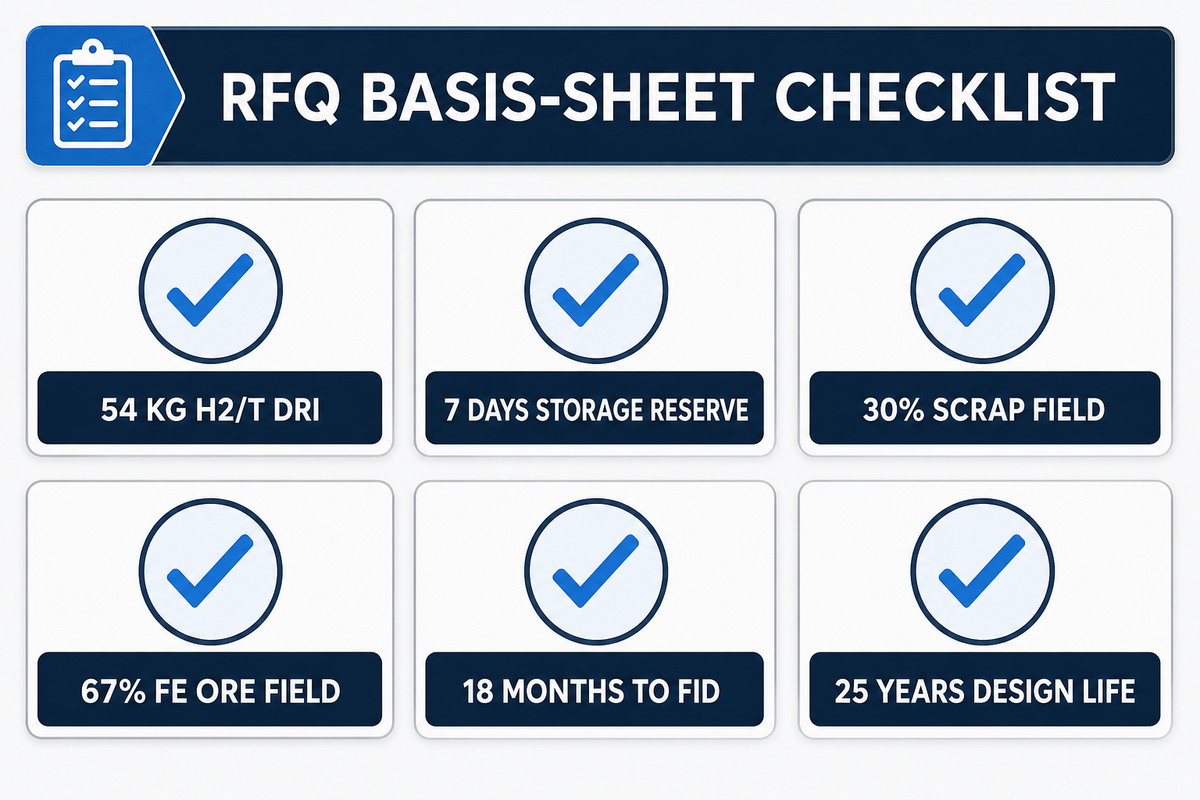
After the route comparison, use the RFQ to force basis labels. The supplier should not only say “green steel” or “hydrogen-ready.” It should state what is included, what is excluded, and what must change before the plant can run on renewable hydrogen or pass a steel plant cost estimator review.
Across the steel industry, the safest comparison format is a basis sheet with units inside the cell, plus the chain-of-custody boundary behind the claim. A sample row format can show 500 MW grid import, 3.2 MWh/t EAF power, 54 kg H2/t DRI, 8,000 hours/year electrolyser availability, 7 days storage reserve, 30 bar hydrogen storage, 0.8 MPa piping class, 30% scrap, 67% Fe, 100,000 tons HBI buffer, 18 months to FID, and 25 years design life. These are example field formats, not benchmark claims; the final numbers must come from the project site and product grade.
| RFQ term group | Terms to define in the proposal | Buyer check |
|---|---|---|
| Hydrogen origin | use of green hydrogen, green hydrogen production, produced from renewable energy, produce hydrogen, renewable energy sources | Ask whether the hydrogen is on-site, purchased, or certificate-backed. |
| Iron reduction chemistry | direct reduction of iron, direct reduction of iron oxides, reduction process, reduce iron oxides, hydrogen as a reductant | Confirm whether the shaft furnace can actually run the stated gas blend. |
| Route naming | green H2-DRI, hydrogen-based direct reduction, green hydrogen-based DRI, green ironmaking, green iron and steel | Separate the process route from the marketing name on the product sheet. |
| Steelmaking scope | steelmaking process, production process, production methods, production pathways, steel produced | State whether the claim covers DRI, crude steel, finished steel, or all stages. |
| Industry boundary | iron and steel sector, iron and steel industry, iron and steel manufacturing, steel manufacturing, technologies in the steel industry | Do not mix global industry claims with a single plant’s scope of supply. |
| Market scale | steel companies, steel market, global steel, global steel production, global steel demand, billion tons | Treat market scale as context, not proof that a local project is bankable. |
| Emissions claim | GHG emissions, greenhouse gas, net zero, EU emissions trading system, carbon dioxide emissions | Ask which scopes, certificates, and upstream power emissions are included. |
| Hydrogen logistics | hydrogen value chain, availability of hydrogen, use of hydrogen, use of green hydrogen, renewable electricity and green hydrogen | Check 12 months and 36 months contract cases, 7 days storage, compression, backup fuel, and annual operating hours. |
| Scrap and charge mix | steel scrap, scrap steel, DRI share, residual elements, melt practice | Tie the DRI-to-scrap ratio to product grade, not only to emissions targets. |
| Downstream steel route | casting, rolling, inspection, continuous casting steelmaking process, heat-by-heat certificates | Make sure the low-carbon route still supports the required product family. |
| Type | Required RFQ field | Planning number or unit | Decision risk |
|---|---|---|---|
| Output type | Crude steel, finished steel, DRI, or HBI basis | 1-3 Mt/y or project-specific tonnes/year | Wrong basis makes hydrogen and power numbers misleading. |
| Hydrogen type | On-site electrolysis, purchase contract, storage, purity | 54 kg H2/t DRI as a planning anchor | Hydrogen-ready equipment may not be hydrogen-supplied. |
| Power type | Renewable electricity source, grid tie, peak EAF load | MW, MWh/t, and annual uptime hours | Cheap H2 assumptions fail if power is scarce or intermittent. |
| Ore type | Pellet Fe content, gangue, impurity limits | 67% Fe often used as a DR-grade reference point | Low-grade ore can raise slag, power, and yield penalties. |
| Scrap type | Scrap ratio, residual elements, sorting plan | % scrap in charge mix | Copper, tin, nickel, chromium, and moly can limit grades. |
| EAF type | Hot DRI, cold DRI, HBI, carbon addition, slag practice | 600 C+ hot charging if included in scope | Melting energy and chemistry shift with charge state. |
| Carbon type | Scope 1, Scope 2, upstream H2, transport, certificates | t CO2/t steel boundary | A green claim can shift emissions outside the stated plant. |
| Project type | Finance, permits, offtake, EPC scope, delivery schedule | months to FID, construction, and ramp-up | Announcement quality differs from bankable execution evidence. |
| Product type | Grade, cleanliness, inspection, heat treatment, downstream route | ppm, %, and heat-by-heat certificate fields | The same low-carbon route may not fit every steel product. |
- Annual output target: crude steel, finished steel, DRI, HBI, or another basis.
- Iron ore and pellet specification: Fe content, gangue, metallization target, impurity limits.
- Scrap ratio: source, residual element risk, product-grade tolerance.
- Hydrogen source: on-site electrolysis, purchased hydrogen, storage, compression, purity, backup fuel.
- Electricity: renewable power source, grid tie, EAF demand peaks, electrolyser uptime.
- Carbon boundary: Scope 1, Scope 2, upstream hydrogen, transport, certificates, chain of custody.
- Product mix: billet, slab, bar, sheet, special steel, cleanliness and inspection needs.
- Site constraints: water, permits, port or rail, hydrogen safety, oxygen, lime, alloy logistics.
- Capital and timeline: phased gas-to-hydrogen plan, expansion path, hot charging, HBI option.
- Commercial proof: finance status, offtake, warranty scope, certification route, delivery schedule.
FAQ
What is green hydrogen steel?
Green hydrogen steel is steel made through H2-DRI-EAF or a similar route that uses renewable hydrogen to reduce iron ore and low-carbon electricity to melt the reduced iron. It should state the ironmaking route, power source, emissions boundary, and chain-of-custody method.
Can hydrogen replace coal in steelmaking?
In direct reduced iron production, hydrogen can replace coal’s reducing-agent role, so H2-DRI-EAF is central to many deep decarbonization plans. The plant still needs suitable ore, reliable hydrogen, low-carbon electricity, safety systems, EAF metallurgy, and a business case for today’s higher production cost. Procurement should test whether the site can secure enough renewable hydrogen and power for the required grade, annual output, storage reserve, backup fuel, and certificate boundary.
Is hydrogen-based green steel commercially available?
Hydrogen-based green steel is emerging, but availability is still much smaller than conventional steel supply. Some projects have moved into finance, construction, or early commercial planning, while others have slowed because hydrogen, power, permitting, and cost assumptions were not bankable. Buyers should ask for volume, schedule, product grade, certification, and emissions-boundary evidence rather than treating a green steel label as enough. They should also ask whether supply is pilot output, contracted commercial volume, or a future option.
How much hydrogen does green steel need?
Required hydrogen depends on the basis. A DRI module can be discussed per tonne of direct reduced iron, while a steel buyer often thinks per tonne of crude or finished steel. SteelWatch reports at least 54 kg of pure hydrogen for 1 tonne of DRI. For an RFQ, ask the supplier to state the basis, metallization target, hydrogen purity, electricity assumption, backup fuel plan, and annual utilization.
Does using hydrogen create brittle steel?
Embrittlement is a real materials concern, but hydrogen used as an iron-ore reductant is not the same as uncontrolled hydrogen trapped in a finished product. Procurement should specify product grade, downstream processing, inspection, heat treatment, and quality documentation instead of accepting a blanket claim.
References & Sources
- IEA: Breakthrough Agenda Report 2025, Steel
- European Investment Bank: H2 GREEN STEEL project sheet
- SteelWatch: Green hydrogen and steel decarbonisation
- IEEFA: H2-DRI-EAF opportunities and challenges beyond 2024
- IEEFA: Iron ore quality as a headwind to green steelmaking
- MIDREX: Pathways to Green Steel
- Steel Breakthrough: Priority Actions for 2025
- Resource and Energy Economics: Green steel investments in the EU
- Google Patents: Processes and methods for the production of iron and steel
![Polypropylene Resin: Grades, Types & Selection Guide [2026]](https://boshiya.com/wp-content/uploads/2026/05/0-150x150.webp)