Get in Touch with BOSHIYA

Hydrocracking vs Hydrotreating: Differences, Selection Logic, and Equipment Implications

The distinction between hydrocracking and hydrotreating lies primarily in the molecular change required for the feed. Hydrotreating mainly removes sulfur, nitrogen, metals, oxygen, and other contaminants while stabilizing reactive molecules. Hydrocracking adds deliberate carbon-carbon skeleton conversion, turning heavier molecules into lighter boiling-range products. The distinction is based on Penn State’s petroleum refining lessons.
Contents
show
The distinction is helpful, but doesn’t provide a complete process design. The composition of feeds, form of contaminants, conversion targets, hydrogen availability, catalyst protection, price of the product, service history, and the licensor still dictate the real plant design.
Short answer: choose hydrotreating when product quality cleanup is the main duty and large boiling-range conversion is unnecessary. Consider mild or full hydrocracking when the project must materially shift molecular weight and product yield. Confirm the choice with the feed assay, product targets, hydrogen balance, catalyst plan, and licensed process basis.
Hydrocracking vs Hydrotreating: The Short Answer
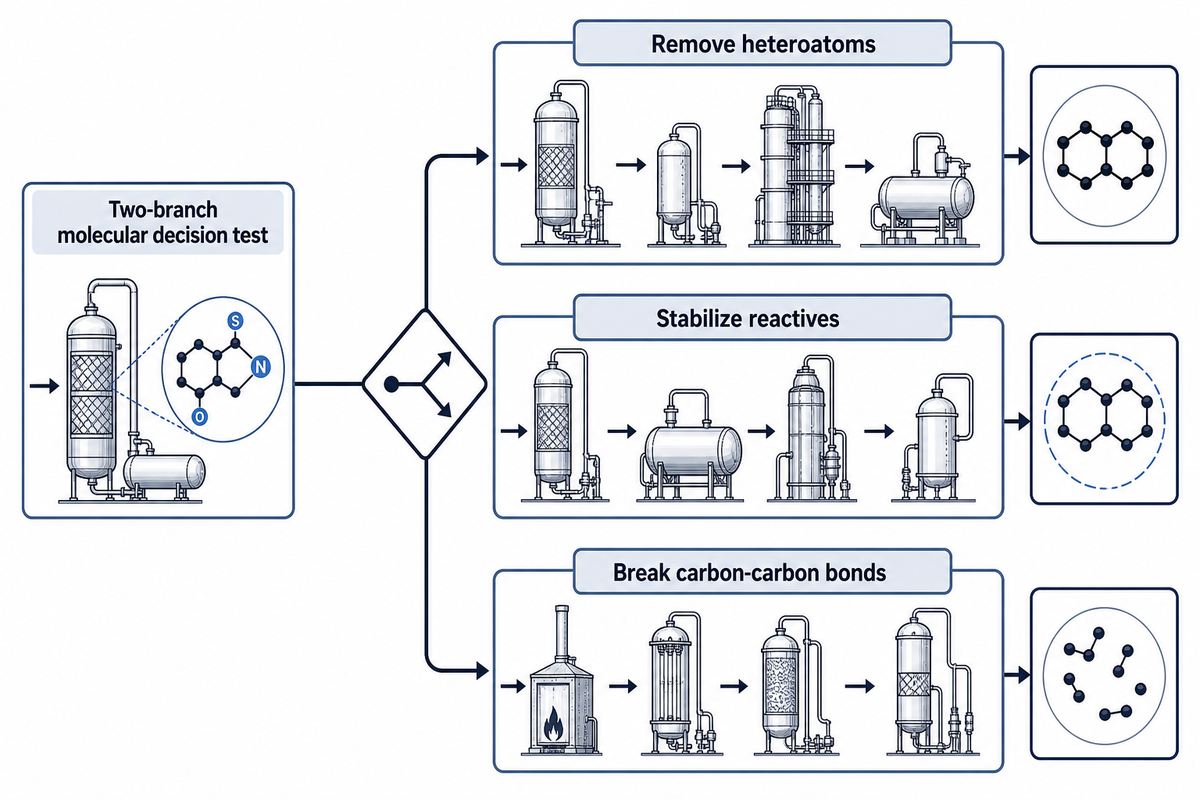
The Bond-or-Impurity test is an early scope question. Is the project primarily (a) removing heteroatoms and stabilizing reactives, or (b) breaking carbon-carbon bonds and moving the material to lower boiling ranges?
The wording is critical. Hydrotreating also breaks chemical bonds, for example, carbon-sulfur bonds during hydrodesulfurization. It isn’t a test of “bond breaking” vs. “no bond breaking.” Rather, it’s a test of “contaminant removal and stabilization” vs. “substantial carbon-skeleton conversion.”
Course material from the Colorado School of Mines places hydrotreating and hydrocracking in different refinery roles while showing that both use hydrogen and catalysts, high pressure and high temperature. Those common features explain why the terms are sometimes confused and why equipment teams need to define sharper process boundaries.
What Each Process Changes at the Molecular Level
Hydrotreating removes or stabilizes contaminants
Hydrotreating includes reactions such as hydrodesulfurization, hydrodenitrogenation, hydrodeoxygenation, hydrodemetallization, olefin saturation, and, in more severe service, some aromatic saturation. Hydrogen converts sulfur, nitrogen, and oxygen compounds into hydrogen sulfide, ammonia, and water, while metals are retained on the catalyst. The treated hydrocarbons become more stable.
The duty goes beyond a total sulfur or nitrogen value. The form of the molecule and steric accessibility affect the rate at which undesirable species react. A feed assay should identify and characterize the species that matter for catalyst selection, not just report an average value of contaminants.
Hydrocracking couples hydrogenation with controlled cracking
The combination of hydrogenation function and acidic cracking function characterizes a hydrocracking catalyst. Hydrogenation stabilizes reactive intermediates and helps control coke-forming reactions. The acidic sites of the catalyst rearrange and cleave the hydrocarbon skeleton. The distribution can favor the formation of naphtha, jet-range materials, or middle distillates, depending on the process scheme and the catalyst system.
Hydrotreating isn’t eliminated by hydrocracking. The same system could require aromatic saturation, sulfur and nitrogen removal, and carbon-carbon conversion. Pretreating duty may be in a different reactor, a first stage, or an integrated catalyst arrangement. This hydroprocessing patent illustrates why a “hydrotreater first” design shouldn’t be treated as a universal rule.
Hydroprocessing is the umbrella term
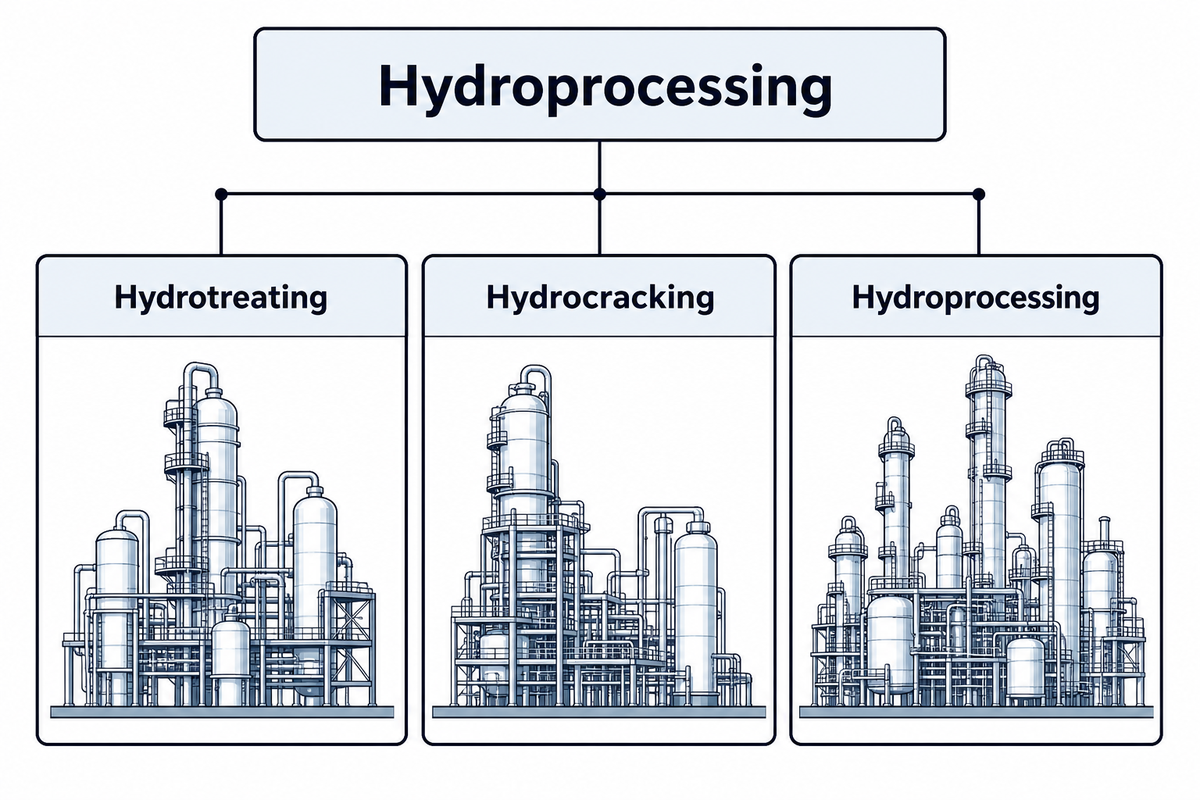
Hydroprocessing covers catalytic treatment and conversion of petroleum fractions in the presence of hydrogen. Hydrotreating and hydrocracking belong to the same process family, but they aren’t interchangeable. Hydrocracking focuses on deliberate conversion, while hydrotreating focuses on contaminant removal and quality enhancement.
The feedstock can range from naphtha and light gas oil to heavy gas oil or vacuum gas oil across hydroprocessing units. Coker gas oils and FCC cycle oils in particular need a thorough examination of contaminants and stability before entering a hydrotreating or hydrocracking process.
A cracking catalyst is usually chosen based on more than nominal activity. Pore structure influences access to active sites, while product properties depend on the balance between hydrogenation and cracking. Catalyst particles must retain physical integrity and an acceptable particle-size distribution during the expected cycle, while reactor internals maintain gas-liquid flow distribution.
Commercial catalyst families may use an amorphous catalyst or a zeolite catalyst or combinations designed for particular feeds and desired product distributions. The preferred catalyst is the one that’s validated for the hydrocracker feedstock and not the formulation with the most aggressive conversion claim.
Side-by-Side Engineering Comparison
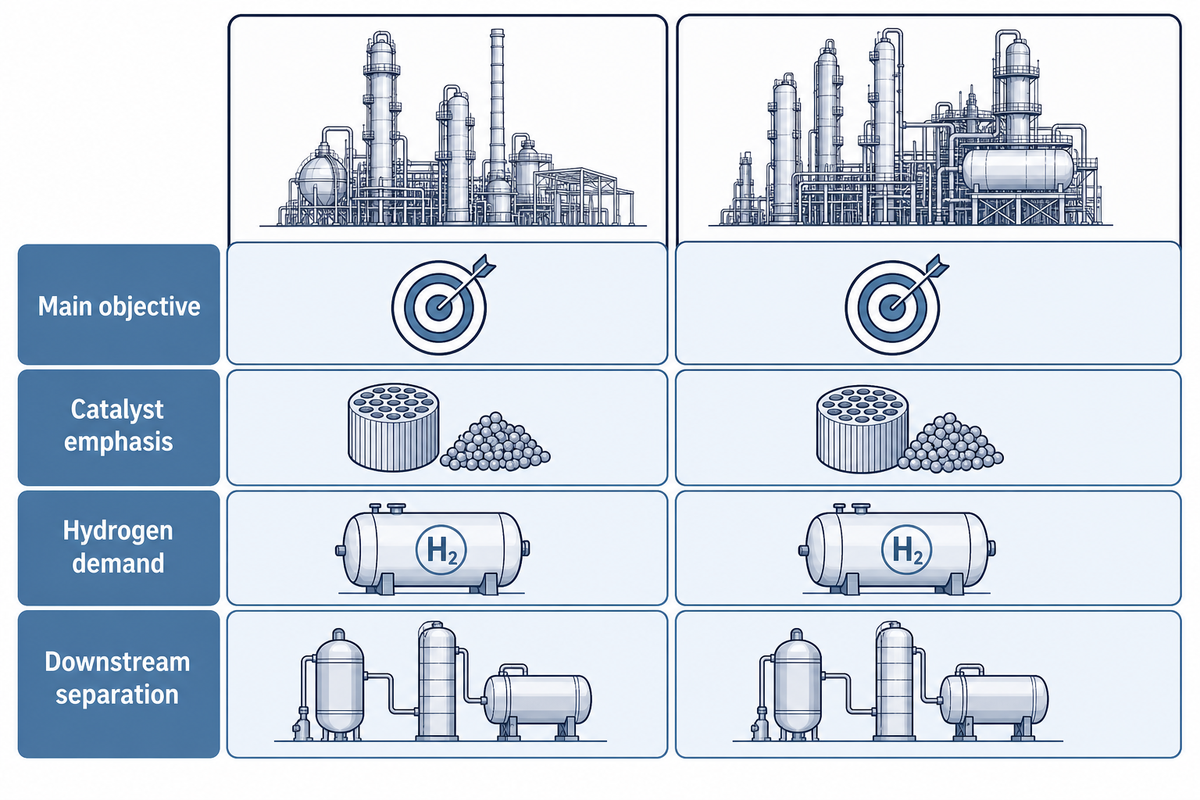
| Decision factor | Hydrotreating | Hydrocracking |
|---|---|---|
| Main objective | Remove contaminants, saturate reactive molecules, improve stability and specifications | Convert heavier molecules into lighter products while also treating the feed |
| Primary molecular change | Heteroatom removal and saturation, with limited conversion depending on duty | Hydrogenation plus deliberate carbon-carbon skeleton cracking |
| Typical project trigger | Sulfur, nitrogen, stability, smoke point, cetane, or downstream catalyst protection | Boiling-range shift, heavier-feed conversion, middle-distillate yield, product flexibility |
| Catalyst emphasis | Hydrogenation and contaminant-removal functionality | Balanced hydrogenation and acidic cracking functions |
| Hydrogen demand | Feed- and specification-dependent; can still be substantial | Generally higher because conversion and saturation occur together |
| Thermal control | Exotherm management remains necessary | More demanding bed, quench, distribution, and temperature-control integration |
| Downstream separation | Gas removal, stabilization, stripping, and product finishing as required | High-pressure separation, recycle-gas cleanup, fractionation, and unconverted-oil routing |
| Design authority | Process/licensor datasheet and project codes | Process/licensor datasheet, conversion basis, catalyst plan, and project codes |
“Mild” and “severe” are relative labels. A difficult hydrotreating feed may need far more hydrogen circulation and strong exotherm control: Penn State’s refining course lists 300-2000 scf/bbl H2/oil for desulfurizing light distillate against 2000-10000 scf/bbl for heavy residue. A mild hydrocracking revamp may likewise operate within constraints significantly different from a new high-conversion unit. Use the project material balance and heat balance rather than a universal range from a comparison article. The Colorado School of Mines hydroprocessing course provides the technical basis for comparing these process roles without treating either column as a universal design rule.
In crude oil refining, adjacent refinery processes also influence choice. FCC and catalytic cracking may compete for gas oil, while a hydrocracker can make fractions for jet fuel and kerosene, diesel fuel, gasoline, or petrochemical naphtha. The optimal route is determined by the particular refinery and value of each fuel product.
Hydrocracking uses a window of process conditions, not one fixed set: one refining textbook table gives conventional units 350–450 °C and 85–140 bar hydrogen pressure. Single stage and two-stage schemes treat, convert, and recycle in differing ways. Hydrocracking conditions are also variable with the quality of the feed, the target conversion, catalyst life, and hydrogenation activity.
Catalyst Systems and Why Pretreatment Matters
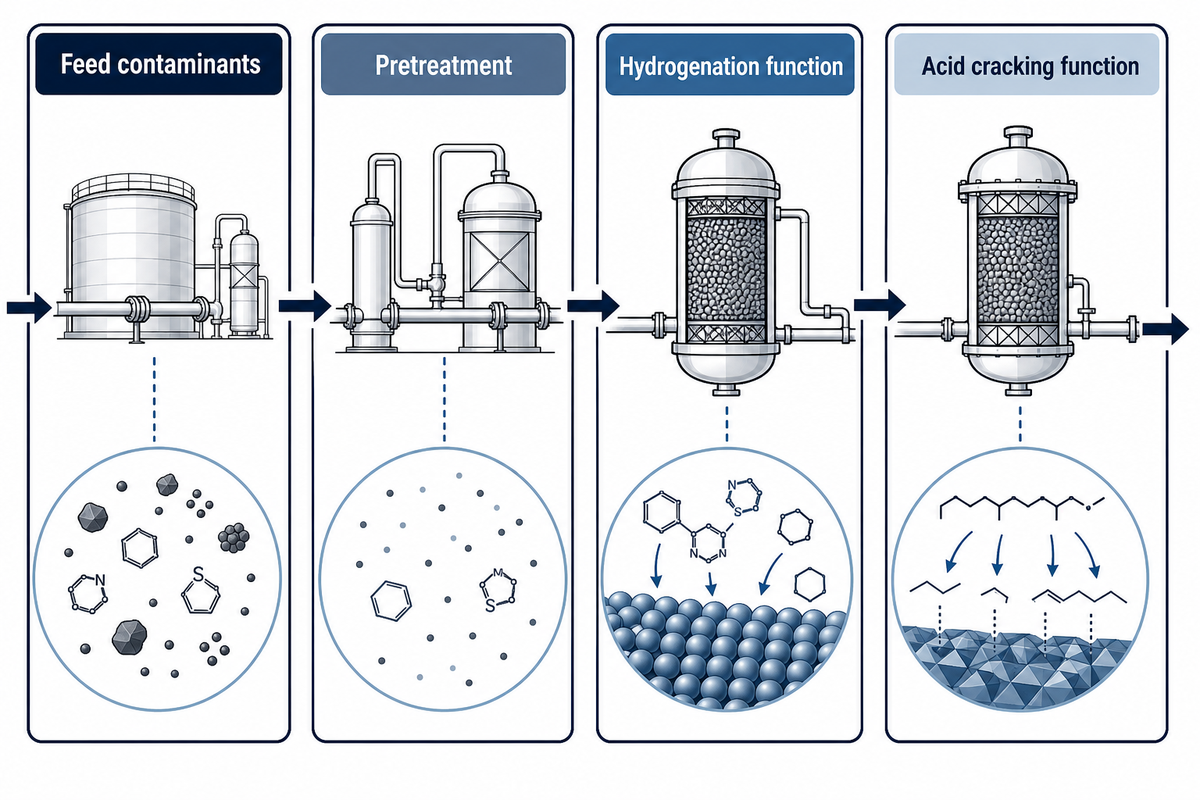
Hydrotreating catalysts depend on the contaminants, saturation duty, the quality of the product, cycle length and the properties of the feed. Hydrocracking catalysts establish a balance between hydrogenation and acid cracking activities. This relationship influences the activity and the selectivity of the catalyst, the gas and liquid product distribution, and the sensitivity to contaminants in the feed.
Nitrogen compounds can suppress acid-site activity. Metals and coke precursors can block or deactivate catalyst functions. The Colorado School of Mines hydroprocessing course is the supporting technical reference; exact sensitivity is catalyst- and feed-specific. Pretreatment is a catalyst-protection and reaction management decision. It isn’t necessarily true that every hydrocracker has an identical upstream vessel sequence.
Feed history is also important. A 2025 Digital Refining catalyst-evaluation article identifies costly selection pitfalls and describes feed changes that materially altered deactivation behavior. The practical lesson is that catalyst proposals should be evaluated under conditions representative of the actual feed.
Catalyst beds, grading layers, and distribution devices work as a system. Metals can accumulate near the catalyst surface, coke formation can restrict access to active sites, and light cycle oil can introduce a different aromatic burden than a straight-run fraction. This can impact catalytic performance and catalyst life.
Catalytic hydrogenation stabilizes intermediates formed during hydrocracking reactions. If the hydrogenation component of the catalyst loses effectiveness, selectivity and product quality can change even if the cracking function remains active. Catalyst regeneration needs to be assessed relative to both functions.
Catalysts have been developed for different catalytic hydrocracking operating conditions, just as a desulfurization process is designed for feed and product specification. Validation is designed to emulate the intended duty, rather than compare vendor labels in isolation.
Regenerated catalyst is another example where a label is inadequate. In an AFPM practitioner discussion, UOP explains that regeneration does not always restore equivalent hydrogenation function even when cracking activity appears acceptable. Factors such as service history, temperature exposure, contamination, catalyst type, conversion level, and selectivity target should be part of the evaluation.
How Product Targets Change the Choice
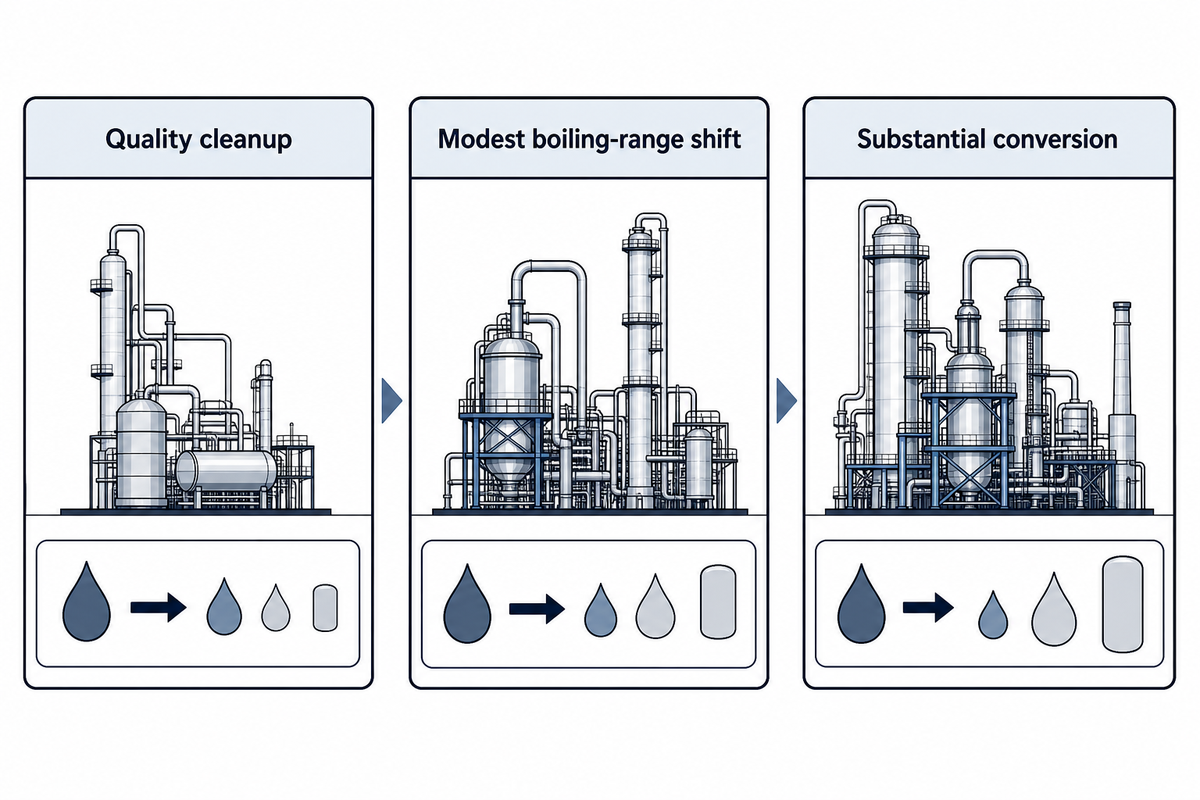
Quality cleanup without major conversion
If the key objective is to remove sulfur and contaminants, and/or improve stability and/or protect a downstream catalyst and the desired boiling range remains largely the same, hydrotreating is the obvious first option. The separation and reactor system still require a complete hydrogen, heat-release, sour water and off-gas basis. The Colorado School of Mines course material shows why feed, conversion, catalyst, and hydrogen-system requirements must be evaluated together when product targets change.
Modest boiling-range shift
Mild hydrocracking occupies the middle lane. It can improve conversion or middle distillate yield and work within defined pressure, reactor, hydrogen and fractionation limits. One refining textbook notes it runs at almost half the hydrogen pressure of conventional hydrocracking; its value is set by refinery integration and product economics, not by acting as a miniature full-conversion unit.
Substantial conversion and product flexibility
It’s when a refinery desires a large shift in molecular weight and flexibility to route products through different naphtha, jet, and diesel ranges that full hydrocracking becomes relevant. The increase in flexibility of product routing causes an increase in the equipment envelope as well as higher hydrogen and utility impacts, and more involved catalyst management.
A modern refinery may use hydrotreated streams to blend finished fuel, protect reforming catalyst, or supply cleaner feed to a conversion unit. Meeting ultra-low sulfur limits can remain a hydrotreating objective, while a simultaneous demand for jet fuel and gasoline may justify additional conversion. Process prestige shouldn’t be the main factor in determining product value.
Choose the Process by the Molecular Change You Need
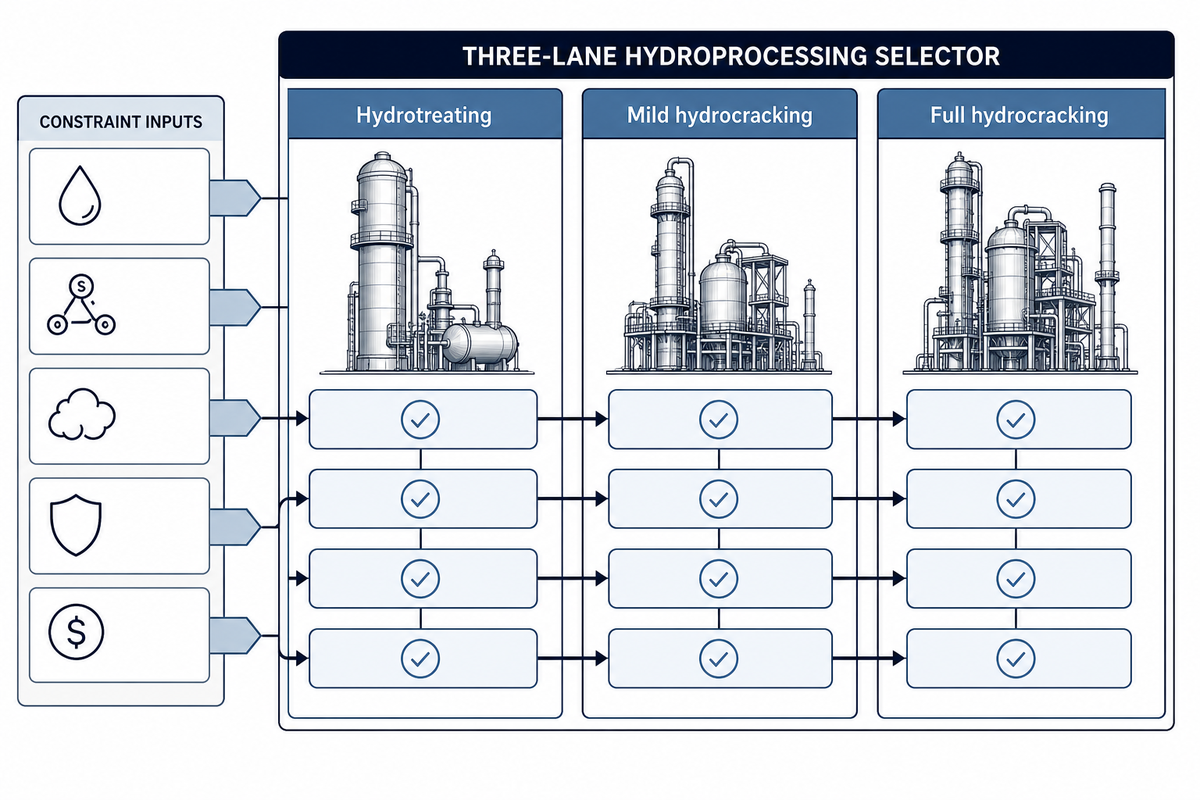
The Three-Lane Hydroprocessing Selector is used for scoping early stage decisions and shouldn’t be used in place of pilot work, catalyst evaluation, process simulation, HAZOP, mechanical design, or guarantees of the licensors.
- Lane 1 – Hydrotreating: Use this lane when the critical task is contaminant removal, saturation, and product-quality compliance, while substantial boiling-range conversion is unnecessary.
- Lane 2 – Mild hydrocracking: This lane is used when some conversion and yield shift creates value, and the refinery is working within existing unit, hydrogen, pressure and/or capital constraints.
- Lane 3, Full hydrocracking: investigate this lane when high conversion, heavier-feed upgrading, and product-slate flexibility justify the broader hydrogen, catalyst, separation, fractionation, and integrity scope.
Answer the following questions prior to assigning a lane: Which molecules are contained in the feed? Which product specification and yield shifts are needed? What’s the extent of conversion that’s valued? What’s the scope of hydrogen, purification, and compression? What must be removed to protect the selected catalyst system? What are the constraints imposed by the existing unit, utilities, plot, metallurgy, and turnaround?
Boundary for renewable or co-processing feeds: feed stability, oxygen content, water/gas formation, compatibility, and plugging risk may determine feasibility before the ordinary three-lane comparison becomes useful. DOE’s bio-oil co-processing material is a reminder to define that feed boundary explicitly.
What Changes in the Equipment Package
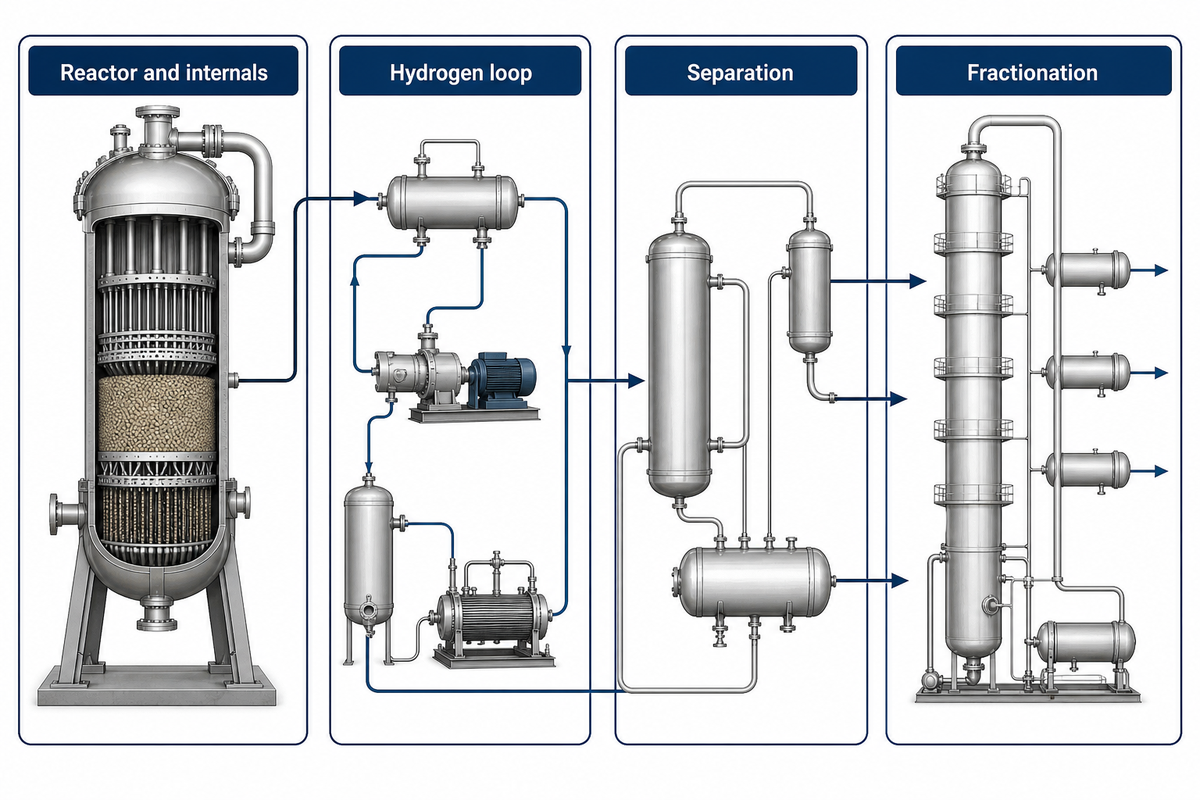
Reactor duty and internals
Both services rely on liquid-gas distribution, catalyst support, pressure control, and exotherm management. Hydrocracking typically increases the importance of bed architecture, quench distribution and control, temperature measurement, catalyst evaluation, and distribution internals. AFPM’s hydrocracking reactor design discussion explains that bed count, bed diameter, and bed length follow from catalyst technology, operating experience, and engineering analysis rather than an industry rule of thumb.
Hydrogen make-up, recycle, quench, and gas cleanup
The hydrogen loop is a system, not a compressor line item. Analyze make-up purity, recycle-gas composition, hydrogen partial pressure, circulation, quench strategy, compressor operating range, purge, amine or other cleanup, and the impact of contaminants and light ends. A conversion change can simultaneously affect reactor heat release, compressor duty, separator performance, and hydrogen-plant margin.
Effluent routing must account for light gas, fuel gas, and heavier liquid fractions without confusing heavy gas with heavy gas oil. Hydrogen purity depends on gas cleanup and purge control. Fractionation and stripping determine whether the required product properties are achieved.
High- and low-pressure separation plus fractionation
Reactor effluent cooling and separation recover recycle gas and split sour water, hydrocarbon liquids, and light ends. A full hydrocracking scheme commonly requires product fractionation and may recycle unconverted oil. Each interface needs a material balance. Consider temperature and pressure, fouling and salting, relief, and battery limits.
When an owner revamps or repurposes an existing hydrotreater for conversion service, the review must cover reactor internals, compressor range, fractionator capacity, flare and relief load, and hydrogen production. Debottlenecking one unit can reveal limits in other units in the oil refining train.
Metallurgy, fabrication, inspection, and documentation
Hydrogen partial pressure, temperature, wall thickness, weld details, cladding or weld overlay, H2S and wet-sour exposure, heat treatment, inspection access, and lifecycle damage mechanisms all affect the mechanical basis. The API Subcommittee on Corrosion & Materials maintains refining-equipment work covering fabrication, corrosion mechanisms, reliability, and equipment life. The EPC must identify which API, ASME, NACE/AMPP, owner, and licensor requirements apply and which editions the contract invokes.
BOSHIYA’s oil refinery equipment pillar provides a broader view of refinery packages and fabrication. Related plant-level interfaces are included in the petrochemical and chemical project scope. This guide stays focused on the hydroprocessing decision and the engineering handoff.
Integrity Boundaries the Comparison Must Not Hide
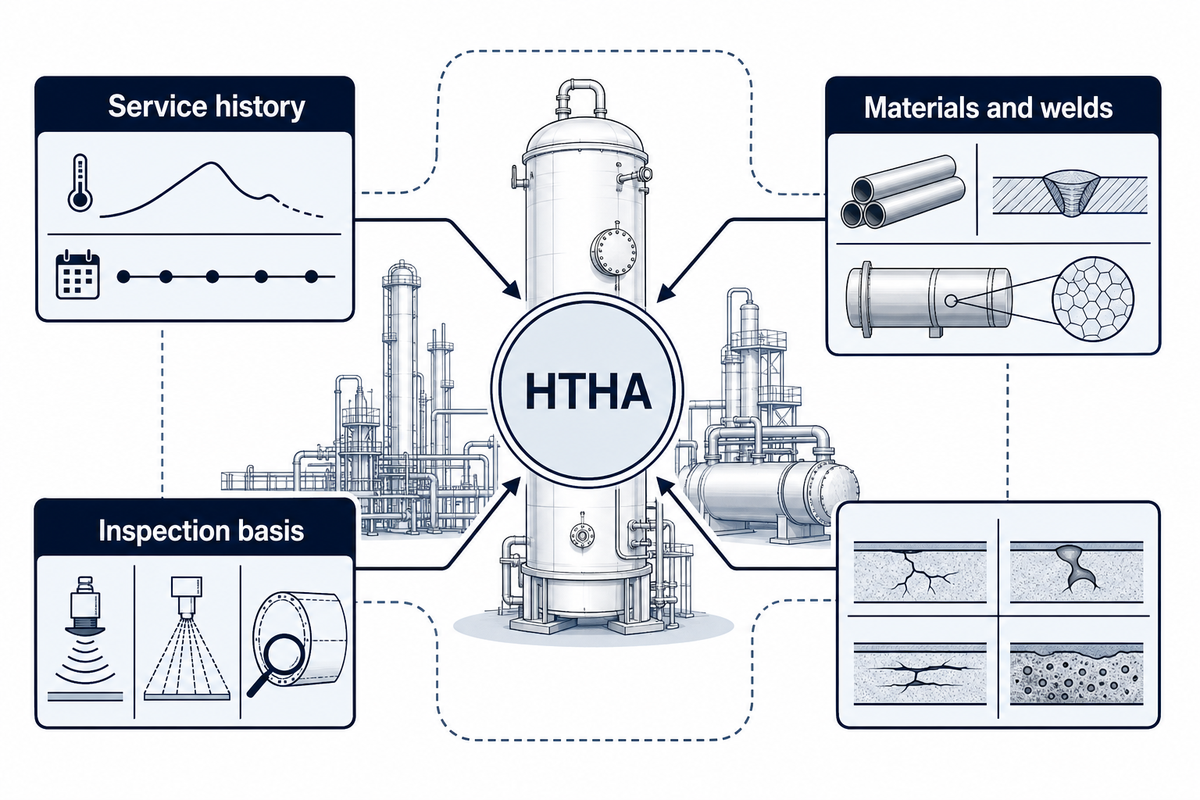
Assessing whether hydrogen service is present requires more information than design pressure and temperature. This information includes actual time-at-temperature history, weld and base metal condition, previous repairs, cladding condition, temper embrittlement exposure, high-temperature hydrogen attack (HTHA), wet H2S damage, ammonium salt deposit, inspection adequacy, and related excursions.
The U.S. Chemical Safety Board’s Tesoro Anacortes safety alert states that over time, HTHA affected the strength of a carbon-steel heat exchanger which ultimately led to rupture. During a revamp, consider not only design data, but also the service history and an integrity assessment.
This comparison isn’t used to select materials or determine inspection intervals. During the project, the process licensor, owner standards, applicable codes, materials/corrosion studies, mechanical design, risk-based inspection program and other company and project specific details govern the work.
EPC RFQ Checklist for Hydroprocessing Equipment
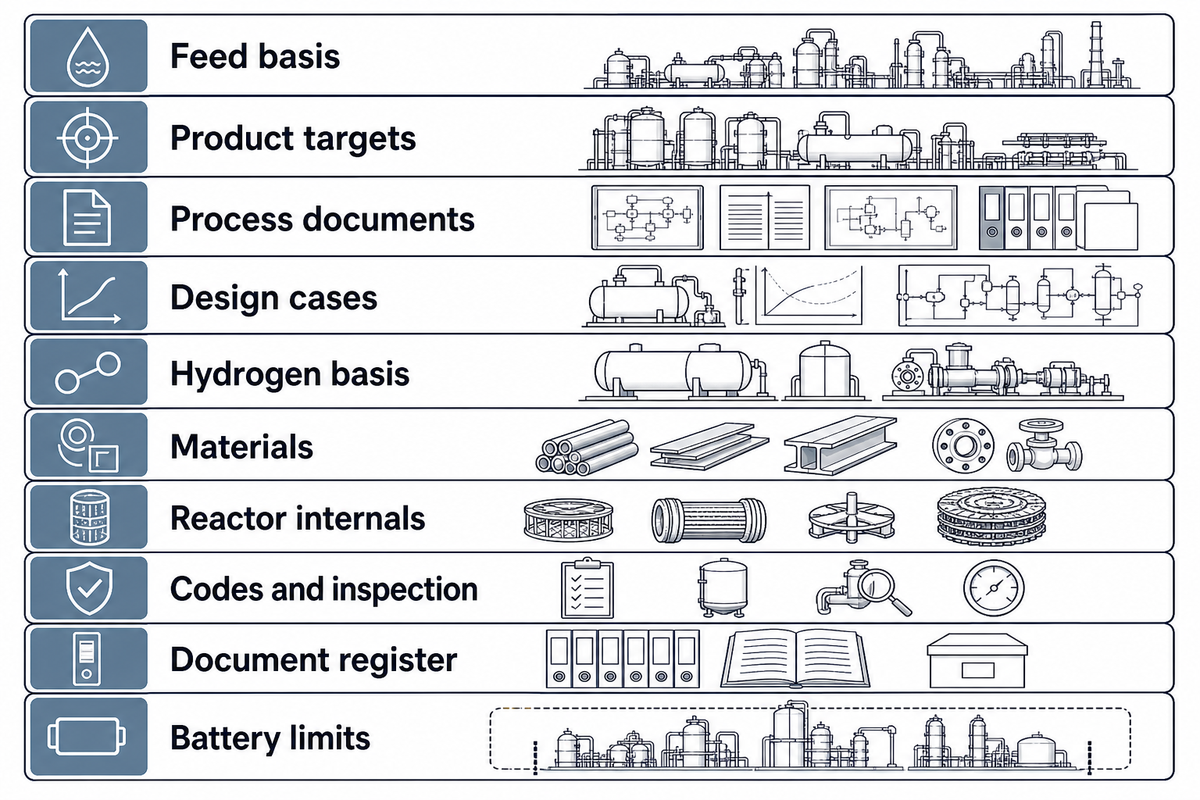
Vessel design pressure and diameter alone do not provide enough information for a responsible quotation. Use this 10-field hydroprocessing RFQ pack to support a consistent comparison of equipment and services:
- Feed basis: stream names, rates, density, distillation curve, sulfur/nitrogen/oxygen, metals, CCR, aromatics, water, solids, and feed variability.
- Product and conversion targets: product specifications, target yields, conversion definition, selectivity priorities, and turndown.
- Process/licensor documents: process datasheets, heat and material balance, PFDs, relevant P&IDs, catalyst loading basis, and guaranteed cases.
- Design and operating cases: normal, start-up, shutdown, regeneration, upset, depressuring, design pressure/temperature, and thermal cycles.
- Hydrogen and sour-service basis: make-up/recycle composition, hydrogen partial pressure, H2S, NH3, chlorides, water, purge, and gas-cleanup interfaces.
- Materials system: base metal, cladding or weld overlay, corrosion allowance, PWHT, hardness limits, bolting, internals materials, and corrosion-study requirements.
- Reactor internals: distributors, quench mixers, catalyst support, grading, thermometry, pressure-drop basis, unloading, and licensor interfaces.
- Codes and inspection: applicable construction codes, API/AMPP specs, NDE, weld qualification, shop inspection, hydrotest, and third-party hold points.
- Document register: calculations, drawings, procedures, inspection, material, manufacturing data book, spares, and preservation.
- Logistics and battery limits: shipping split, site assembly, plot constraints, nozzle loads and tie-ins, utilities, insulation/fireproofing, commissioning, support, and exclusions.
Issue the pack with a deviation schedule. Two suppliers can appear commercially comparable while assuming different alloy systems, internal scope, inspection levels, document deliverables, or site assembly responsibilities. These must be disclosed before award.
When the boundary spans process, mechanical, piping, controls, and site integration, coordinate the package through a defined EPC interface. The technical service scope provided by BOSHIYA offers an additional internal handoff point. For a project specific review, send the completed data pack through the BOSHIYA contact channel rather than requesting a reactor quote for a short equipment description.
Frequently Asked Questions
Is hydrotreating a type of hydrocracking?
No, both are hydroprocessing operations, but the purposes are different. In Hydrotreating, a major function is to remove contaminants and stabilize the feed, with limited conversion for most duties. In Hydrocracking, a significant amount of carbon-carbon conversion is purposely added to shift heavier feed to lighter products.
Does a hydrocracker always need a separate hydrotreater first?
No single arrangement is universal. Many schemes incorporate pretreatment to protect downstream catalyst functions. That duty can be carried out in a separate reactor, a first stage, or an integrated catalyst system. The choice depends on the feed assay, catalyst path, conversion target, hydrogen circuit, and licensor basis.
Which process consumes more hydrogen?
Hydrocracking generally consumes more hydrogen because conversion and saturation occur alongside contaminant removal. A tough hydrotreating duty can still be hydrogen-intensive. Use the project material balance; don’t size the equipment from a generic consumption value.
Can mild hydrocracking replace a full hydrocracker?
Sometimes: mild hydrocracking can fit when the required conversion and product shift are modest and existing-unit constraints favor it; one refining textbook table puts it at 20–70% conversion and 35–70 bar hydrogen pressure, against 70–100% and 85–140 bar for conventional hydrocracking. It may not provide the same conversion flexibility or product slate as a full hydrocracker. The answer depends on the feed, hydrogen capacity, desired yields, catalyst cycle, fractionation, and economics.
What data is needed to quote a hydroprocessing reactor?
Request the process/licensor datasheet based on feed and product basis, all design and operating cases, hydrogen and sour service composition, materials and overlay requirements, reactor internals, construction code, inspection plan, document register, shipping limits, battery limits, and deviation schedule.
Conclusion: Start With the Molecule, Then Define the Unit
Hydrotreating cleans and stabilizes; hydrocracking performs substantial molecular conversion. That is the useful starting distinction. Safety must govern the full definition process, including the feed and product target, hydrogen system, catalyst protection, process configuration, integrity history, and commercial boundary.
Use the Bond-or-Impurity Test to frame the problem, the Three-Lane Selector to point to the possible process family, and the 10-Field RFQ Pack to hand the project to licensors, EPC teams, and equipment manufacturers without concealing the assumptions.
References & Sources
- Colorado School of Mines, Hydroprocessing: Hydrotreating & Hydrocracking
- Penn State, Petroleum Refining finishing-process lessons
- AFPM, Hydrocracking reactor design considerations
- AFPM, Fresh versus regenerated hydrocracking catalyst experience
- API, Subcommittee on Corrosion & Materials
- U.S. CSB, HTHA safety alert from Tesoro Anacortes investigation
- Digital Refining, Diesel hydrotreating and mild hydrocracking
- Google Patents, US6630066B2 hydrocracking and hydrotreating separate refinery streams