Get in Touch with BOSHIYA


How Flex Lance Bundle Cleaning Keeps Heat Exchangers Running at Peak Efficiency
Contents
show
As one of the leading causes of inefficient operation in industry, heat exchanger fouling costs the United States alone over $16.5 billion annually (revealed in a landmark, Department of Energy National Laboratory study (OSTI). Though a myriad of concerns can cause fouling, the main contributing factors to heat transfer impedance are deposits of scale, coking, and biological material that plug heat transfer tubes. Flex lance bundle cleaning is a high-pressure water jetting solution that removes these deposits from heat exchanger tubes while maintaining the integrity of the heat exchanger bundle—without the need for removal.
Instead of chemical-based removal, flex lance system techniques use high pressured water jets, directed from the outside in at pressures of up to 40,000 PSI, to drive away deposits. In this article, we explore how flex lance units operate, why they’re a versatile solution to many maintenance needs, which specific applications are best suited for flex lance cleaning, the technical details that influence choosing this unit over others, and safety practices that are essential for any operator. If you’re involved in refining or power plant turnarounds, we hope you find this information helpful to improve your cleaning techniques.
What Is Flex Lance Bundle Cleaning?
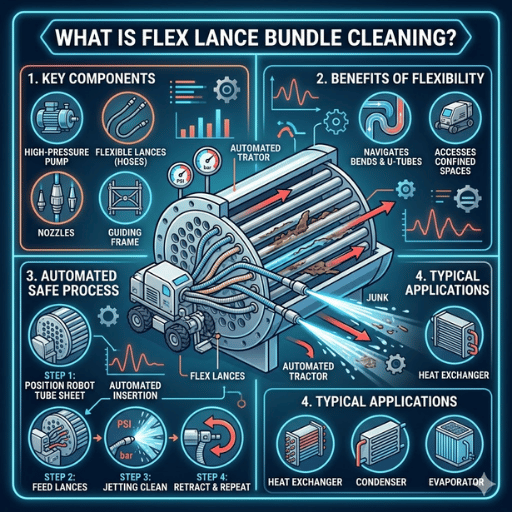
Flex lance bund cleaning. Is a form of mechanically cleaning a shell and tube heat exchanger (STHX) bundle with flexible water lances. Flexible high pressure water lances are inserted into the tubes, where they traverse the bends-for example tight U-tubes, delivering water jets to scour deposits from the inside of the tube using nozzles that direct pulsating water jets to scale, coke, etc. to break away without harming the tube walls.
The ‘workhorse’ of the process plant has to be the ‘shell and tube’ heat exchanger. Flows of heat between two fluids are separated by thousands of individual tubes, all contained in a shell of limited diameter. Such processes could run for months on end.
Deposits formed on the interior of the tube wall encapsulate calcium carbonate scale, polymerized crude oil coke, corrosion by-products, and bacterial colonies and significantly reduce the physical diameter of the tube and insulate the wall from the heat being transferred.
Standard methods of cleaning are to circulate chemicals, use a hydro jet with a rigid lance, or mechanically pig. The chemical cleaning is designed for the removal of softer deposits, but is ineffective on deposits that have hardened, and poses significant waste disposal problems. The use of the flex lance bundle cleaning bridge’s the gap: it is capable of cleaning both straight and curved tube bundles, with a normal operating pressure of between 10,000 and 40,000 PSI (700 to 2800 bar), in a single session.
📊 Field Data
Flex lance systems are capable of processing 200- 500 tubes per shift in refinery turnaround projects, this limit depends on length of tube, deposit hardness and Lance design. From this flow rate turnaround teams should be able to clean an entire exchanger in hours instead of days.
Flex lance technology has become the norm in industrial markets due to lower turnaround, a significantly decreased consumption of fresh water compared to conventional water blasting, and an ability to produce consistent results in multiple tube geometries. To view equipment and specifications, visit our flex lance bundle cleaning product page. In a DOE study conducted in 1992, fouling related losses in U.S. industry were estimated to be in excess of $16.5 billion dollars per year http://147.9.242.230/NonProc/Journal/articles/Vol37/37-03/1308.pdf-a figure which, when adjusted for inflation and increased capacity, is guaranteed to be higher today.
Efficient systems bring those dollars back to the bottom line.
How a Flex Lance Tube Cleaner Works
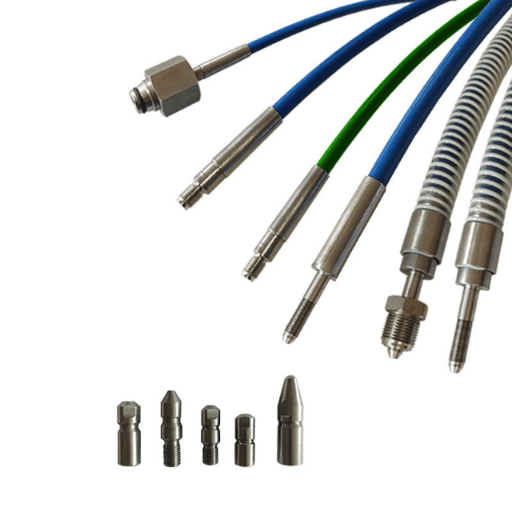
A lance tube cleaner is a tool that pushes a flexible wash line through the internal tube passage of a heat exchanger. Its wash line is operated under high pressure (10,000-40,000 PSI) using jets to water and penetrate deposits, flushing them to tube exit. Cleaners employ mechanics, high-performance nozzles, and a stand frame to clean an entire bank of tubes with minimal human effort.
Here is the step-by-step cleaning cycle:
- Pre-cleaning inspection- The operator uses a go/no-go gauge to assess the tube internal diameter (ID), recognizes deposit type (scale, coke, biological), notes bundle orientation (horizontal or vertical). This information then guides the decision on lance diameter, nozzles to be used and water pressure setting.
- Equipment arrangement- Lance feeder and positioner are mounted on a frame system aligned with the face of the tube sheet. Hoses connect the lance to the high pressure pump unit. Air motor/hydraulic drive units power the feeder rollers.
- Lance insertion – The feeder advances the flexible lance into the tube at an applied rate. At the tip, the lance carries a rotating jet nozzle that has recession and output jets. This rotating nozzle advances by the driving pressure of the water.
- Deposits removal-High pressure water jets penetrate tube wall at close distance to break up scale and dislodge deposits. Lance speed is maintained at 18-30″ (45.72-76.2 cm) per sec, depending on rate of scale dissolution. Pull and push force is 110 ft-lb (~489 N), sufficient to propel lance through partially clogged tube.
- Lance retraction- The feeder ru ns in reverse pulls the lance back however the jets continue to flush the loosened material from the tube. A second pass may be required for very fouled tubes.
- Indexing to next tube- The positioner advances the lance to the next tube hole. Semi-automatic and fully automatic systems index across the tube sheet pattern without operator intervention.
- Post-cleaning inspection Operators visually inspect cleaned tubes using a borescope or light test and ensure that the level of deposit removal is above the required standard of cleanliness.
In our team, pre-cleaning inspection is applied for tube ID, type of deposits and bundle orientation prior to selecting the lance diameter and pressure setting. Such procedures can prevent most potential field problem, such as lance jamming or insufficiency of cleaning.
Standard lance lengths are available in 50, 75 and 100 feet long in order to suit the standard size of the exchanger tubes. Flexible lances are fabricated from high strength braided hose suitable for continuous operation at Maximum Working Pressure.
To understand how these systems handle different tube configurations, it helps to see the core components side by side:
| Component | Function | Typical Specification |
|---|---|---|
| Flexible Lance | Carries water to the nozzle through tube bends | 50’–100′ length, 10,000–40,000 PSI rated |
| Rotating Nozzle | Creates spinning water jets for 360° cleaning | Rear-firing + forward-firing jets, self-rotating |
| High-Pressure Hose | Connects pump to lance feeder | Braided steel, rated to system max pressure |
| Lance Feeder | Drives lance forward and backward through tube | Pneumatic or hydraulic drive, roller-fed |
| Air Motor / Hydraulic Drive | Powers the feeder mechanism | 110 ft-lbs push/pull force |
| Positioner | Indexes lance across tube sheet pattern | Manual, semi-automatic, or fully automated |
| Frame System | Mounts feeder and positioner to tube sheet | Adjustable for horizontal and vertical cleaning of bundles |
Flex Lance vs. Rigid Lance — Which Suits Your Application?
The decision of a flex vs. rigid lance depends on three factors. Tube geometry, deposit hardness and time available. Flex lances can snake through the bends and are usually used in situations where multiple tubes are to be cleaned while rigid lances work very well in straight tube situations.
Maximum allowable pressure for rigid is greater than that of flex lance. Get to know the limits of one before buying to avoid wasting time on under performing tools and rounds of re-cleaning.
| Feature | Flex Lance | Rigid Lance |
|---|---|---|
| Tube Access (U-tubes, bends) | Passes through 180° bends and U-tube layouts | Straight tubes only; cannot pass bends |
| Pressure Range | 10,000–40,000 PSI (700–2,800 bar) | Up to 43,500 PSI (3,000 bar) |
| Cleaning Speed | 18–30 in/sec, 50–80% time reduction vs. rigid | Single-tube sequential, slower overall |
| Multi-tube Capability | 2–5 tubes cleaned simultaneously | Single lance per tube |
| Operator Safety | Remotely operated; operator stays behind shield | Closer operator proximity; higher exposure risk |
| Best For | U-tube bundles, tight turnarounds, mixed geometries | Straight-tube condensers, maximum-pressure jobs |
U-tube bundle case in point: Selecting a rigid lance on a U-tube where the bend radius in the bundle exceeds (180-the inch line R) is a good illustration of oversights prone to chronic selection criteria – the lance just can’t get to the other side, deposits remain. We’ve seen turnaround teams blow an entire shift on the spot trying to find a flexible lance system!
When does flex win?
Select a flex lance system if the bundle has U- tubes, if several tubes must be cleaned simultaneously or if turnaround time is critical. Multiple flex lances used in parallel can reduce cleaning time by 50-80 %, vs. a single lance. Set-up is simple, production speed fast and the flex lance bundle cleaner, once placed, indexes automatically over the tube sheet.
One operator is sufficient.
When does rigid win?
Rigid lances are still a viable option for straight tube condensers with severe fouling that needs the lowest absolute pressure possible. If all the tube are straight from tube sheet to tube sheet, and the deposits are baked enough so that 40+ PSI is needed to break them a rigid lance can give the pressure we need without having the flexibility cost.
In reality, several cleaning contractors maintain both kinds on the truck. for tube cleaner choice, it all comes down to the particular exchanger shape. On site, crews decide based on each bundle. Flex lance systems are the best choice for horizontal and vertical bundles where the tube row configuration is variable, based on its repetitive reliability on varied setups. Dual flex lances internal tube cleaner rigs can halve the time on a 2,000-tube condenser job.
Applications — Where Flex Lance Bundle Cleaning Delivers the Most Value

Batch cleaning with Flex lance yields the highest return when heat exchangers are running on a continuous basis, fouling progresses rapidly and unplanned outages are very costly. It is applicable to any operation utilizing shell and tube heat exchangers and there are six areas that dominate the demand for industrial cleaning services.
15%
one quarter of all factory maintenance costs is spent on heat exchangers—as much as 50% of this amount is due directly to fouling deposits
Petroleum Refineries,-Crude oil processing produces coke, asphaltene and salt scale deposits within exchanger tubes. Turnarounds are hours, and tens of thousands of dollars lost for every hour that a refinery is down. Flex lance systems are utilized to clean crude preheat trains, overhead condensers and product coolers at planned shutdowns.
Cost for cleaning an ex-changer is far less than $40,000-$50,000, but the recovered heat transfer efficiency paidbacks that within weeks of restarting operation.
Petrochemical Plants – Polymerization byproducts, wax and resin film fouls tubes in ethylene crackers, styrene units and polymer manufacturing lines. Tube bundle cleaning systems capable of 2,800 bar is able to blast away the toughest polymer deposits. In our experience, petrochemical exchangers with polymer fouling are best cleaned using the 360 jet pattern of the rotating nozzle.
Power Generation – An important source of power plant inefficiency comes from mineral scale and biological growth inside the condenser tube bundles that are cooled by wastewater. Power generating facilities that use power plant condenser tube cleaning systems often do so on the order of an entire power plant condenser unit, which can encompass thousands of tubes. Increasing your power plant power generation efficiency by 1% can save a 500 MW facility over $500,000 per year in fuel costs.
HVAC and Chiller Systems – Commercial and industrial building cooling systems include chillers which heat exchangers use shell & tube evaporators and condensers that develop biological and calcium carbonate fouling. A flex lance bundle cleaning system can restore chiller heat transfer efficiency without the handling of hazardous acids that is required during acid cleaning and the associated disposal.
Marine – Vessels equipped with heat exchangers and engine cooling systems operating in saltwater are susceptible to saltwater scale buildup and biological fouling. Space is at a premium aboard vessels so a flexible lance feed system becomes essential-rigid lance assemblies are too large to fit into the tight confines of a vessel engine room.
Pulp and Paper – Calcium carbonate and sodium sulfate salt scale buildup is common in mud lakes and black liquor evaporator tubes and exchanger systems on giant pulp and paper plants. Short maintenance windows available on pulp & paper presses demand the flexibility of flexible lance systems working in parallel on an entire tube sheet.
Across all these highly diverse industries, the physical set-up and cleaning requirements are similar: remove biological deposits and hardite salts from heat exchanger tubes without damaging tube walls, complete the cleaning within several hours, and return as much of the heat transfer coefficient to as close to to new as possible. Biological growth reactions in cooling towers, hard salts in acid refiner service, or exactly what kind of hardide you have are different-but the flexible tube cleaning approach handles all. For more on specific tube bundle cleaning equipment, visit our product page. IntechOpen offers a guide on the science behind fouling in the form of a chapter on Heat Exchanger Fouling.
Key Specifications to Check Before Selecting a Flex Lance System

Matching your flex lance tube cleaning system specifications to the dimensions of your heat exchanger tubes, the physical nature of your fouling, and your site constraints is the first step in choosing the right system. A mismatch among any of these parameters can lead to inadequate cleaning results or damage to the tubing. Here’s what to look for:
| Parameter | What to Check | Typical Range |
|---|---|---|
| Operating Pressure | Must exceed fouling hardness threshold | 10,000–40,000 PSI (700–2,800 bar / ~1,400 atm max) |
| Tube ID Range | Lance OD must clear minimum tube ID | 12 mm–50 mm (½”–2″) |
| Lance Material | Rated for pressure and chemical exposure | High-tensile braided steel or thermoplastic |
| Drive Type | Match to site utilities (air, hydraulic, electric) | Pneumatic, hydraulic, or electric |
| Automation Level | Manual for small jobs; automated for large bundles | Manual, semi-automatic, fully automated (robotic) |
| Lance Count | More lances = faster cleaning, higher flow demand | Single, dual flex lances, or 5-lance configuration |
💡 Pro Tip
Match your flex lance pressure rating to the like amount of deposited hardite deposits. Soft deposits like biological growth require only 10,000 PSI while hardite buildup on tubes in a refinery might require 30,000 pounds per square inch. Operating at higher pressure than necessary wastes energy and water; operating below the required level wastes time and cleans out some fouling but leaves residuals behind.
Don’t forget your minimum tube ID-take time to confirm that your maximum internal lance pressure will not cause jamming or impact damage. Just five seconds with a go/no-go gauge can save hours of normally scheduled down time by avoiding having to extract a stuck lance assembly from a tube in the outer tube sheet.
The lance feeder positioner cycles the poppet valve and controls tube-to-tube indexing-along with insertion/deletion speed this determines how quickly the assembled lance moves in or out of a heat exchanger. A semi-automated feed system is able to run each tube position with the operator triggering each run while an automatic or remotely operated feeder runs the entire tube sheet pattern with the operator monitoring in a control room. A growing field of robotic automated tube cleaning systems are finding a place in ultra-large refineries featuring run lengths of 5000+ tubes per exchanger.
Frame system design is also critical. Frame design must be strong enough to hold to tube sheet or support frame properly, keep the lance centered across entire tube sheet diameter, and allow horizontal and vertical bundle handling. Frame that is not square will cause the lance to hit the tube openings and cause damage to the tube sheet face. It also costs a lot of time to reposition a non-square frame.
For full technical information on several industrial lance systems designed by our team, see our flex lance product page with specs by model and configuration.
Safety and Operational Best Practices for Bundle Cleaning
Water jetting at 10,000 40,000 PSI is dangerous. It poses a broad spectrum of hazards from injection injuries to catastrophic equipment failure. Assure every flex lance bundle cleaning operation follows established safety protocols that safeguard employees and equipment. Cutting corners can result in life-threatening injuries from water penetration.
Before and during your water jetting operation, follow this safety checklist :
- Isolate whole system from all power sources – Follow OSHA 29 CFR 1910.147 lockout/tagout procedures to ensure a system is void of energy before starting any work.
- Wear appropriate PPE at all times -A face shield is mandatory under 2,000 PSI. All operators and other personnel in the area must wear waterproof gloves, steel-toe boots, hearing protection, and full-body waterproof suits.
- Perform pre-cleaning tube assessment – The operator measures the internal tube id, characterizes deposits, and checks for thinning, pitting, or tube wall breaching. Record all bundle orientation and dimensions.
- Make sure hose and lance components can all operate at the water pressure – Contractors must replace any hose or fitting showing harm/abrasion/deformation.
- Designate an exclusion zone – Establish a barricade around the tube sheet face to prevent access of all unauthorized personnel while the system is under pressure.
- Never leave a pressurized system – A trained operator should be stationed at the controls during pumping operations. No dead-man systems are permissible without operator intervention.
- Abide by Confined Space Rule 13 – Permits are required for all shellside access. Maintain continuous communication with the standby rescue team, and test atmosphere conditions.
- Depressurize – Bring the system to a dead stop hydraulically before any nozzle change, frame adjustment, or lance jam clearing.
Failure to do extensive pre-cleaning tube inspection is the major reason our team experiences lance failure during operation. One wrong deposit or foreign object in the row to be cleaned can trap the entire lance requiring hours of strenuous removal efforts. We always perform our own tube inspections before cleaning cycles.
Standards regarding high-pressure cleaning are issued through ASME PCC-2 (Repair of Pressure Equipment and Piping) and the SafeContractor Guidance Note 36 on High Pressure Water Jetting. These rules detail how often equipment should be tested, what kind of training is required by operators, and how an operation must respond in case of emergency. It is required in our team do follow these standards.
It appears that following sound operator safety procedures and the well maintained equipment in conjunction with pre-job planning, can allow the cleaning crews to achieve cleaning efficiency from shift to shift.
Frequently Asked Questions

Q: What is flex lance bundle cleaning?
View Answer
Flex lance bundle cleaning is a high pressure water jetting process that utilizes flexible lances in order to clean deposits such as fouling from the heat exchanger tube bundles. Unlike straight lances, these flex lances internal tube cleaner units are capable of traversing through tube bends—extreme U-tube configurations at pressures between 10,000 and 40,000 PSI. The rotating nozzles near the ends of the lances maintain a 360° cleaning pattern around the tube bundle and have the horsepower to perform jet cleaning of deposits such as—scale, coke, biological—without damaging the tube walls.
The use of flexible lances becomes popular during a refinery turnarounds or power generation outages where the speed of cleaning directly impacts on the costs of downtime. Learn more about flex lance bundle cleaning systems and their uses.
Q: Are flex lances suitable for both horizontal and vertical tube cleaning?
View Answer
Yes. Both horizontal and vertical tube bundles can be cleaned with Flex lance systems. The frames and positioners can be converted to fit either type and most industrial systems are supplied with hardware for both.
Q: How does high-pressure tube cleaning affect heat exchanger performance?
View Answer
High-pressure tube cleaning. Fouling deposits on tube walls create a thermal barrier that reduces flow. Once the tube is exposed to high pressure water (50-60000 psi) cavitation and scrubbing action clean the deposit, restoring the heat transfer coefficient to near design values.
Outlet temperatures are reduced back to specification and upstream pressure drop across the exchanger is also reduced. Facilities undergoing a flex lance clean experienced 10-30% increases in thermal efficiency, once fouling deposits were removed on a thorough clean. For refineries, this allows less energy to be used to generate the same amount of heat on each barrel of oil processed.
Power plants experience similar gains; re-optimization of a condenser back to near-new condition at a 500 MW power station has been estimated to save $500,000 per year in fuel costs.
Q: What technical data should I check before selecting a flex lance for bundle cleaning?
View Answer
Verify six factors: operating pressure(PSI/bar), 1 minimum and 2 maximum tube ID, 3 lance material and pressure rating, 4 drive type(pneumatic, hydraulic, electric), 5 level of automation (manual all the way to full automation ), and6 number of lances(single, dual or 5-lance). Assure pressure is compatible with deposit hardness and that your lance outer diameter will allow sufficient clearance over your most diminutive tube ID.
Q: What safety considerations should operators follow during bundle cleaning?
View Answer
Follow OSHA 29 CFR 1910.147 lockout/tagout procedures, always wear a face shield and waterproof PPE, create an exclusion zone, and remain with a pressurized system at all times. Dead-man controls are always necessary on lance feeder equipment.
Q: What is a bundle extractor and how does it relate to flex lance cleaning?
View Answer
The bundle extractor is a mechanical piece of equipment used to extract the tube bundle out of the exchanger shell to provide external access. When doing flex lance cleaning, this can be achieved in-situ in the vessel by having the bundle within the shell this confers zero extraction time and a lower total turnaround time ( hours). When visual inspection is required due to shellside fouling or tube sheet corrosion, the bundle will be extracted, placed on a support rack, cleaned using flex lances from both sides of the tube sheet, inspected and placed back into the vessel:
Need Professional Flex Lance Bundle Cleaning?
BOSHIYA Group has over 110 years of engineering experience with the ISO9000 quality industrial grade flex lance cleaning systems. We have organized our team to tailor for your specific cleaning requirement:
About This Guide
This flex lance bundle cleaning guide references field data gathered from industrial tube bundle cleaning operations across the following industries: petroleum refineries, power plants, and petrochemical plants. BOSHIYA Group’s maintenance and equipment division has been providing tube bundle cleaning support in these industries since our founding in 1915. The technical specifications and safety procedures referenced herein are representative of the standards of modern practice as outlined in OSHA 29CFR 1910.147 and ASME PCC-2.
References & Sources
- The Cost of Heat Exchanger Fouling in the US Industries — U.S. Department of Energy, Office of Scientific and Technical Information (OSTI)
- OSHA 29 CFR 1910.147 — The Control of Hazardous Energy (Lockout/Tagout) — U.S. Department of Labor
- Fouling in Heat Exchangers — IntechOpen (Academic Publisher)
- Fouling and Fouling Mitigation on Heat Exchanger Surfaces — IntechOpen
- Guidance Note 36: High Pressure Water Jetting — SafeContractor
- Prevention of Water Jetting Injuries — Occupational Health & Safety Magazine
![Polypropylene Resin: Grades, Types & Selection Guide [2026]](https://boshiya.com/wp-content/uploads/2026/05/0-150x150.webp)