Get in Touch with BOSHIYA


Contents
show
Flex Lance or Rigid Lance — Which One Actually Cleans Your Tubes Better?
Heat exchanger fouling drains US industry between $4.2 billion and $10 billion every year. That figure accounts for lost thermal efficiency, unplanned shutdowns, and the labor required to restore tube bundles to service. For mechanical tube cleaning, the choice between a flex lance and a rigid lance determines how thoroughly you remove deposits — and how quickly your equipment returns to full production. This article compares flex lances and rigid lances in five key areas: tube geometry reach, cleaning power and pressure ratings, operator safety, turnaround speed, and total cost of ownership. Whether your plant runs straight-through condensers or tightly curved U-tubes, the right lance system can cut downtime in half or leave stubborn fouling behind. Read on for a head-to-head breakdown backed by field data, industry standards, and real pressure and flow numbers.
Flex Lance vs Rigid Lance at a Glance
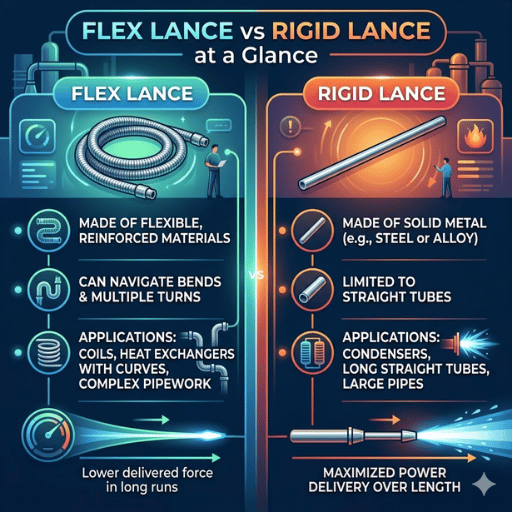
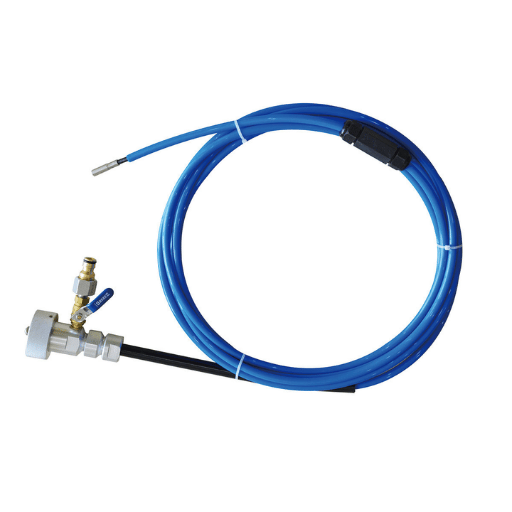
A rigid lance is a straight steel tube — typically stainless steel — connected to a high-pressure pump. The operator or machine feeds this lance through a tube in a single linear pass. Rigid lances excel in straight-through heat exchanger tubes where the path from tubesheet to tubesheet has zero bends. A flex lance, by contrast, is a flexible high-pressure hose assembly reinforced with braided steel that follows curves, U-bends, and offset tube layouts. Both lance types connect to nozzles that direct water jets against the tube wall to blast away scale, biofilm, and coke deposits.
| Dimension | Flex Lance | Rigid Lance |
|---|---|---|
| Tube Access | U-bends, curved paths, tight radii | Straight-through tubes only |
| Max Pressure Range | 5,000–20,000 PSI | 10,000–40,000 PSI |
| Cleaning Speed | Moderate (bend navigation adds time) | Fast (up to 3x manual methods) |
| Operator Safety | Automated feed available; manual still common | Fully remote machine operation |
| Best Application | U-tube bundles, curved exchangers | Straight condensers, heavy fouling |
Bottom line: rigid lances deliver maximum pressure and speed on straight tubes. Flex lances reach places rigid lances physically cannot. Many plants need both.
Up to 40,000 PSI
Rigid lance maximum pressure rating
180° Bend Navigation
Flex lance capability in U-tube bundles
Tube Geometry and Cleaning Reach
Tube geometry is the single biggest factor in lance selection. A flex lance travels through U-tube bends at 180°, handles tight bend radii down to 1.5 inches (3.8 cm), and follows offset tube paths that rigid equipment simply cannot enter. Rigid lances, limited to straight-through access, risk jamming or damaging tubes when the bend radius exceeds what the steel tube can tolerate — generally anything tighter than a 3-inch radius rules out rigid lancing entirely. Both lance types serve pipe and tube cleaning tasks, but the geometry of the passage dictates which one can physically complete the job.
Standard flex lance lengths come in 50-foot, 75-foot, and 100-foot sections, allowing operators to extend reach for deep bundles or multi-pass exchangers. Rigid lance lengths run from 10 to 40 feet, sized to match the tubesheet-to-tubesheet distance of straight-tube designs. The length you need depends on tube length plus enough extra to account for insertion clearance and nozzle travel.
Under TEMA standards (Tubular Exchanger Manufacturers Association), the three most common tube bundle types are Fixed Tube Sheet, U-Tube, and Floating Head. Each presents a different cleaning challenge:
| Tube Configuration (TEMA) | Flex Lance Compatibility | Rigid Lance Compatibility |
|---|---|---|
| Fixed Tube Sheet (straight) | ✔ Compatible but slower than rigid | ✔ Ideal — fastest cleaning speed |
| U-Tube (180° bends) | ✔ Required — only viable method | ✖ Cannot enter bends |
| Floating Head (removable) | ✔ Compatible for curved sections | ✔ Compatible for straight passes |
💡 Pro Tip: When the bend radius drops below 3 inches, flex lancing is the only viable cleaning method. Forcing a rigid lance into a tight bend risks puncturing the tube wall and turning a routine cleaning job into a costly repair.
In our bundle cleaning projects at BOSHIYA Group, U-tube exchangers with 180° bends consistently require flex lancing for full tube coverage. We have documented cases where rigid lance attempts on tight-radius tubes caused tube-end damage that added days to the turnaround schedule. Learn more about flex lance bundle cleaning and how tube geometry drives the selection.
Cleaning Power and Pressure Ratings
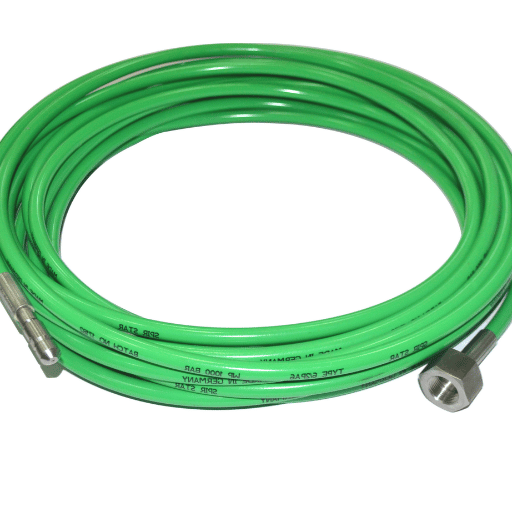
Pressure rating is where rigid lances hold a clear advantage on paper. A rigid lance system operates between 10,000 and 40,000 PSI, delivering concentrated forward jet power that blasts through heavy-duty calcium scale, coke deposits, and polymerized fouling. Flex lances generally operate between 5,000 and 20,000 PSI, though specialized systems from manufacturers such as Derc Salotech push flex lance ratings up to 1,500 bar (approximately 21,750 PSI).
The difference is not just about peak pressure. It is about how much pressure reaches the deposit surface. Rigid lances maintain nearly 100% of pump output at the nozzle because the water jet travels a straight, unobstructed steel tube. Flex lances lose some energy to friction and directional changes at each bend, though modern reinforced hose construction minimizes that loss to roughly 5–12% through a single 180° turn.
Nozzle selection matters as much as pressure. Rigid lance machines commonly use rotating line moles — NLB Corporation alone offers more than 40 nozzle models — that spin at high RPM to scour the full tube circumference. Flex lance nozzles tend toward self-propelling designs that pull the hose through the tube using rearward-facing jets, while forward-facing jets attack the deposit. Thread compatibility matters when swapping nozzles: rigid lance systems typically use NPT or BSPP thread connections, while flex lance fittings may require adapter thread sizes depending on the manufacturer and pressure class.
| Parameter | Flex Lance | Rigid Lance |
|---|---|---|
| Operating Pressure | 5,000–20,000 PSI | 10,000–40,000 PSI |
| Typical Water Flow | 8–25 GPM | 15–60 GPM |
| Nozzle Type | Self-propelling, forward/rear jets | Rotating line moles, fan jets |
| Pressure Loss Through Bends | 5–12% per 180° turn | N/A (straight path only) |
| Best for Deposit Type | Soft to medium fouling | Hard scale, coke, polymer buildup |
10,000–40,000 PSI
Rigid lance operating range
5,000–20,000 PSI
Flex lance operating range
“Matching pressure to deposit hardness is half the equation. The other half is making sure that pressure actually reaches the fouling surface. A 40,000 PSI rigid lance pointed at a U-tube entrance accomplishes nothing — the water jet never touches the bend.”
— BOSHIYA Group, Industrial Cleaning Division
Operator Safety and Remote Operation
High-pressure water jetting is among the most hazardous tasks in industrial maintenance. Water jets operating above 5,000 PSI can inflict injuries that medical professionals compare to gunshot wounds, according to reporting from Occupational Health & Safety (OHS Online). Proper lance system selection directly affects how far the operator stands from the point of impact — and that distance can mean the difference between a routine shift and a medical evacuation.
Three regulatory and industry frameworks govern lance cleaning safety. OSHA 29 CFR 1910.147 (Lockout/Tagout) requires isolation of stored energy before maintenance work on heat exchangers. OSHA 29 CFR 1910.146 covers confined space entry protocols — relevant when operators must work inside exchanger shells. The WJTA Industry Best Practices (2nd Edition, 2021) provides water jetting–specific guidance on safe standoff distances, equipment inspection intervals, and personal protective equipment requirements.
Rigid lance machines offer the highest level of operator separation. Modern multi-lance systems position the operator in an elevated, temperature-controlled cab up to 30 feet from the tubesheet. The machine handles lance insertion, feed rate, and retraction entirely by remote control. This design eliminates direct exposure to high-pressure water jet kickback and flying debris.
Flex lance systems increasingly offer automated feed mechanisms, but manual operation remains common — especially on smaller portable rigs. Manual flex lancing places the operator within arm’s reach of the tube entrance. A back-out preventer (also called an anti-withdrawal device) is critical for both lance types. This fitting clamps around the lance at the tubesheet and prevents sudden ejection if a nozzle encounters a blockage.
⚠️ Safety Warning: Water jets above 5,000 PSI can cause amputation-level injuries. Never operate lance cleaning equipment without verifying that the back-out preventer is installed and secured at the tubesheet.
The most common mistake we see in the field: running high-pressure flex lance operations without a back-out preventer installed. This happens when crews rush to meet turnaround deadlines and skip what they consider a “minor” fitting. That single omission has caused some of the worst water jetting incidents in the industry.
Required PPE for Lance Tube Cleaning:
- ✔ Full-face shield or safety goggles with splash guard
- ✔ Impervious waterproof suit rated for high-pressure wash applications
- ✔ Steel-toe boots with metatarsal protection
- ✔ Cut-resistant gloves (ANSI Level A4 minimum)
- ✔ Hearing protection (85+ dB environments)
- ✔ High-visibility vest when working near mobile equipment
Cleaning Speed and Turnaround Time
Turnaround duration defines profitability for every heat exchanger cleaning project. Rigid lance machines clean straight tubes up to 3 times faster than manual rodding or chemical soaking methods. Multi-lance machines push that advantage further — setups with 1, 2, 3, or 5 simultaneous rigid lances allow a single machine to clean multiple tubes per pass cycle.
Published results from Conco Technology document a 60% reduction in cleaning time across 29 heat exchangers at a refinery turnaround using automated rigid lance equipment. That time savings translated directly into reduced downtime costs and earlier unit restart.
Flex lance cleaning runs slower on a per-tube basis. Each bend adds 15–30 seconds of feed time compared to a straight push, and the operator or automated system must carefully control insertion speed to prevent the hose from kinking at the bend entry. For a 500-tube U-tube bundle, that extra time per tube adds up to hours of additional work.
However, speed comparisons miss a critical point. If the tubes have bends, a rigid lance cannot clean them at all. A “faster” system that leaves 40% of your bundle uncleaned is not actually faster — it is incomplete. Automated flex lance feed systems narrow the speed gap by maintaining consistent hose travel rates through bends without manual intervention.
| Scenario | Flex Lance | Rigid Lance | Winner |
|---|---|---|---|
| 500 straight tubes, light scale | ~6–8 hours | ~2–3 hours (5-lance machine) | Rigid lance |
| 300 U-tubes, medium fouling | ~5–7 hours | Not possible | Flex lance (only option) |
| Mixed bundle: 400 straight + 200 U-tube | ~10–14 hours (all tubes) | ~2–3 hours (straight only) | Both systems together |
| Heavy coke, straight tubes | ~8–10 hours (multiple passes) | ~4–5 hours (40,000 PSI) | Rigid lance |
💡 Key Takeaway: Speed matters, but matching the lance to your tube geometry matters more. A rigid lance machine that finishes in 3 hours but skips every U-tube bend leaves your exchanger half-cleaned.
Our approach at BOSHIYA Group: assess deposit type and tube geometry first, then select the lance system that covers 100% of the tube surface. For mixed bundles, we deploy rigid lances on straight passes and flex lances on U-tube sections — a two-system strategy that minimizes total turnaround time. Explore BOSHIYA’s flex lancing solutions for more on this dual approach.
Cost and ROI Considerations
Refinery and petrochemical downtime costs can exceed $600,000 per exchanger when factoring production losses, flaring penalties, and emergency labor premiums. According to analysis published by Digital Refining, fouling-related efficiency losses in heat exchanger networks represent one of the largest controllable costs in refinery operations. Against that backdrop, lance system selection is not just a cleaning decision — it is a financial one.
Rigid lance machines carry higher upfront equipment costs. A multi-lance automated system with pump unit, control cab, and nozzle inventory can represent a significant capital investment. The tradeoff: once deployed, rigid lance machines deliver lower per-tube operational costs because they clean faster and require fewer operators. For plants with large straight-tube bundles, the ROI breaks even within 2–3 turnaround cycles.
Flex lance equipment costs less to acquire. The core components — reinforced high-pressure hose, fittings, nozzles, and a compatible pump — are simpler and more portable. Labor intensity is higher, though, especially for manual-feed operations. Each tube takes longer, and skilled operators command premium day rates during turnaround season.
The ROI decision framework comes down to tube bundle composition. If more than 40% of your bundle consists of U-tube construction, flex lance ROI is clear because no other mechanical method can reach those deposits.
5 Cost Factors in Lance System Selection:
- Equipment purchase or rental — pump unit, lance assembly, hose reels, fittings
- Nozzle inventory — different tube IDs and deposit types require different nozzle designs
- Labor — number of operators per shift, skill level required, overtime rates
- Downtime value — production loss per hour while the exchanger is offline
- Tube damage risk — wrong lance choice can puncture tubes, triggering expensive retubing
For plants that maintain both straight and curved exchangers, owning or contracting both lance types — whether purchased directly from a manufacturer or sourced through an authorized dealer — is the most cost-effective long-term strategy. The versatile two-system approach covers every tube configuration without compromise on cleaning quality or turnaround speed.
Which Lance System Should You Choose?
Every tube bundle has a geometry, a deposit profile, and an access constraint. Match those three variables to the right lance, and you minimize downtime while maximizing cleaning quality. The decision matrix below covers the five most common plant scenarios our team encounters.
| Plant Scenario | Recommended System | Rationale |
|---|---|---|
| All straight tubes | Rigid lance | Maximum speed + highest pressure rating available |
| Mixed straight + U-tube | Both systems | Rigid for straight passes, flex for bends — full coverage |
| Majority U-tube construction | Flex lance | Tube geometry demands flexible cleaning access |
| Heavy fouling / coke deposits | Rigid lance | Higher PSI needed to blast through hardened scale |
| Congested bundle / tight access | Flex lance | Maneuverability in restricted spaces |
5 Questions to Ask Before Choosing a Lance System:
- What percentage of your tubes have bends or U-tube construction?
- What is the deposit type — soft biofilm, calcium scale, or hardened coke?
- What tube inner diameter and length are you working with?
- Does your turnaround schedule allow extra time for manual flex lance feed?
- Is your crew trained on high-pressure water jet safety per WJTA standards?
For plants with complex or mixed exchanger fleets, the ideal solution is a service partner that operates both rigid and flex lance systems — and knows when to use each one. See how flex lances handle curved tube bundles to understand the construction and application in detail.
Need Help Selecting the Right Lance System?
Tell us about your tube bundle configuration and deposit type. Our team will recommend the right lance system – or combination – for your plant.
Frequently Asked Questions
What is a flex lance?
View Answer
A flex lance is a reinforced flexible high-pressure hose assembly built to travel through curved, bent, and U-tube paths inside heat exchangers. Braided stainless steel reinforcement lets flex lances handle pressures between 5,000 and 20,000 PSI. Self-propelling nozzles pull the hose through bends while forward-facing water jets strip deposits from the tube wall. Standard lengths run 50, 75, and 100 feet – long enough for most tube bundle cleaning jobs in refinery and petrochemical plants.
What is the difference between a flex lance and a rigid lance?
View Answer
The core difference is flexibility. A rigid lance is a straight stainless steel tube that can only clean straight-through tubes – it cannot pass through bends. A flex lance is a flexible hose that follows curved tube paths, including 180 U-tube bends. rigid lances support higher pressure ratings (up to 40,000 PSI) and clean straight tubes faster, especially with multi-lance machine configurations. flex lances operate at lower pressures (5,000-20,000 PSI) but reach tube geometries that rigid equipment physically cannot access. Many plants use both systems on the same turnaround to cover all tube configurations in their exchanger fleet.
Can a flex lance clean heavy fouling deposits?
View Answer
Flex lances handle soft to medium fouling deposits effectively – biological growth, light calcium scale, mud, and silt. For heavy fouling like hardened coke, calcium silicate scale, or polymerized hydrocarbons, flex lances face real limitations. Their lower maximum pressure (20,000 PSI ceiling vs 40,000 PSI for rigid) means less cutting force at the nozzle tip. Multiple cleaning passes can compensate partially, but each pass adds turnaround time. If the deposit is truly hard and the tube runs straight with no bends, a rigid lance at 30,000+ PSI will remove material faster and more completely. Some operations pre-treat heavy deposits with chemical soak before running a flex lance through – that combination works when the tube geometry rules out rigid equipment. The honest answer: flex lances are geometry tools first, heavy fouling tools second. Pick them when you must reach the deposit, not when you need maximum force against it.
How do I choose the right lance length?
View Answer
Start with the tube length measurement from the exchanger datasheet. Standard flex lance sections come in 50-foot, 75-foot, and 100-foot lengths. The 10% rule applies: select a lance at least 10% longer than the total tube travel distance (including bends for U-tubes) to account for insertion clearance and nozzle positioning at both ends. For rigid lances, match the lance length to the tubesheet-to-tubesheet distance. Going too short means the nozzle cannot reach the far end; going excessively long adds unnecessary weight and storage challenges. When working deep bundles, flex lance sections can be joined with quick-connect fittings to extend total reach.
What safety precautions are needed for lance tube cleaning?
View Answer
Lance tube cleaning must adhere to additional safety standards. OSHA 29 CFR 1910.147 mandates lockout/tagout of the exchanger before the cleaning process. OSHA 29 CFR 1910.146 addresses confined space access should operators be working within the shell.OSHA WJTA Industry Best Practices, 2nd Edition (2021) details water jetting-specific standoff safety distances and procedures, hose inspection, and emergency guidance. Full-face shield, impervious clothing, steel-toe boots with metatarsal guards, cut-resistant gloves, and hearing assembly are all necessary PPE precautions. For each lance operation, a back-out preventer must be incorporated at the tubesheet to preclude hose ejection.
Can you use both flex and rigid lances on the same heat exchanger?
View Answer
Yes. Several refineries operate the use of rigid lances on straight tube passes and flex lances on U-tube returns in one bundle on a single turnaround.
About This Analysis
BOSHIYA Group brings over 110 years of industrial maintenance and equipment service experience to this comparison. This analysis draws from field data collected across tube bundle cleaning projects involving both flex lance and rigid lance systems on heat exchangers of various construction types. Pressure ratings, cleaning times, and application guidance reflect real-world performance across refinery, petrochemical, and power generation applications.
References & Sources
- OSHA 29 CFR 1910.147 — The Control of Hazardous Energy (Lockout/Tagout). U.S. Department of Labor. osha.gov
- WJTA Industry Best Practices for the Use of High Pressure Waterjetting Equipment, 2nd Edition, 2021. WaterJet Technology Association. wjta.org
- TEMA Standards of the Tubular Exchanger Manufacturers Association. tema.org
- Prevention of Water Jetting Injuries. Occupational Health & Safety. ohsonline.com
- Heat Exchanger Cleaning Case Studies. Conco Technology. conco.net
- Fouling and Cleaning Analysis of Heat Exchanger Networks. Digital Refining. digitalrefining.com
![Polypropylene Resin: Grades, Types & Selection Guide [2026]](https://boshiya.com/wp-content/uploads/2026/05/0-150x150.webp)