Get in Touch with BOSHIYA


Updated August 2026
Contents
show
Steel decarbonization is not a single furnace purchase. It is a sequence of measurement, constraint screening, demand-side action, plant investment, market evidence, and project governance. Credible plans show what is being reduced, which inputs can support the change, and what evidence must exist before an engineering scope or investment decision is approved.
Direct answer
Start with a site-specific emissions baseline, screen power and metallic inputs, rank actions by dependency, compare projects on one economic boundary, then freeze the evidence and ownership needed for a project brief.
Roadmap Boundaries
| Starting point | Measured plant and product data, not a global average |
| Decision unit | One defined project with one reference year and denominator |
| Output | A decision-ready evidence pack, not an unsupported route ranking |
| Commercial handoff | Plant configuration and equipment scope move to BOSHIYA after the evidence gate |
What this guide adds
- A six-step sequence from baseline to project brief.
- A nine-row matrix that exposes hidden dependencies.
- A claim card that prevents denominator and boundary errors.
- A project evidence pack for plant, finance, quality, and procurement teams.
Steel Decarbonization Starts With Sequence, Not a Technology List
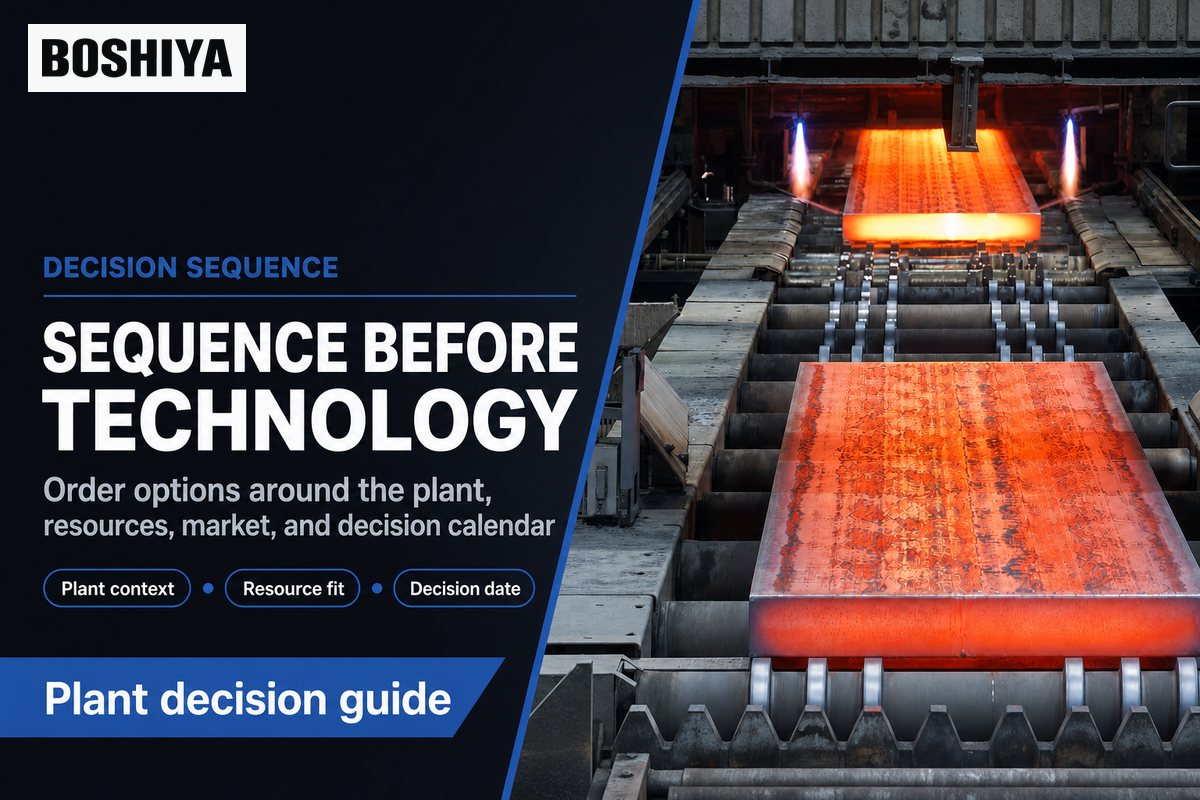
Steel decarbonization works only when technology options are ordered around the existing plant, resources, market, and decision calendar. Identical equipment can have a different result when electricity, ore, scrap, product mix, infrastructure, or reporting boundaries change. Plant teams therefore need a decision sequence before they need another route catalogue.
Research in the 2025 Nature plant-level study revealed different least-cost routes across plants and regions. OECD’s steel policy analysis introduces a second constraint: technology, resources, capital investment, markets, infrastructure, and the phase-out of emissions-intensive assets interact.
Technical routes can be available in principle yet unavailable to one site. That is why this article does not repeat the hydrogen, direct reduced iron, or electric arc furnace process explanations already covered in BOSHIYA’s specialist guides.
Translate Steel-Decarbonization Language Into Plant Decisions
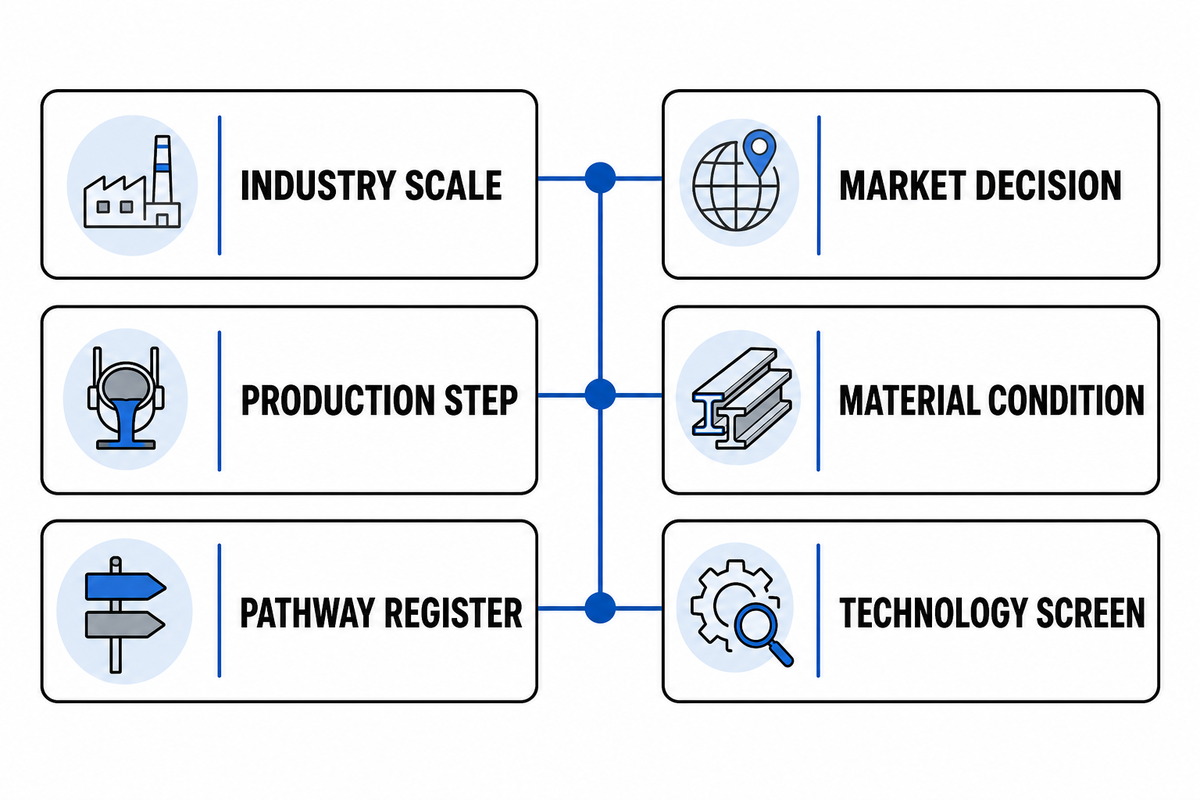
Industry language changes meaning with scale. The iron and steel industry includes different steel industries, production routes, products, and regions; the iron and steel sector in one inventory may not use the same boundary as the global steel industry. Likewise, global steel production and steel produced at one site are different evidence levels. Comparisons of steel globally, steel producing countries, or the United States steel sector can frame policy, but they cannot set a plant baseline. Every steel producer and steel mill still needs its own measured record.
Readers often search for steel decarbonization today, steel decarbonization companies, or green steel production. Those query labels do not define a project boundary. Lists of green steel companies and any green steel technology description still need plant, product, date, method, and verification evidence before they can support a steel industry decarbonization decision.
Market language also needs a named decision. Steel demand, demand for steel, global steel demand, and the steel market are outlook variables; they are not purchase orders. Demand for decarbonized steel needs a buyer, quantity, product grade, threshold, delivery date, and verification rule. Steel supply and suppliers of low-carbon steel need the same qualification. Product teams should distinguish steel products, structural steel, carbon steel, and other grades because the quality of steel can limit metallic inputs and process choices. Forecasts for new steel, future steel, the future of steel, steel use, and use of steel belong in scenario analysis rather than the measured baseline.
Production language should identify the asset and transformation step. Iron and steel production spans iron production, primary steel, steel making, iron and steel making, and downstream finishing. Integrated steel sites differ from an electric arc furnace operation, while steel manufacturing may include processing beyond the melt shop. Production processes, production methods, production capacity, and new production are therefore separate fields. Statements about how to make steel should name the route, feedstock, product, utilization, and boundary before they are used to rank steel technologies.
Material labels are equally conditional. Steel scrap and scrap steel require grade, residual-element limits, yield, source, and preparation evidence. Green iron and green iron and steel are commercial descriptions unless a method, denominator, threshold, and verifier are attached. Even low-carbon steel or decarbonized steel is not self-defining: the carbon intensity of steel changes with electricity, iron ore, metallic inputs, allocation, and product stage.
Pathway language should lead to a testable project register. A decarbonization pathway or a set of decarbonization pathways and policy recommendations may describe national direction; deep decarbonization and industrial decarbonization describe ambition, not an approved scope. Decarbonizing the steel industry, decarbonization of the iron production stage, decarbonizing the iron and steel value chain, and decarbonizing steel production can require different actions. Low-carbon production must be tied to measured emissions from steel and emissions from steel production. Incentives for decarbonization may support the decarbonization case, but they do not prove the result. This article uses “steel decarbonization”; “steel decarbonisation” is the same concept in UK spelling.
Technology labels remain inputs to screening. Green steel projects may combine efficiency, clean power, direct reduced iron, carbon management, or material measures. H2 green steel normally points to a hydrogen-linked route, yet green hydrogen depends on a defined hydrogen production method and electricity basis. For a major steel group, traditional steel assets and proposed new routes should use the same decision dictionary. The broader steel transition succeeds only when plant capability, actual operation, product claims, and commercial demand are evidenced separately.
Set the Emissions Baseline Before Ranking Projects
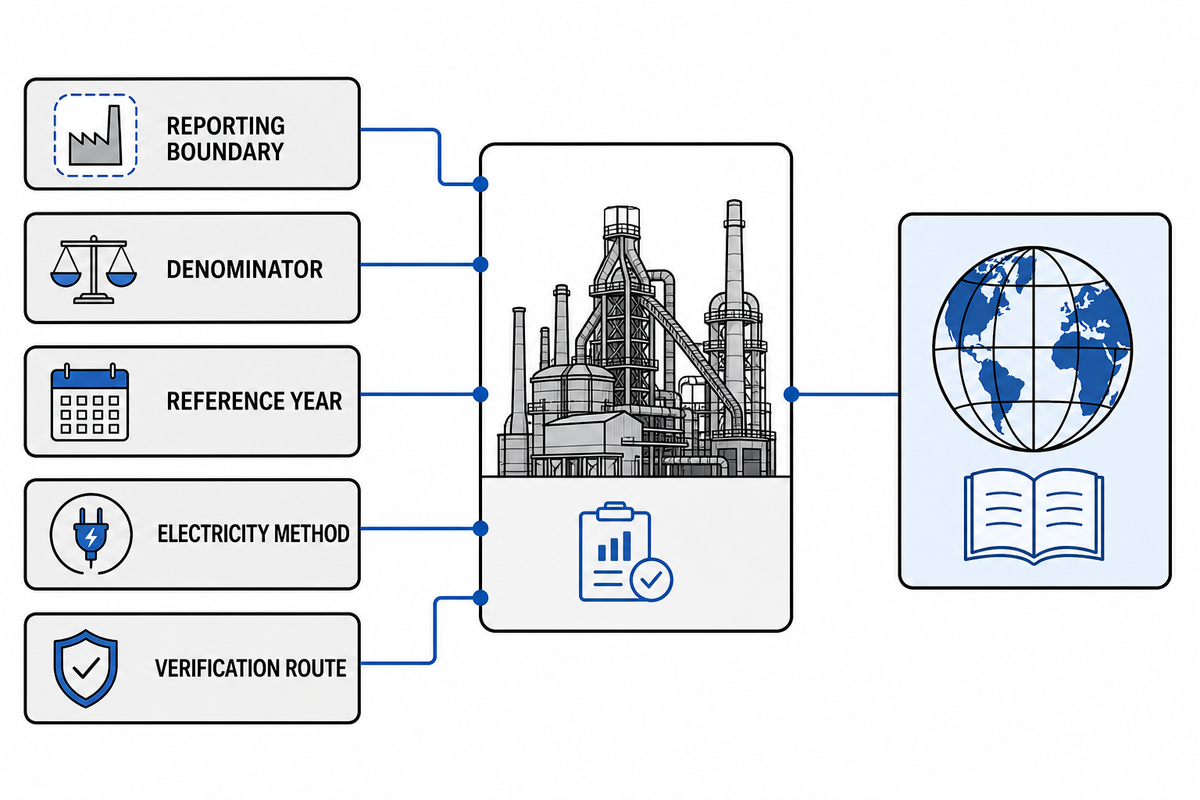
Decision-safe baselines state the reporting boundary, denominator, reference year, production mix, electricity method, metallic inputs, allocation method, and verification route. Without those fields, two carbon-intensity numbers or a steel carbon footprint may describe different products or stages. Industry averages provide context, but they cannot replace measured site data.
Worldsteel’s Sustainability Indicators Report 2025 lists a 2024 global weighted average of 2.18 tonnes CO2e per tonne of crude steel. Its definition covers Scope 1, Scope 2, and Scope 3 category 1 and scales BF-BOF, scrap-EAF, and DRI-EAF routes by their shares of global production. That makes the figure an industry indicator, not a BOSHIYA number or a plant baseline.
By contrast, the Steel Climate Standard uses tonnes CO2e per tonne of hot-rolled steel. Its fixed boundary includes relevant Scope 1, Scope 2, and Scope 3 emissions, scrap collection and processing, and hot rolling; it excludes purchased offsets from Scope 1 calculations and requires third-party verification. Crude steel and hot-rolled steel denominators cannot be silently compared.
How do you decarbonize steel without choosing technology too early?
Decarbonizing steel starts by measuring where emissions and material losses occur, then separating actions that work with today’s asset base from actions that require new power, feedstock, or infrastructure. The baseline should also distinguish plant emissions from product embodied emissions and trade-adjusted effects. Only then can a team compare abatement, cost, schedule, and verification on the same footing.
Boundary warning
A lower plant total doesn’t automatically prove a lower product footprint if production moved elsewhere, upstream metallic inputs changed, or the reporting denominator changed.
Use the Baseline-to-Bid 6-Step Roadmap
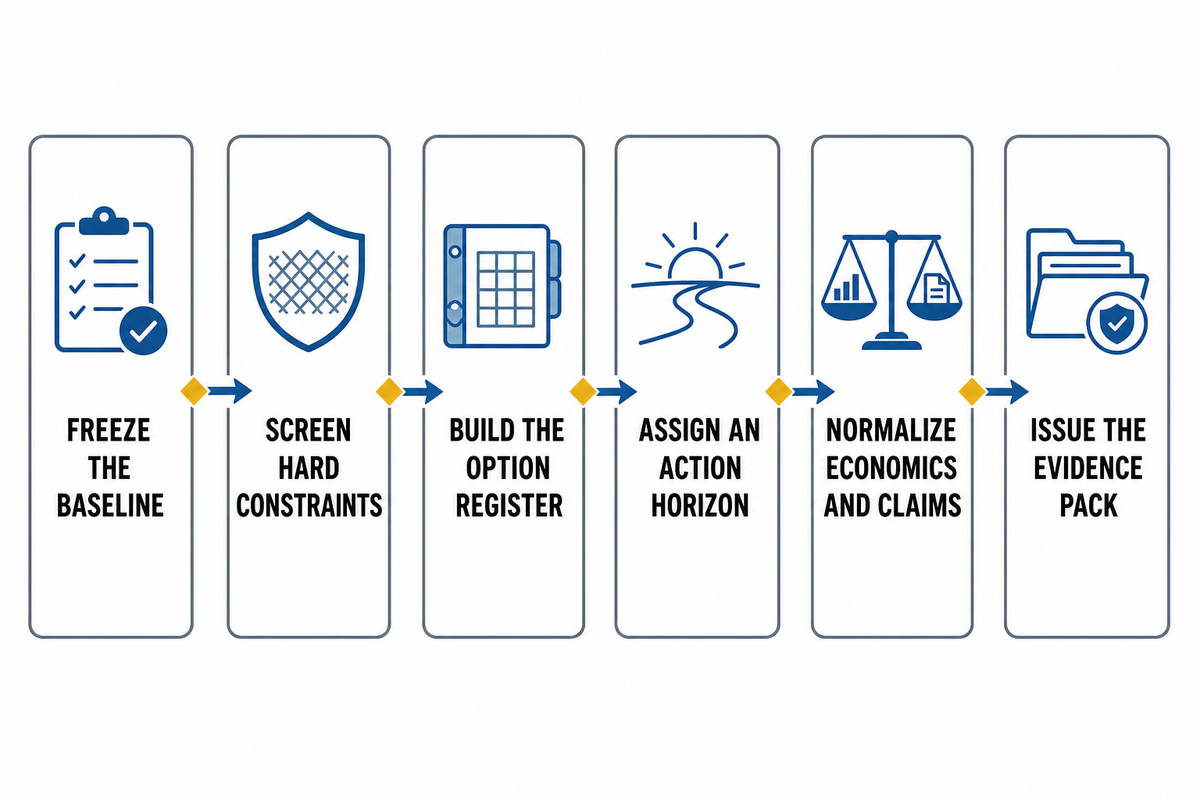
With the emissions boundary fixed, Baseline-to-Bid 6-Step Roadmap prevents a technology shortlist from becoming a premature request for quotation while carrying forward upstream inputs and the reporting denominator. Each step closes a different uncertainty: measurement, resource fit, action horizon, economic comparability, evidence quality, and governance. Projects should move forward only when their upstream assumptions are documented and owned.
- Freeze the baseline — record the boundary, denominator, reference year, route, production, energy and metallic inputs.
- Screen hard constraints — test power, scrap quality, ore, hydrogen, water, land, logistics, permits and carbon infrastructure.
- Build the option register — include efficiency, material demand, reuse, scrap, route changes, capture and market evidence without double counting.
- Assign an action horizon — separate no-regret, transitional and route-change projects by dependency and decision date.
- Normalize economics and claims — use one reference year, capacity basis, carbon boundary, procurement exposure and verification method.
- Issue the evidence pack — name the sponsor, data owner, verifier, change authority, risks, outcomes and missing information before engineering scope.
The 2025 deployment evidence separates equipment that is capable of near-zero operation from capacity that actually plans to operate that way. A project label is not an operating state.
This sequence does not say every mill must follow the same route. It says every mill should close the same classes of uncertainty before committing capital.
Split Options Into No-Regret, Transitional, and Route-Change Actions
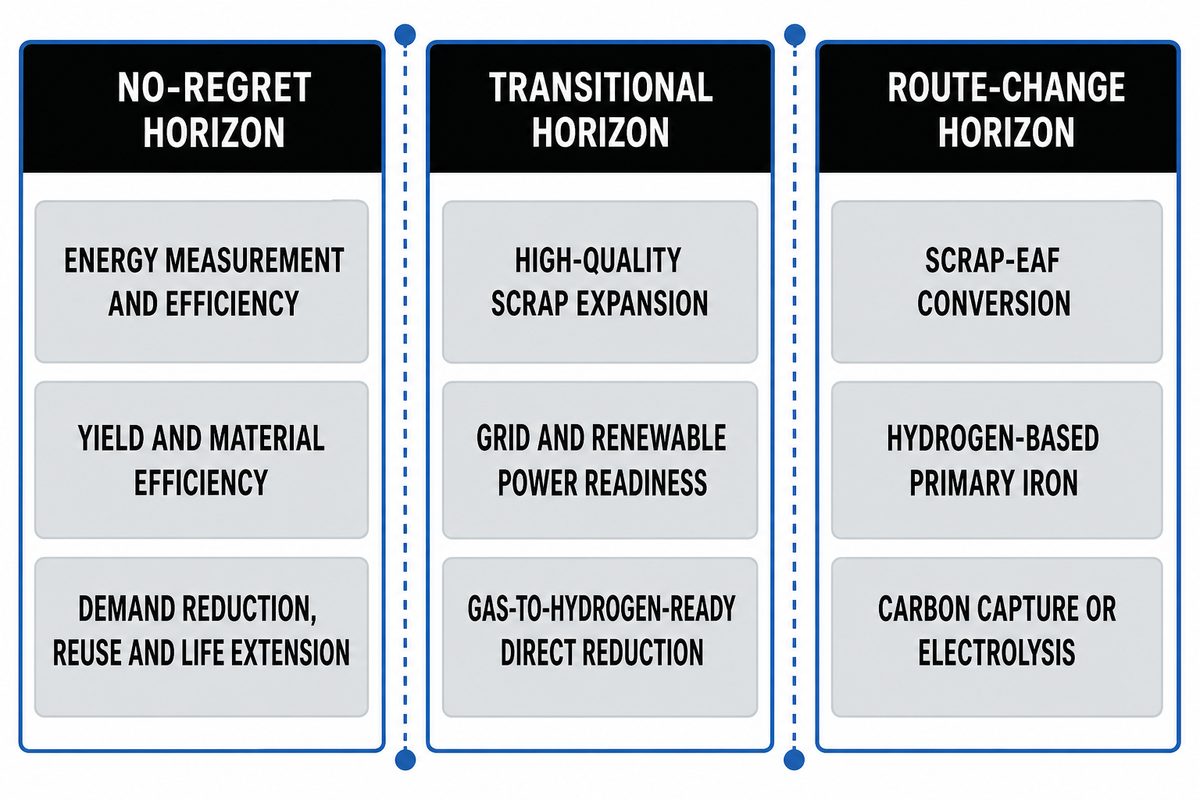
After the roadmap assigns uncertainties to owners, Three-Horizon Abatement Sequence Matrix exposes the dependency that can stop each action. No-regret actions use today’s asset base, transitional actions prepare or bridge infrastructure, and route-change actions alter primary iron or steel production. Demand reduction and product-life extension sit beside plant measures because they can reduce the new capacity required.
| Horizon | Action | Decision evidence | Hidden dependency | Limitations / not suitable for |
|---|---|---|---|---|
| No-regret | Energy measurement and efficiency | Metered loss map and verified baseline | Instrumentation and shutdown access | Does not remove deep process emissions |
| No-regret | Yield and material efficiency | Mass balance, rejects and product mix | Quality and customer specifications | Cannot be claimed from production volume alone |
| No-regret | Demand reduction, reuse and life extension | Design and procurement demand case | Downstream buyer participation | Not controlled by the mill alone |
| Transitional | High-quality scrap expansion | Low-residual supply and sorting plan | Product-grade residual limits | Aggregate scrap tonnage is insufficient |
| Transitional | Grid and renewable power readiness | Connection capacity and hourly profile | Network timing and electricity basis | A certificate alone may not solve physical capacity |
| Transitional | Gas-to-hydrogen-ready direct reduction | Fuel timeline, ore and offtake evidence | Hydrogen cost and infrastructure | Can lock in gas without a dated transition |
| Route change | Scrap-EAF conversion | Metallic charge, power and grade case | Upstream metallic and grid emissions | EAF is not automatically low carbon |
| Route change | Hydrogen-based primary iron | Ore, power, water, hydrogen and product case | Binding offtake and finance | Not a near-term universal solution |
| Route change | Carbon capture or electrolysis | Capture chain or technology-readiness case | Transport/storage or commercialization | Model results vary by region and date |
U.S. pathway research shows why demand-side measures belong in this matrix: lower demand can reduce the carbon-capture and hydrogen production required. This table is a planning aid, not a published standard.
Screen the Asset Base Against Power, Scrap, Ore, Hydrogen, and Carbon Infrastructure
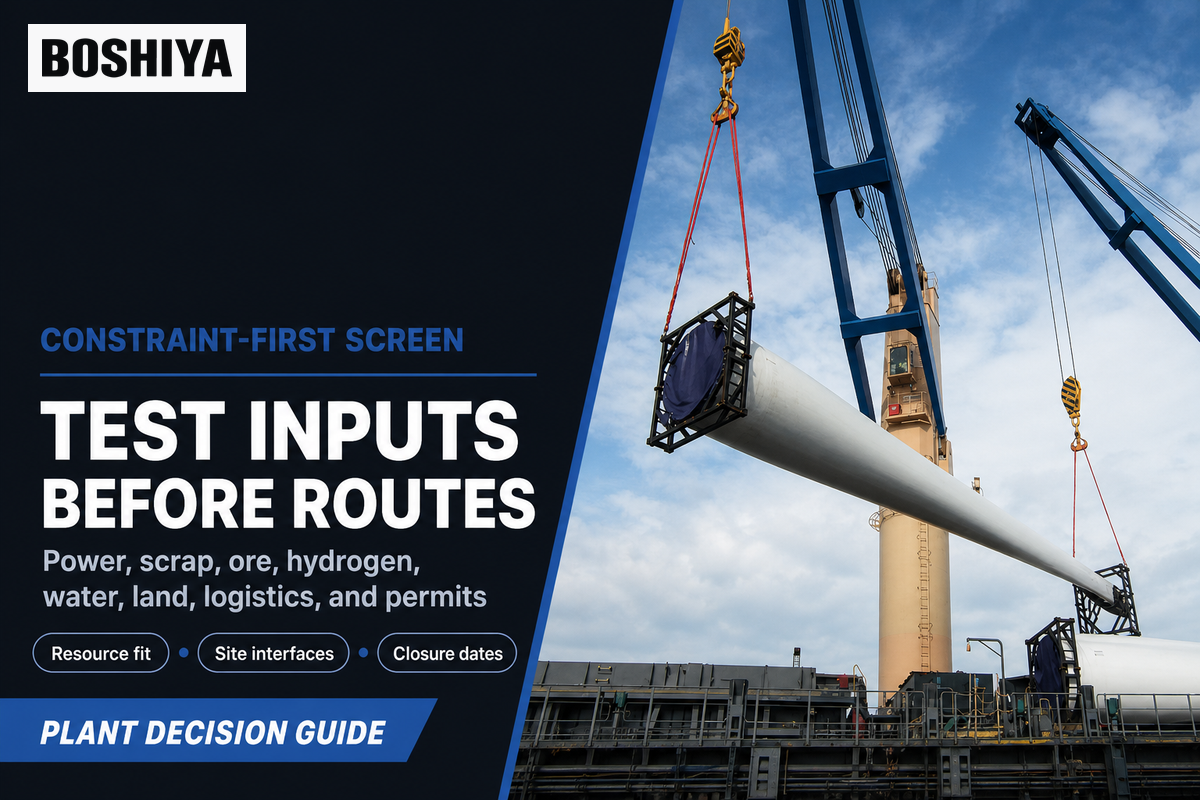
Constraint screens should eliminate impossible pathways before detailed engineering starts. Check power capacity and carbon basis, low-residual scrap and sorting, ore suitability, hydrogen supply, water and land, gas and carbon networks, logistics, product grades, permits, and construction windows. Missing dependencies become dated evidence requests, not optimistic assumptions.
What are the disadvantages of steel decarbonization projects?
Steel projects can be delayed by high capital demand, uncertain energy or hydrogen prices, inadequate grid capacity, scarce low-residual scrap, ore constraints, unproven capture chains, permit lead time, and weak offtake. Brownfield projects add shutdown, layout, tie-in, and product-mix constraints. The main disadvantage is not one technology; it is committing before the dependency chain is verified.
UK government’s Steel Strategy treats high-quality low-residual scrap as a separate constraint from total scrap supply and calls for recycling-process upgrades. This is a UK planning example, not a global scrap forecast.
For process detail, use BOSHIYA’s guides to hydrogen-ready H2-DRI-EAF plant decisions, the BF-BOF and EAF route comparison, the direct reduced iron process, and electric arc furnace steelmaking. This roadmap only screens when those routes merit deeper study.
Compare Projects on the Same Economic Boundary
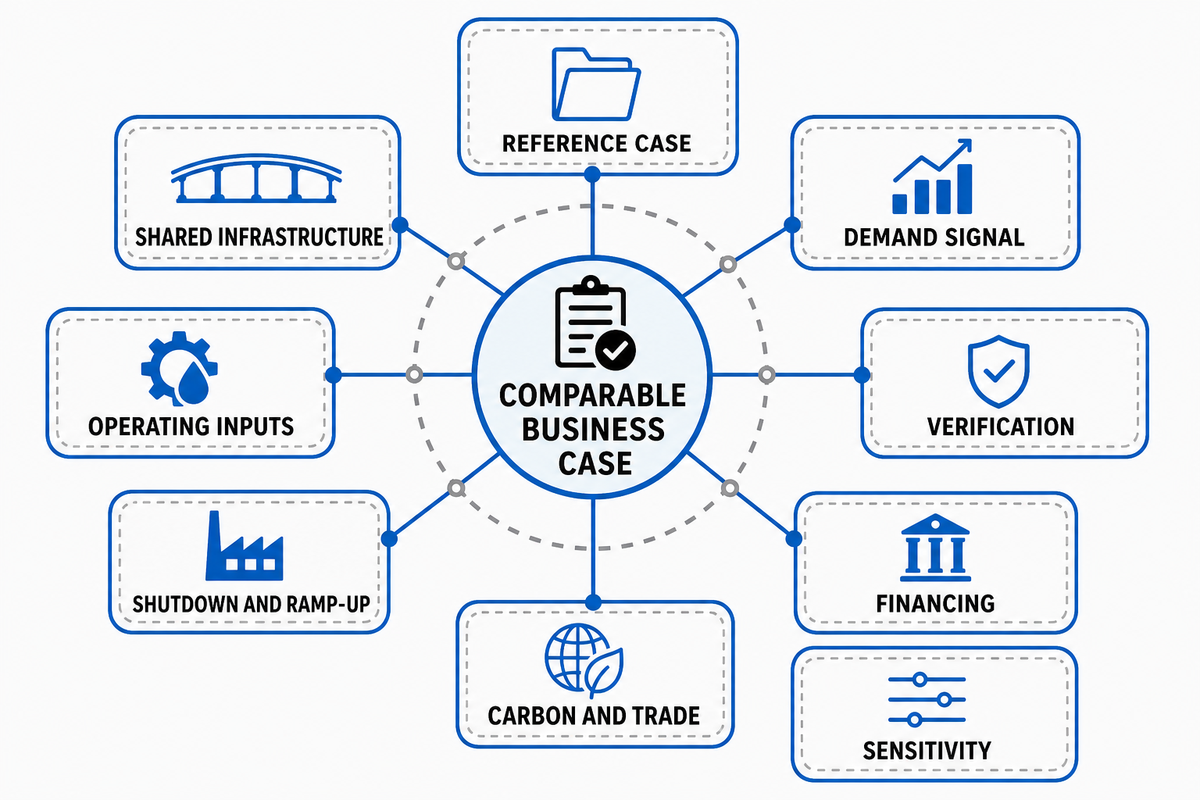
Once route constraints have been screened, finance can compare projects only when every option uses the same capacity basis, reference year, utilization, infrastructure boundary, energy and feedstock assumptions, shutdown treatment, carbon exposure, procurement signal, product premium, offtake, financing, and verification cost. A green steel cost comparison or headline capital number without those fields is not a comparable business case.
| Input | Evidence to freeze | Finance question |
|---|---|---|
| Reference case | Year, route, capacity, utilization | What is the counterfactual? |
| Shared infrastructure | Grid, hydrogen, water, storage, logistics | Who pays and when? |
| Operating inputs | Energy, ore, scrap, consumables | Which price and quality cases? |
| Shutdown and ramp-up | Tie-in, outage, learning curve | What production is at risk? |
| Carbon and trade | Boundary, price, CBAM exposure | Which market-access cost applies? |
| Demand signal | Tender threshold, offtake, premium | Is the revenue contracted? |
| Verification | Standard version, auditor, frequency | What evidence cost persists? |
| Financing | Capital structure, incentives, covenants | What conditions gate close? |
| Sensitivity | Power, feedstock, carbon, volume | Which variable reverses the decision? |
Berkeley Lab’s Buy Clean study explains that tightening embodied-carbon procurement thresholds can create financial incentives and de-risk plant investment, while procurement alone cannot decarbonize every plant.
European Commission states that the CBAM definitive regime applies from 1 January 2026 and covers iron and steel. This is market-access context, not legal advice for a particular shipment.
Make Low-Emission Steel Claims Auditable
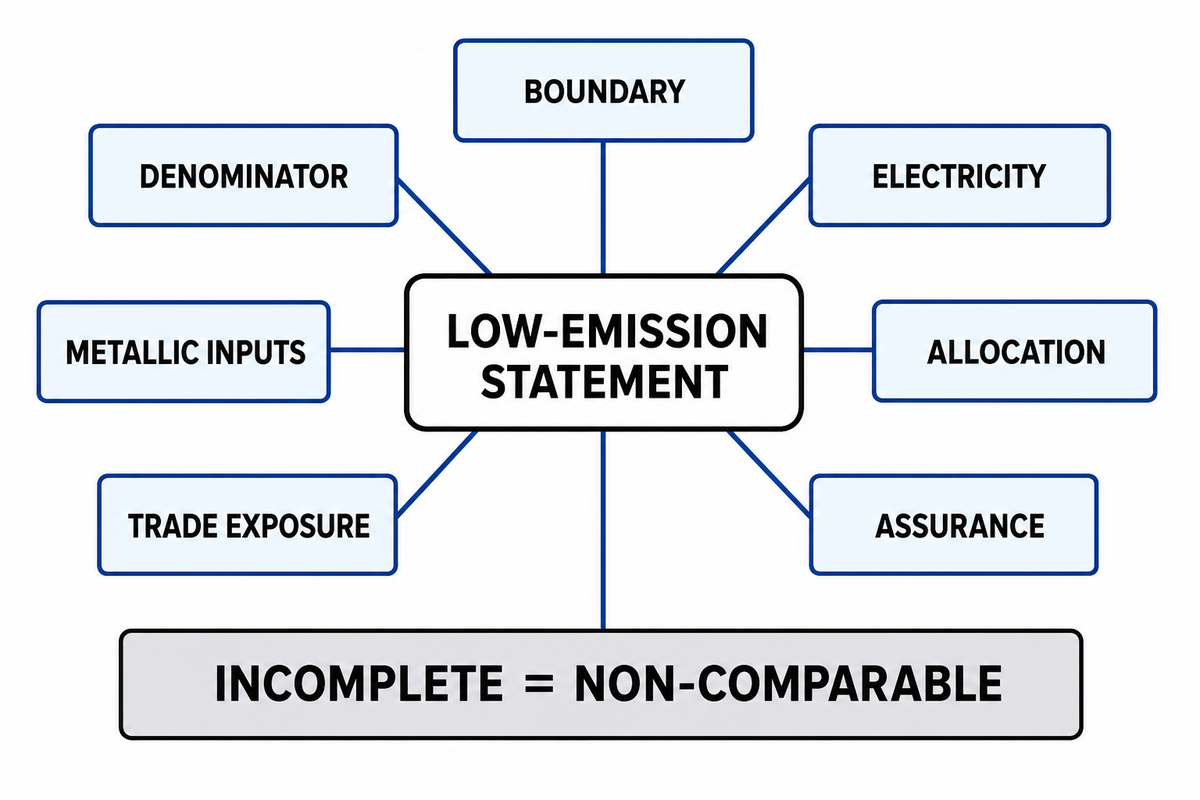
After projects share one economic boundary, Claim-to-Evidence Boundary Card tests whether a low-emission statement can survive procurement and assurance review. Each claim must identify the standard version, boundary, denominator, electricity method, metallic inputs, allocation, embedded-emissions treatment, baseline, verification body, and validity period. Missing fields do not make the claim false; they make it non-comparable.
| Field | Acceptable evidence | Failure signal |
|---|---|---|
| Boundary | Named standard and included stages | Scope stated only as low carbon |
| Denominator | Crude, hot-rolled, or finished product unit | Ton of steel without product stage |
| Electricity | Method, period, factor, instruments | Renewable claim without accounting basis |
| Metallic inputs | Scrap, DRI, pig iron and upstream basis | EAF treated as automatic outcome |
| Allocation | Documented product and co-product rule | Best product receives all savings |
| Trade exposure | Embedded-emissions declaration and market rule | Plant reduction assumed global |
| Assurance | Independent verifier and valid period | Self-declared number with no method |
ResponsibleSteel’s revision page shows why version control matters: first public consultation was planned for Q3 2026, Version 3.0 publication for Q3 2027, and full effect for Q3 2028. Its timeline is explicitly subject to change.
Build the Decarbonization Evidence Pack for Project Definition
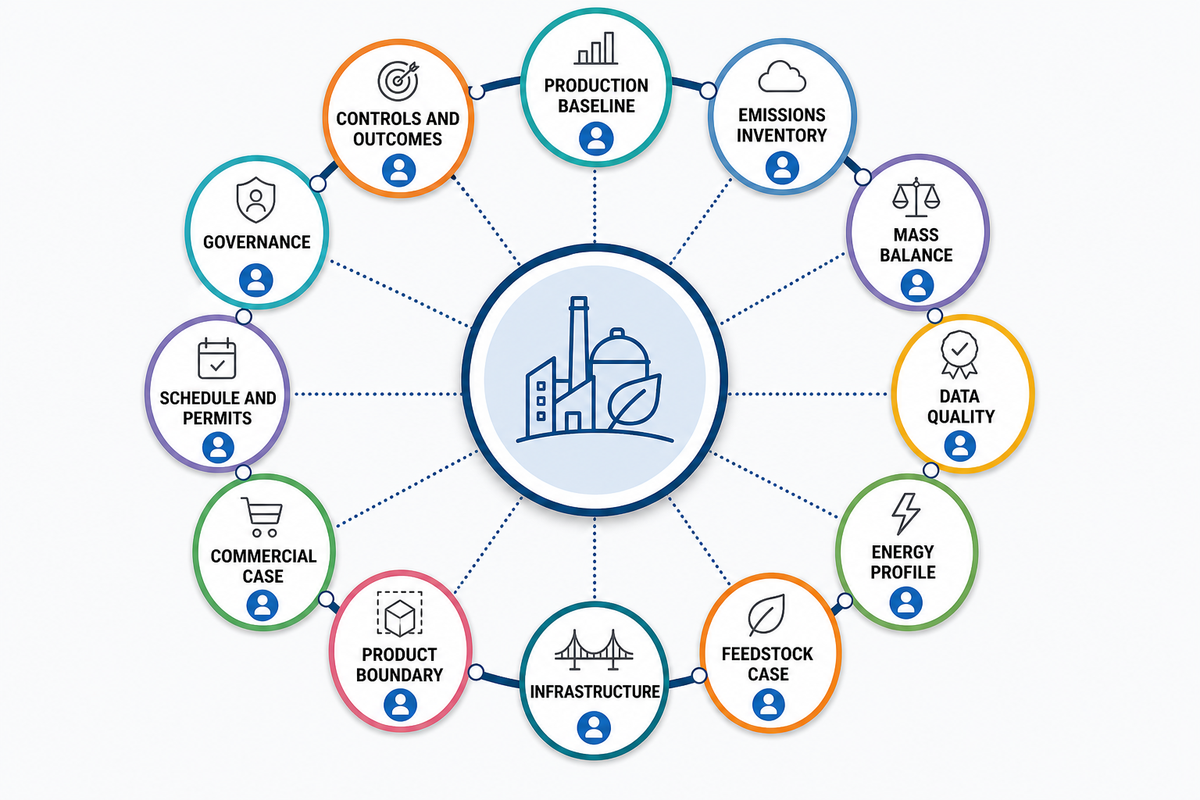
Decarbonization Evidence Pack is the minimum shared record before a steel manufacturing plant asks engineering, finance, quality, or procurement to approve scope. It combines steel-specific measured inputs with greenhouse-gas project controls and project governance. The pack does not replace a feasibility study; it shows whether one can start without filling gaps with assumptions.
| Data type | Example unit formats | Decision use |
|---|---|---|
| Capacity | 1 t/yr; 1 t/h; 1% | Annual basis, line rate, and utilization |
| Electricity | 1 kWh; 1 kW; 1 MW | Energy, demand, and connection capacity |
| Fuel and solids | 1 kg/h; 1 kg; 1 ton | Flow, batch quantity, and delivered mass |
| Water and gas | 1 m³; 1 bar; 1 MPa | Consumption, delivery pressure, and equipment basis |
| Site and layout | 1 m²; 1 m; 1 mm | Plot area, routing distance, and interface tolerance |
| Programme | 1 year; 1 month; 1 day | Development, procurement, and outage windows |
| Operating time | 1 hr; 1 min; 1 sec | Run time, sampling interval, and control response |
| Electrical interface | 1 Hz; 1 V; 1 A | Supply frequency, voltage, and current basis |
| System context | 1 EJ; 1 GW; 1 MW | National scenario, regional system, and plant connection |
Replace every demonstration value with a sourced plant value or leave the field visibly open. If a capacity field changes from the demonstrated 1 t/yr format, record the conversion method. Do not treat a unit-formatted placeholder as an engineering assumption.
| Record | Minimum content | Owner / check |
|---|---|---|
| Production baseline | Route, unit, annual production, utilization, product mix | Plant data owner |
| Emissions inventory | Unit CO2e, sources, boundary, reference year | GHG lead |
| Mass balance | Fuel, iron, scrap, flux, carbon, ore, electrodes, products | Process engineer |
| Data quality | Meter method, provenance, missing-data treatment | Quality / verifier |
| Energy profile | Power, fuel, hourly load, connection capacity | Utilities owner |
| Feedstock case | Ore grade, scrap residuals, sorting, hydrogen specification | Metallurgy / procurement |
| Infrastructure | Water, land, logistics, gas, carbon transport/storage | Site engineering |
| Product boundary | Grades, quality limits, allocation, customer acceptance | Technical sales / quality |
| Commercial case | Reference cost, offtake, procurement threshold, incentives | Finance |
| Schedule and permits | Shutdown, tie-in, decision dates, approvals | Project manager |
| Governance | Sponsor, decision owner, verifier, change authority | Steering group |
| Controls and outcomes | Risks, issues, changes, benefits, outcomes, information plan | Project assurance |
As a U.S. reporting reference, 40 CFR 98.176 supplies steel-specific reporting inputs, while ISO 14064-2:2019 adds baseline, monitoring, quantification, reporting, and data quality. ISO 21505 and ISO’s project-management summary add ownership, risk, change, benefits, outcomes, information, and oversight.
When the pack is complete, pass the commercial plant definition to BOSHIYA’s steel and metal plants team. BOSHIYA is the engineering and equipment handoff in this article; no hydrogen, DRI, electrolysis, carbon-capture, or furnace-core intellectual property is attributed to BOSHIYA.
What Changes the Sequence Through 2030
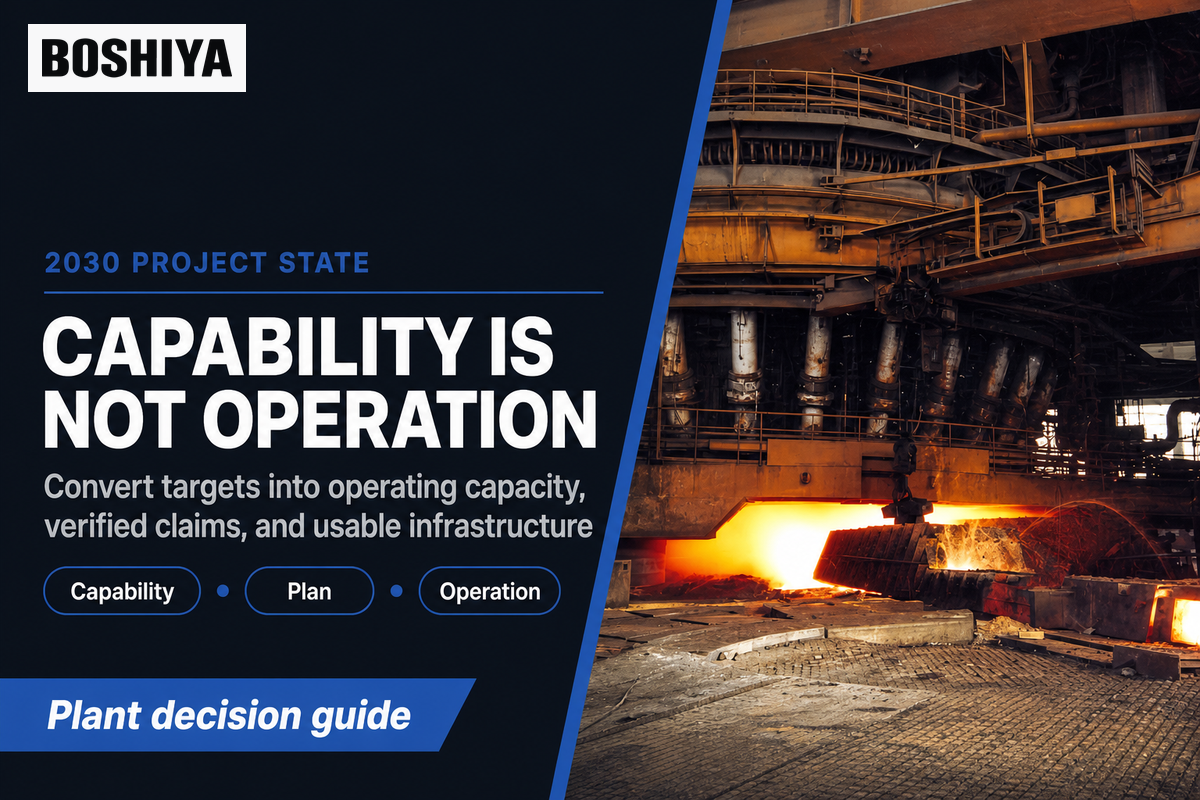
Through 2030, the decisive change is not a new technology list; it is the conversion of targets into operating capacity, procurement thresholds, binding offtake, verified claims, and usable infrastructure. Plant teams should revisit the roadmap when a standard version, trade rule, grid date, hydrogen contract, scrap-quality plan, or customer threshold changes.
IEA’s 2025 steel assessment reported about 10 Mt of near-zero-emissions iron capacity planned for 2030 and just over 80 Mt of near-zero-capable capacity. Only 25 Mt of the capable capacity planned near-zero operation by 2030, and those projects were early stage. Capability, plan, and operation are different project states.
Demand-side decisions also move the sequence. The U.S. pathway research identifies material demand reduction and embodied emissions in steel trade as material, while Buy Clean thresholds can reward verified lower-emission products. The EU CBAM definitive regime has applied since 1 January 2026, so embedded-emissions evidence can affect market access before a major route conversion is finished.
Use dated checkpoints. ResponsibleSteel’s public timeline targeted Q3 2026 consultation, Q3 2027 Version 3.0 publication, and Q3 2028 full effect, but the organisation says those dates may change. A project brief should record the version it uses and a trigger for reassessment.
Key takeaway
A steel decarbonization project is ready for bid only when its baseline, hidden dependencies, common economic boundary, evidence version, and decision owners can be checked by someone outside the project team.
Frequently Asked Questions
What is steel decarbonization?
Steel decarbonization reduces greenhouse-gas emissions across plant operations, energy, materials, products, and supply chains while preserving product performance and making the reporting boundary, denominator, and verification method explicit.
It includes efficiency, material demand and reuse, scrap and electric production, lower-emission primary iron, capture, clean power, and auditable product claims. The right combination depends on the plant’s asset base, feedstock, product grades, infrastructure, market, and reporting boundary. It also depends on whether the objective is a plant inventory, a product footprint, or a trade-adjusted result. Technology names alone do not prove a lower-emission outcome.
Why is steel hard to decarbonize?
Steel combines process emissions, high-temperature energy, long-lived assets, product-quality limits, and infrastructure dependencies because route changes must keep production, metallurgy, quality, and delivery stable during a long capital transition.
Deep change can require new electricity, hydrogen, ore or scrap systems, carbon transport and storage, water, land, permits, and binding offtake. Existing mills must also protect production, metallurgy, customer qualifications, and delivery schedules during tie-ins and ramp-up. Demand-side material efficiency may reduce capacity needs, while procurement and trade rules can change the business case. These constraints vary by site, product, region, and time, so a global pathway average cannot substitute for a plant feasibility study.
Does an electric arc furnace always mean low-carbon steel?
An electric arc furnace is a production platform, not an automatic low-carbon result; its outcome depends on electricity, metallic inputs, yield, product stage, and the accounting boundary.
Its carbon intensity depends on electricity, scrap and other metallic inputs, upstream direct reduced iron or pig iron, process yield, and the accounting boundary. A buyer should ask for the electricity method, charge mix, product denominator, allocation rule, reference period, and verification method rather than accepting the furnace label alone.
How should a steel plant measure carbon intensity?
A steel plant should use a named boundary, denominator, period, electricity method, metallic inputs, allocation rule, and verification process so different plant and product figures remain comparable and auditable.
Plant records should preserve annual production by unit, fuels, electricity, iron, scrap, flux, carbonaceous materials, ore, electrodes, products, by-products, measurement provenance, and missing-data procedures. The team must record the standard version and whether the denominator is crude steel, hot-rolled steel, or a finished product. Plant operating emissions should stay separate from product embodied emissions and trade-adjusted outcomes. Allocation and electricity methods need named owners, and independent assurance should match the claim being made. Different frameworks can be valid while remaining non-equivalent.
Which steel decarbonization projects should an existing plant start first?
Start with projects supported by measured losses, available inputs, short dependency chains, and a clear effect on the chosen boundary rather than the most fashionable or capital-intensive technology label.
Energy and material efficiency, yield, demand-side material reduction, reuse, and verified scrap opportunities often deserve early screening. They do not replace deeper route change, but they can improve the baseline and reveal whether future power, hydrogen, capture, or metallic-input infrastructure is worth developing.
What belongs in a steel decarbonization project brief?
The brief needs plant data, emissions and mass balance, energy, feedstock, infrastructure, product, commercial, schedule, governance, and verification records with named owners, dates, sources, and closure actions for every gap.
It should name the baseline, reference year, production mix, grid and fuel assumptions, ore and low-residual scrap quality, water and land, logistics, permits, shutdown and tie-in plan, product-grade constraints, procurement threshold or offtake signal, and financing boundary. Governance fields should identify the sponsor, decision owner, data owner, verifier, and change authority. Project controls should list risks, issues, missing data, change decisions, expected benefits, measurable outcomes, and the information-retention plan. Each assumption needs a source or a named closure action. Missing items should remain visible rather than being filled with generic assumptions.
How often should the roadmap be reviewed?
Review the roadmap at each investment gate and whenever a controlling assumption changes, including power, feedstock, market rules, standards, permits, offtake, or plant shutdown timing.
A fixed annual review is useful, but it is not enough for a live capital programme. Reopen the relevant decision when grid capacity, power carbon factors, hydrogen or scrap supply, ore quality, product mix, customer thresholds, trade rules, verification standards, permitting dates, or shutdown windows change. Record the trigger, previous assumption, new evidence, owner, affected projects, and decision date. A change may reorder the action horizon without invalidating the whole plan. For example, a delayed connection date can move an electrification package behind efficiency or material measures, while a binding offtake can accelerate verification work. The purpose of review is to preserve the logic between evidence and sequence, not to keep an old route ranking unchanged.
Turn the roadmap into a plant brief
Bring your production route, energy profile, feedstock, product mix, site constraints, target markets, and verification needs. Use that evidence to frame an engineering and equipment discussion with BOSHIYA.
How This Roadmap Was Built
The BOSHIYA roadmap analysis combines current public steel-pathway research, emissions-accounting standards, government trade and reporting rules, and BOSHIYA’s live content boundaries. It does not use private plant data, infer confidential performance, or claim that BOSHIYA owns the decarbonization technologies discussed.
References & Sources
- Technological Pathways for Cost-Effective Steel Decarbonization — Nature
- Breakthrough Agenda Report 2025: Steel — International Energy Agency
- Addressing Steel Decarbonisation Challenges — OECD
- The Steel Climate Standard — Global Steel Climate Council
- Sustainability Indicators Report 2025 — World Steel Association
- The Role of the Iron and Steel Sector in U.S. Net Zero — Energy and Climate Change
- Maximizing the Benefits of Buy Clean Policies — Lawrence Berkeley National Laboratory
- The UK Steel Strategy — UK Government
- CBAM Definitive Regime — European Commission
- 40 CFR 98.176 — Electronic Code of Federal Regulations
- ISO 14064-2:2019 — International Organization for Standardization
- ISO 21505:2017 — International Organization for Standardization
- ResponsibleSteel Standard Revision — ResponsibleSteel
![Polypropylene Resin: Grades, Types & Selection Guide [2026]](https://boshiya.com/wp-content/uploads/2026/05/0-150x150.webp)