BOSHIYAと連絡を取りましょう


Naphtha cracking transforms a liquid hydrocarbon mixture into ethylene, propylene, and other chemical building blocks. For a useful comparison, trace the feed all the way to the recovered products: its composition changes the product slate, and the value of that slate may be more important than the ethylene percentage.
内容
ショー
Process at a glance
- Feed: a mixed petroleum fraction characterized by composition and boiling behavior.
- Main route: thermal steam cracking, followed by product recovery.
- Main products: light olefins, with C4 streams, pyrolysis gasoline and fuel gases.
- Comparison basis: net recovered products per tonne of fresh feed, with coproduct credits counted once.
The transformation of hydrocarbon to ethylene always requires a trade-off. With an increase in ethylene yield, costs of conversion increase or value coproducts decline. The example below puts both effects in the same account; the feed checklist then connects a proposed saving to the equipment that can realize the saving.
Naphtha cracking uses heat and dilution steam to convert mixed hydrocarbons into lighter products. Feed composition, reaction conditions and recovery determine the saleable slate. Compare its total value on a common fresh-feed basis.
Key takeaways
- A blend’s product yield can depart from a weighted average of its separate feeds.
- Dry furnace-effluent yield and recovered saleable-product yield describe different boundaries.
- Mixed C4 and its contained butadiene are alternative accounting boundaries, not two independent sales.
- A feed change affects the recovery train as well as the furnace.
What Is Naphtha Cracking?
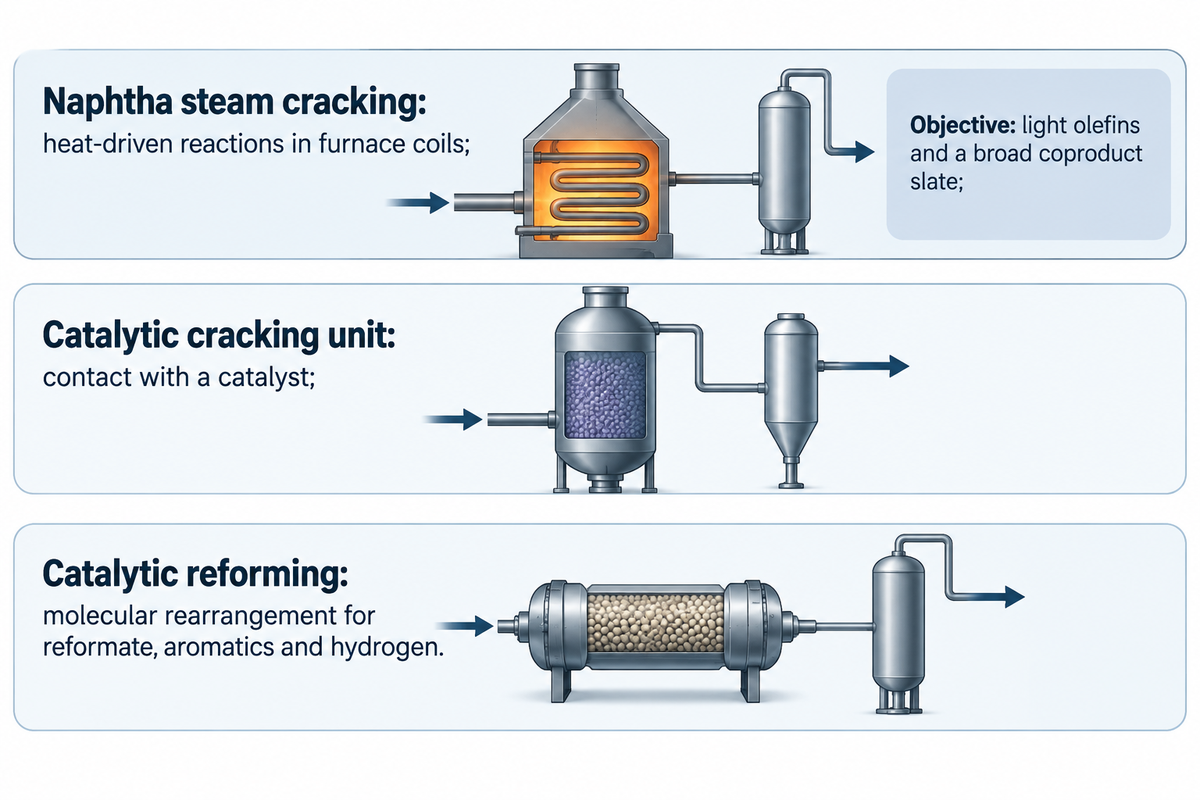
The conventional naphtha cracking process uses a thermal cracking process for producing light olefins from a mixed liquid feed. Hydrocarbon molecules break into smaller molecules in heated tubes in the presence of steam. The gases and liquids produced must be cooled and processed before sale.
In the cracking of hydrocarbons in the furnace, the partial pressure of hydrocarbon is lowered by dilution steam; it isn’t a catalyst or the principal carbon source for the products as described in the naphtha-cracking study by Ren and colleagues.
| ルート | What drives conversion? | Product objective |
|---|---|---|
| Naphtha steam cracking | Heat-driven reactions in furnace coils | Light olefins and a broad coproduct slate |
| Catalytic cracking unit | Contact with a catalyst, with refinery gas oil among the possible feeds | Refinery fuels or olefins, according to the process |
| Catalytic reforming of naphtha | Catalytic molecular rearrangement and related reactions | High-octane reformate, aromatics and hydrogen |
Catalytic cracking and steam cracking require separate equipment scopes in a project specification. Regenerating the catalyst is associated with relevant catalytic systems, such as FCC; it isn’t the same as removing coke from a thermal cracking coil.
For the refinery branch of the subject, see thermal cracking in refinery service. Cracking hydrocarbon oils can serve different fuel and chemical functions, and the product slate is determined by the naphtha feed stream.
How Naphtha Composition Changes the Product Slate
The cracking of naphtha in the laboratory study by Karaba and colleagues gave 24.1 wt.% ethylene from the light sample and 13.6 wt.% from the heavy sample at 810 °C. Their results highlight the importance of feed composition: a boiling-range cut describes a fraction, and the constituents of that cut will determine reaction pathways.
の The 2020 experiment on mixed and separate processing found nonlinear blend behavior. Both ethylene and propylene yields fell as the heavy sample’s share increased; “heavier feed means more propylene” would have given the wrong answer for these particular samples.
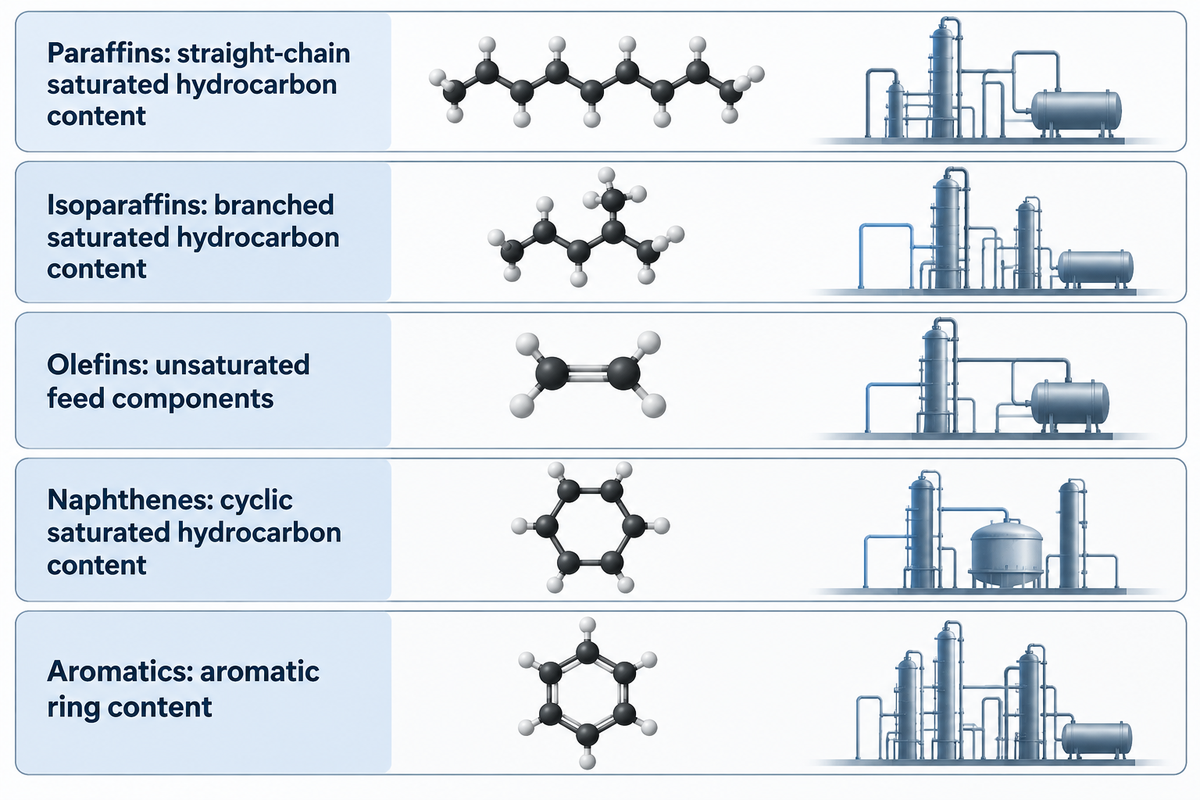
| Assay group | What the result adds | Why a light/heavy label misses it |
|---|---|---|
| Paraffins | Straight-chain saturated hydrocarbon content | Feeds with similar boiling ranges can contain different molecular families |
| Isoparaffins | Branched saturated hydrocarbon content | Branching changes the available reaction pathways |
| オレフィン | Unsaturated feed components | Feed origin and previous processing change unsaturation |
| Naphthenes | Cyclic saturated hydrocarbon content | Ring structure differs from an open-chain molecule |
| アロマティクス | Aromatic ring content | Carbon distribution among rings and chains affects the product slate |
PIONA describes paraffins, isoparaffins, olefins, naphthenes, and aromatics. Boiling point distillation gives the boiling point distribution, and feed density and molecular weight add further characterization. Ren’s model predicts product distribution based on bulk properties of the feed and reaction conditions.
Hypothetical buying scenario: the cheaper heavy cut
A buyer receives a lower-priced heavy naphtha offer and assumes that extra propylene will offset the lower ethylene yield. The laboratory team compares the offered assay with the current feed and finds a different aromatic fraction and distillation tail, so the process engineer evaluates the proposed blend rather than averaging two catalog yields.
Finance keeps the offered price in the calculation but waits for the corresponding recovered product quantities. This changes the purchasing question from “Which cut is cheaper?” to “Which qualified feed produces the better net product account in this unit?” The laboratory blend study explains why that extra step matters: even a light naphtha stream can interact with the heavy component rather than behave as an independent fraction.
From Liquid Feed to Separated Products
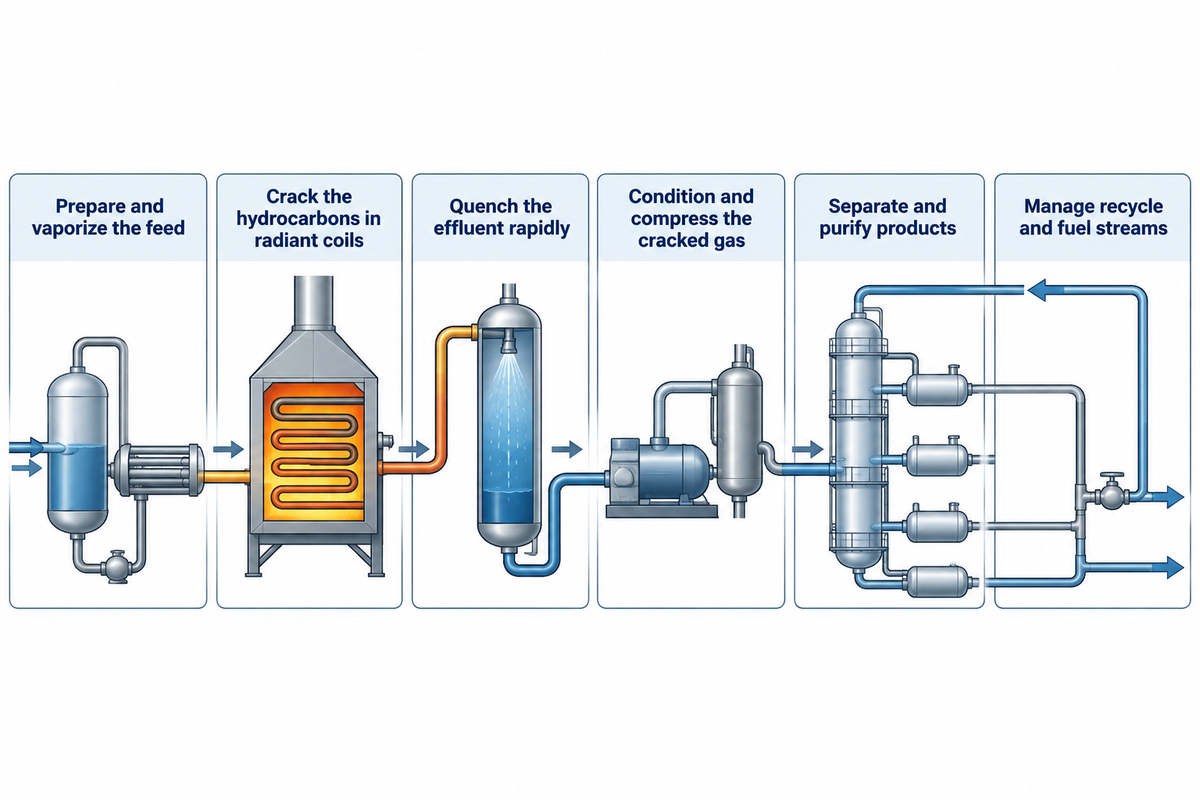
A naphtha cracker converts liquid feed in the furnace. Hot effluent is then converted to individual product streams through quenching, condensation and separation. The process integration diagram links the various processes of a petrochemical plant from reaction to product. The composition of the product from the furnace represents only a small part of the entire plant account.
- Prepare and vaporize the feed. The liquid feed and dilution steam enter a thermal environment suited to the accepted feed envelope.
- Crack the hydrocarbons. Heat supplies the energy for endothermic reactions and light olefin production in the radiant coils.
- Quench the effluent. Rapid cooling limits continued reactions after the intended cracking zone.
- Condition and compress the cracked gas. Cooling and treatment prepare it for the recovery system.
- Separate and purify products. The recovery train uses more than one separation unit to produce individual light-gas, olefin and liquid streams.
- Manage recycle and fuel streams. Internal recycle stays separate from net products leaving the plant boundary.
What is a naphtha cracking unit?
A naphtha cracking unit describes the process system for the conversion of naphtha to lighter hydrocarbons, typically in a steam cracking unit. Within the scope of a project, the term may encompass the furnace alone, or a larger system with recovery equipment. The equipment list and battery limits define the scope of what’s included in the unit quoted.
Acetylene treatment illustrates the boundary: acetylene can occur in cracked gas, but the recovered ethylene must meet its product specification. Catalytic treatment downstream is compatible with a thermal furnace reaction upstream.
の The Steam-cracking process Overview provides the broader plant sequence. For a naphtha project, the additional questions are how the variable liquid feed vaporizes, what liquid coproduct it produces, and what recovery equipment is used to remove that coproduct.
Products and Yields: Read the Basis Before the Percentage
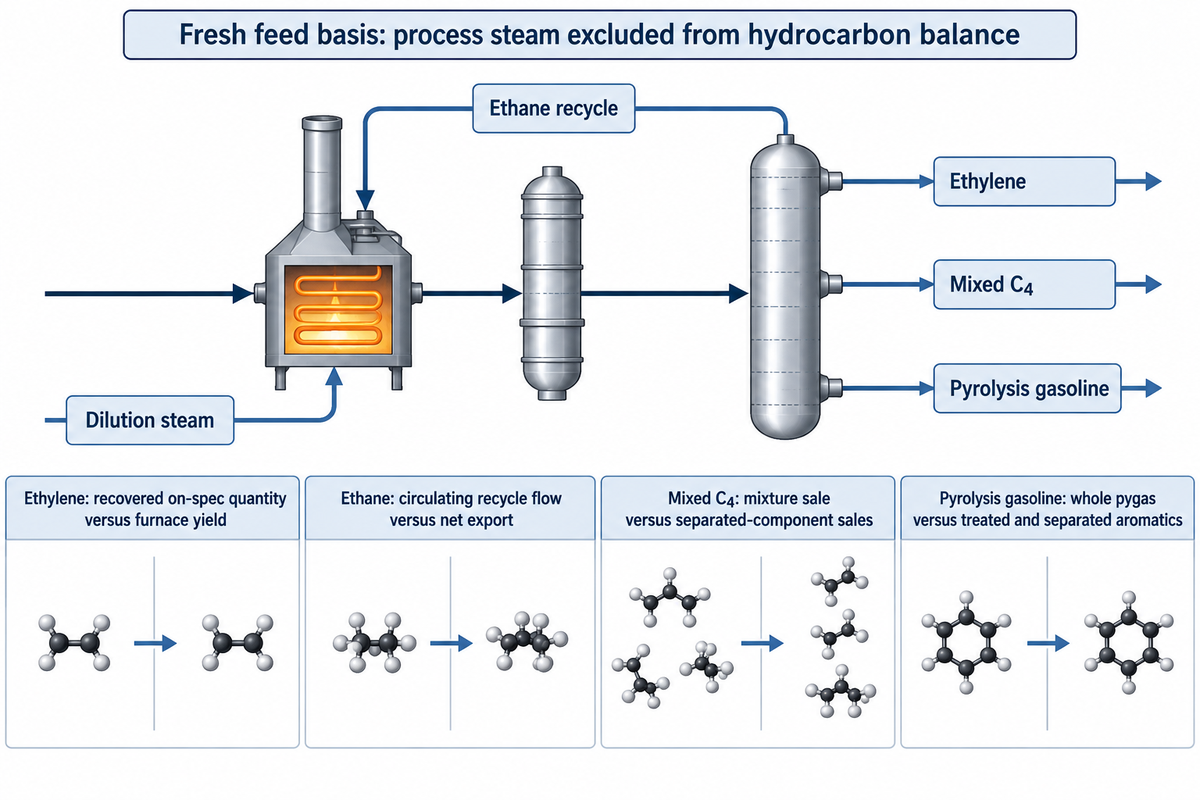
The yield of ethylene and other naphtha cracking products provides a clear attribution of each product quantity to a specified feed quantity and process boundary. A commercial comparison uses net recovered products per mass of fresh feed, states how recycle is handled, and separates process steam from the hydrocarbon balance; percentages from the furnace-effluent provide an answer to a different question.
For example, Ren’s reactor model reports dry outlet yields after water is removed. A commercial account must address recovery, product purity, product consumption and what remains in the process.
| Component or stream | Possible role | Accounting distinction |
|---|---|---|
| エチレン | Polymer and chemical building block | Recovered on-spec quantity versus furnace yield |
| プロピレン | Polypropylene and chemical feedstock | Product grade and realized netback |
| 水素 | Recovered product or fuel-system component | Separate recovery versus inclusion in a fuel pool |
| Methane | Fuel-system component | Internal fuel value versus external sale |
| エタン | Potential recycle material | Circulating flow versus net export |
| Propane | Potential recycle or separate stream | Actual routing in the evaluated plant |
| Mixed C4 | Stream containing C4 hydrocarbons, potentially including butadiene | Mixture sale versus separated-component sales |
| 熱分解ガソリン | Aromatic-containing liquid coproduct | Whole pygas versus treated and separated aromatics |
| Heavier liquids | Other liquid coproduct destinations | Accepted specification, handling and netback |
| Coke and losses | Deposits or uncredited balance items | No sale credit in the example |
Pyrolysis gasoline, or pygas, isn’t finished motor gasoline. Its downstream treatment and BTX aromatics recovery is a separate product pathway; the same is true for ethylene oxide, which is produced downstream from ethylene rather than recovered as a furnace coproduct.
Hypothetical review scenario: two attractive yield sheets
A project team receives one yield sheet at the furnace outlet and another at the product-storage boundary. The first includes ethane that will circulate through recycle; the second lists only net recovered products, with steam outside the reported mass balance.
Before comparing the ethylene figures, the engineer rebuilds both accounts on fresh feed and marks each product’s measurement point. Procurement then separates a mixed C4 offer from an offer for purified butadiene, while finance removes the duplicated component credit. The apparent advantage may shrink before any price changes are considered. The useful deliverable is a reconciled table with a common denominator, not an average of the two headline percentages.
Temperature, Steam and Residence Time: Linked Tradeoffs
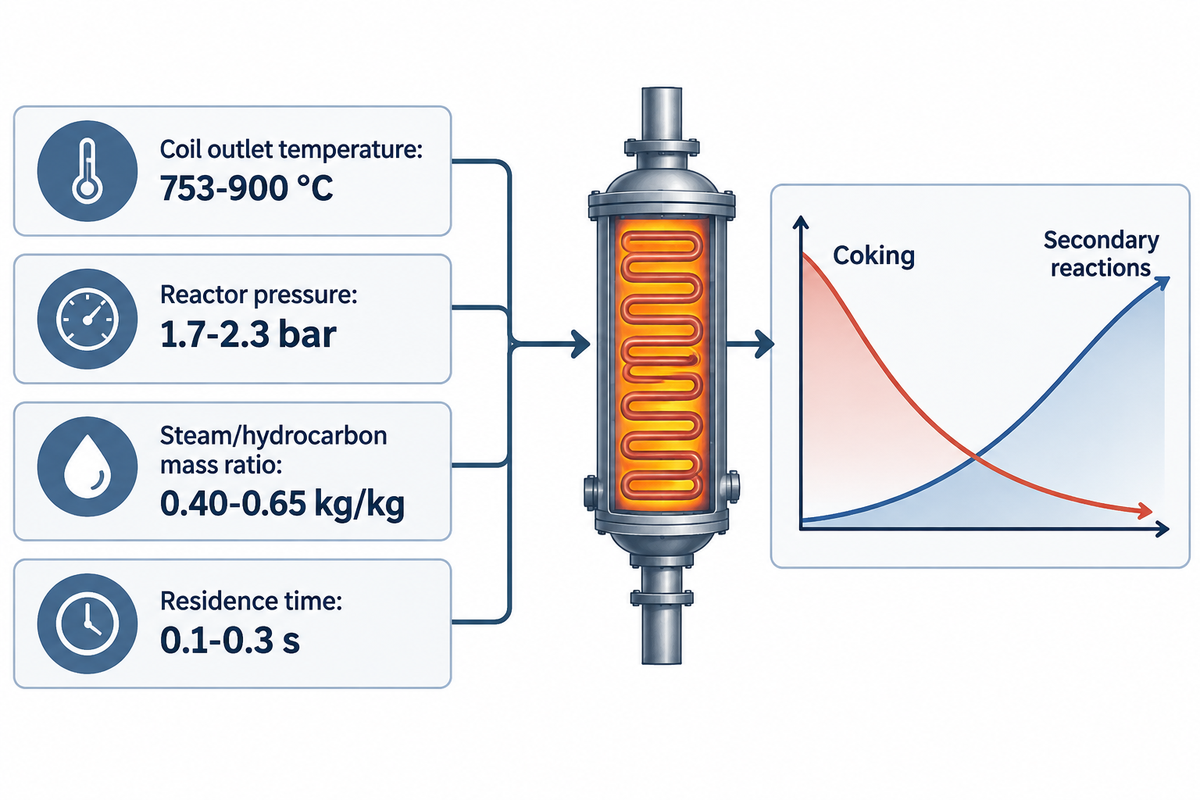
Cracking severity affects the yield of light olefins through primary and secondary reactions, as well as coke formation. Residence time and steam dilution, along with temperature profile, play a role; therefore a higher yield of ethylene must be considered in light of other products, the heat balance and the capacity of the recovery system for effluent.
Gao and colleagues’ numerical study links temperature profile and steam-to-hydrocarbon ratio to both product yields and coking. In Keyvanloo and colleagues’ experiment, interactions among temperature, steam ratio and residence time were part of the light-olefin yield model.
Products resulting from primary cracking can still be reactive and engage in further reactions prior to quenching. A review of steam-cracking research states that in Keyvanloo’s study, higher residence time resulted in higher propylene yield at lower reaction temperatures, but decreased it at higher temperatures as secondary reactions developed. Therefore, holding the products hot for longer can consume part of the coproduct that’s targeted.
What temperature is used for naphtha cracking?
Ren and colleagues specified a coil-outlet temperature range of 753 to 900 °C in their naphtha reactor-model dataset. That’s a documented study envelope, with pressure, steam ratio and residence time also defined; an operating unit uses its own approved feed and equipment limits, rather than adopting the endpoints as limits.
| 変数 | Study range | What the comparison must preserve |
|---|---|---|
| Coil outlet temperature | 753–900 °C | Temperature location and profile |
| 原子炉圧力 | 1.7–2.3 bar | Pressure definition and reactor model |
| Steam/hydrocarbon mass ratio | 0.40–0.65 kg/kg | Steam and hydrocarbon mass basis |
| レジデンス 時間 | 0.1–0.3 s | Reactor geometry and flow assumptions |
Coke provides thermal resistance and decreases flow passage as deposits build up. Therefore, a proposal that increases short-term yield can affect the time available for production, while a larger cracked-gas load can affect the resistance further downstream.
- Process engineering: compare the entire recovered slate for the accepted feed.
- Operations: include coil condition and time available between cleaning events.
- Finance: value the resulting throughput and utilities, not just selectivity to light olefins.
Naphtha vs Ethane: Compare the Whole Product Slate
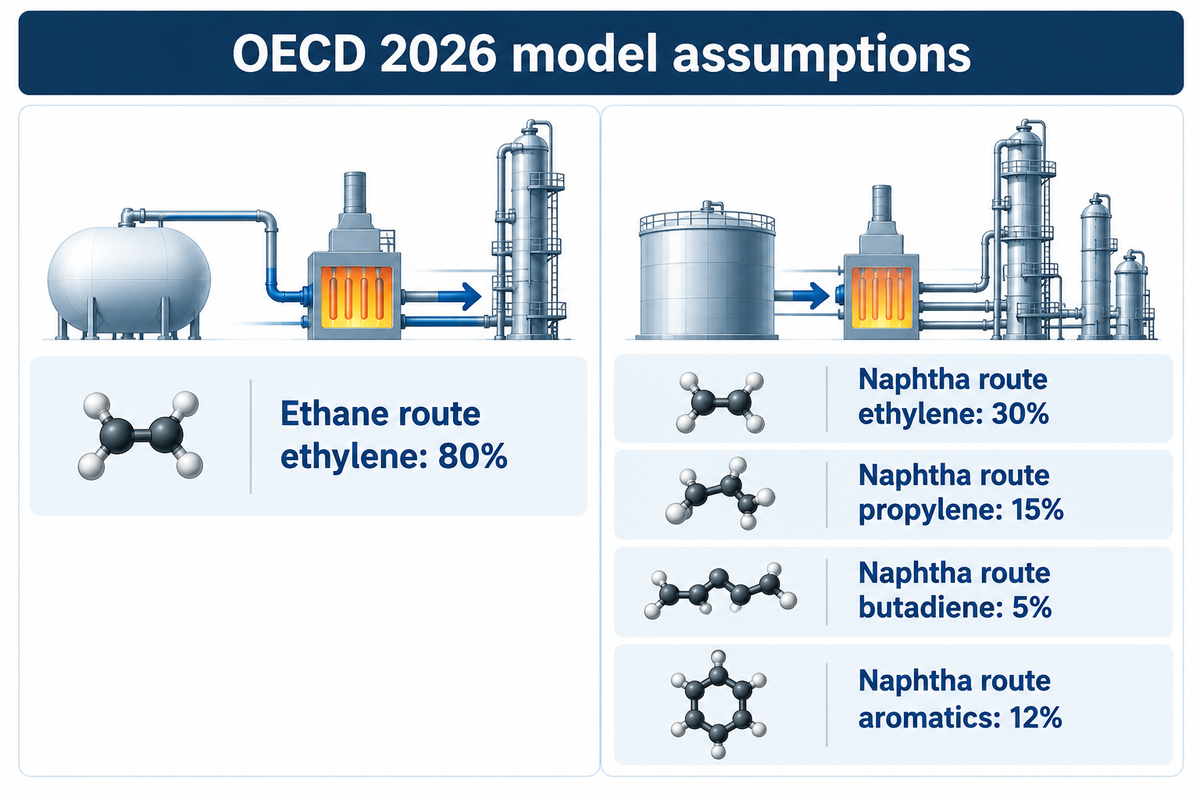
Naphtha supports a broader coproduct slate, which includes propylene and heavier streams, as compared to ethane-based ethylene production. The preferred feed reflects the balance of fed and recovered products, raw material costs, and the installed capacity of the plant; an adequate raw material price in isolation can’t warrant a change in feed.
| Yield assumed in the model | Ethane route | Naphtha route |
|---|---|---|
| エチレン | 80% | 30% |
| プロピレン | <2% | 15% |
| ブタジエン | <2% | 5% |
| アロマティクス | Not specified | 12% |
These are assumptions based on the OECD’s Annex G techno-economic scenario, not complete mass balances, for the products listed.
の The U.S. Energy Information Administration’s 2023 analysis connects feed choice to both relative prices and switching capability. An ethylene plant integrated with local propylene or aromatics consumers has a different commercial context from one focused mainly on ethylene exports.
- Ethane option: check supply logistics and the value of concentrating output on ethylene.
- Naphtha option: value the whole slate and its recovery obligations.
- Switching proposal: compare qualified feed envelopes, actual equipment changes and net products on the same basis.
Coproduct Economics: A Higher Ethylene Yield Can Earn Less
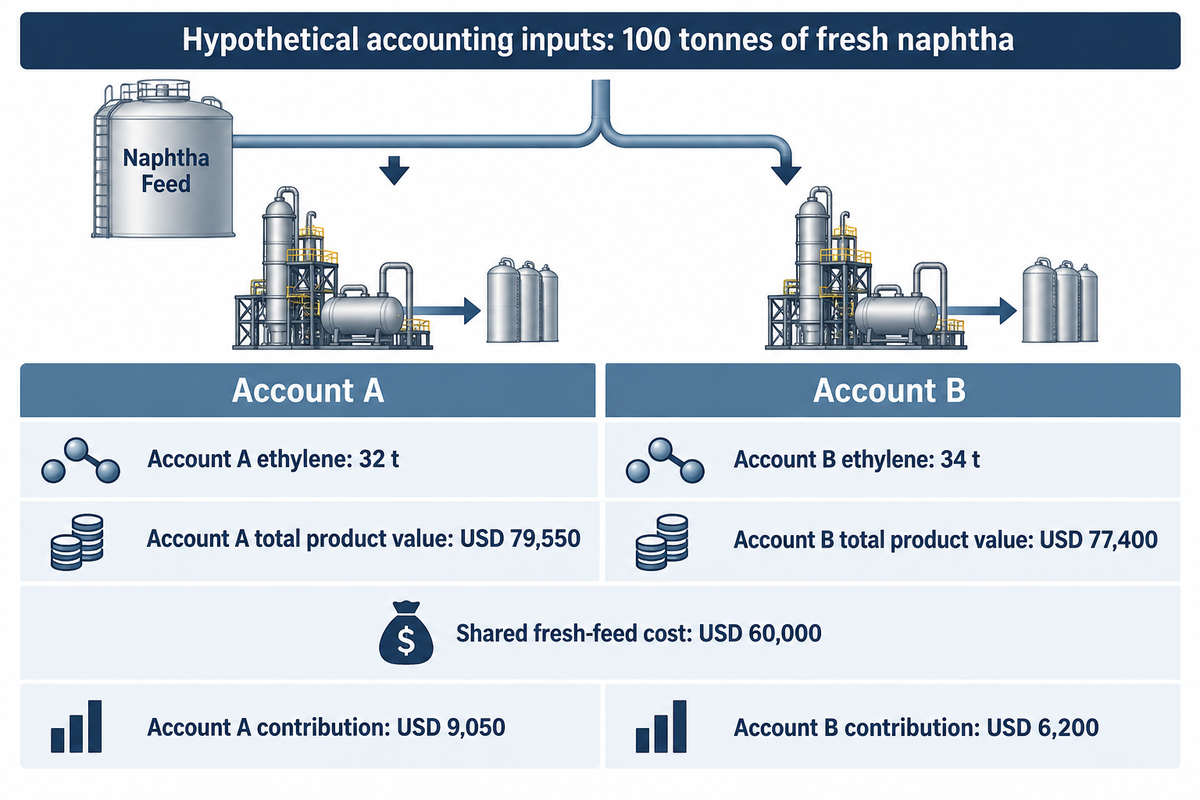
An increased ethylene yield can diminish contribution due to the loss of other valuable products and additional conversion costs exceeding the value of the added ethylene. The Slate-to-Value Test involves balancing the total product accounts to be compared on the same fresh-feed basis and adjusting either price or quantity to make the result visible.
“Ethylene feedstock margins account for coproduct credits, which mainly include propylene, butadiene, benzene, and xylene.”
Hypothetical accounting inputs
Each account uses 100 tonnes of fresh naphtha and net recovered outputs after internal recycle; steam is excluded. Quantities, netbacks and costs are invented teaching inputs, not measured results, current prices or physically validated alternatives for changing operating severity.
Mixed C4, whole pygas and the fuel-gas pool are sold as mixtures, each credited once. Product-specific handling costs are already deducted in the netbacks; the separate conversion-cost line excludes those deductions.
| Product or balance item | Netback, USD/t | Account A | Account B |
|---|---|---|---|
| エチレン | 950 | 32 | 34 |
| プロピレン | 1,000 | 16 | 13 |
| Mixed C4 | 1,300 | 10 | 9 |
| Whole pygas | 700 | 18 | 17 |
| Fuel-gas pool sold | 350 | 18 | 20 |
| Heavy liquid products | 250 | 5 | 6 |
| Coke and uncredited losses | 0 | 1 | 1 |
| Total accounted mass | 該当なし | 100 | 100 |
| Feed cost, USD per account | 600 per t feed | 60,000 | 60,000 |
| Variable conversion cost, USD per account | 該当なし | 10,500 | 11,200 |
| Total product value, USD per account | 該当なし | 79,550 | 77,400 |
| Contribution, USD per account | 該当なし | 9,050 | 6,200 |
Contribution = total product value − fresh-feed cost − variable conversion cost. For account A, that’s USD 79,550 − USD 60,000 − USD 10,500 = USD 9,050.
Now let’s consider a finance analyst looking at two hypothetical accounts. Account B supplies 2 t more ethylene, which at the assumed netback is worth USD 1,900, but non-ethylene credits fall USD 4,050, and conversion costs rise USD 700.
The change in contribution is therefore USD 1,900 − USD 4,050 − USD 700 = −USD 2,850. Keeping every other input fixed, the extra ethylene would need a netback of (USD 4,050 + USD 700) ÷ 2 t = USD 2,375/t for the accounts to break even; the analyst can now test an actual price assumption rather than defend the larger yield figure alone.
Unit ethylene cost uses a different denominator: residual variable cost per tonne of ethylene = (feed cost + variable conversion cost − nonethylene credits) ÷ recovered ethylene tonnes. With the same hypothetical inputs, account A gives (USD 60,000 + USD 10,500 − USD 49,150) ÷ 32 t = USD 667.19/t; account B gives (USD 60,000 + USD 11,200 − USD 45,100) ÷ 34 t = USD 767.65/t.
Energy costs should be allocated to variable conversion costs. Therefore, changes in consumption or costs of utilities affect both the unit-cost result and contribution, and are residual variable costs after coproduct credits. Fixed costs, capital charges and the example’s measured energy consumption haven’t been provided, and therefore, it isn’t possible to determine the physical energy intensity.
Keep the sales boundary consistent
Adding butadiene revenue to a sale of the whole C4 stream counts the same material twice. The same applies to benzene within sold pygas, or hydrogen within the sold fuel-gas pool; internal fuel use would need its own avoided-cost treatment instead of an additional sale credit.
For annual planning, contribution per fresh feed tonne is multiplied by the total fresh feed tonnes. Production rate and available operating hours are included. Capital recovery, fixed costs, financing and taxes aren’t included in the example, and therefore the result is variable contribution rather than net profit.
Feed Qualification and the Hidden Bottleneck Map
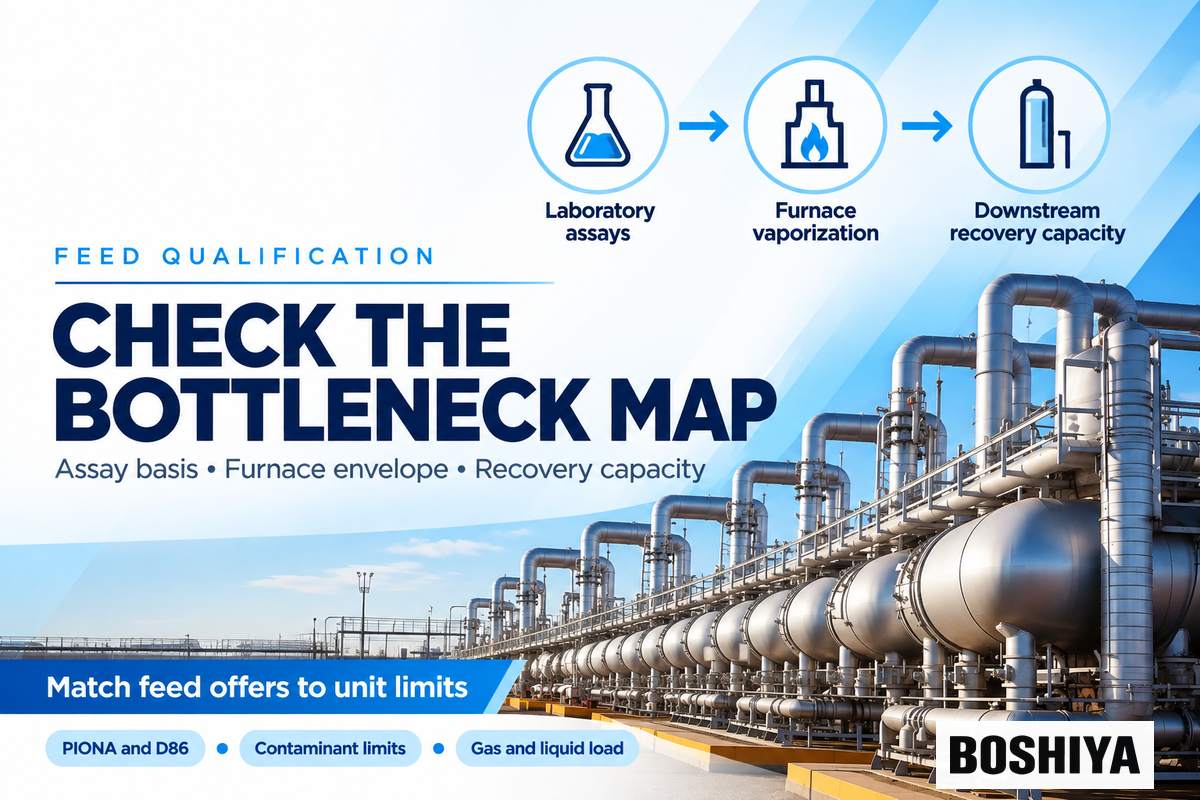
Feed qualification relates the product value to the assay, furnace and recovery equipment as well as contracts that support it. In support of each proposed change, a measured property should be identified and a decision made accountable. Therefore, a change in the delivered price of feed should be evaluated in the context of vaporization, treatment, recovery and value of the product.
ASTM D86 measures atmospheric-distillation behavior for products including naphtha. Its public scope excludes material with appreciable residue; the method identifies how a property is measured, while the purchase contract and unit’s accepted feed envelope set the acceptance limits.
| Proposed change | Measured input | Potential constraint | Decision owner and evidence |
|---|---|---|---|
| Different molecular composition | PIONA fractions, wt.% | Product-slate change | Process engineering: qualified yield assessment |
| Heavier distillation tail | Distillation curve, °C | Vaporization and heavy-liquid handling | Engineering: accepted feed and separation envelope |
| Changed sulfur content | Sulfur assay and agreed units | Treatment and product specifications | Laboratory and operations: feed and additive context |
| Changed nitrogen content | Nitrogen assay and method | Relevant treatment-system compatibility | Process engineering: unit-specific acceptance |
| Chloride or water concern | Applicable assay, detection limit and sample handling | Feed conditioning and materials requirements | Laboratory and engineering: acceptance specification |
| Higher cracked-gas volume | Gas flow at a stated temperature and pressure | Compression and cooling capacity | Operations: rated capacity and actual load |
| Changed acetylene load | Composition and molar flow | Hydrogenation and ethylene purity | Recovery team: treatment envelope |
| Higher C4 or pygas production | Net recovered t/h and composition | Separation, storage and offtake | Operations and sales: capacity and buyer specification |
| More ethylene but less available time | Saleable t/h and annual operating hours | Annual production and contribution | Finance and operations: matched annual case |
Heavy-tail handling is an equipment and feed labeling issue. One solution described in Technip’s technical discussion in Digital Refining is a feed separator upstream of the radiant section. The lesson here’s to couple the acceptance of feed and design considerations.
Project data to include in a technical inquiry
- Feed origin, representative sample date, composition and distillation method.
- Accepted ranges with units, analytical methods and detection limits.
- Fresh-feed rate, recycle basis and required product specifications.
- Recovery-system constraints and existing utility availability.
- Saleable-product quantities, offtake arrangements and netback basis.
Industry Outlook: What Is Changing in Naphtha Cracking?
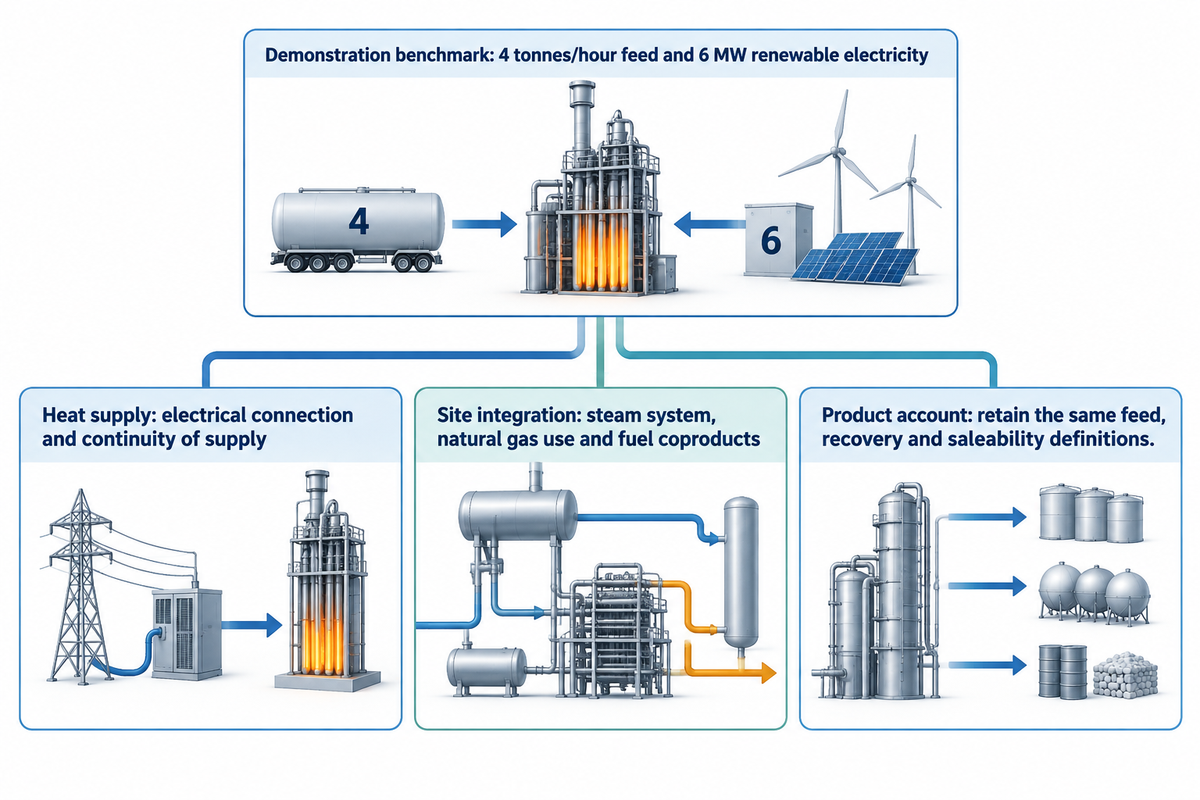
For the petrochemical industry, some of the naphtha-cracking investment decision is moved to the more flexible electric furnace heating, and integration of site energy and electricity. Project teams still need to integrate a qualified feed and recovery case, and balance the continuous process demand with power supply, cost, availability and emission constraints.
In April 2024, BASF, SABIC and Linde announced an electric steam-cracking demonstration in Ludwigshafen. The two demonstration furnaces process approximately 4 tonnes of hydrocarbon feed per hour, using 6 MW of renewable electricity; one heats the coils directly and the other uses electrical heating elements.
- Heat supply: evaluate the electrical connection and continuity of supply.
- Site integration: account for the existing steam system, natural gas use and destinations for fuel coproducts.
- Product account: retain the same feed, recovery and saleability definitions when comparing cases.
This project explores the demonstration-scale limits of heating concepts and high-temperature material behavior. The announced emissions benefit is conditioned on the renewable electricity and concerns the cracking heat supply. Whole-site and life cycle analyses require their energy and material boundaries.
A 2025 preprint on microgrid-scheduling by Naraghi and colleagues analyzes the ethylene production and variable renewable generation mismatch. The case study is centered on ethane and considers grid supply and backup dispatch.
For a project comparison
A time-matched energy balance complements the feed and product balance by showing electricity sources during periods of low renewable generation, the treatment of fuel coproducts, and any change to steam imports or exports.
Feed provenance is another qualification task when the suggested supply changes. Remember molecular composition, impurities and boiling behavior, case by case, rather than allowing an origin to replace the assay; this way procurement can compare supply contracts based on the same acceptance criteria and product value model.
Naphtha Cracking FAQs
なぜ石油会社はクラッキングを行うのですか?
Petroleum companies use a cracking process to produce smaller molecules from larger hydrocarbons for fuel or chemical applications. Steam cracking for light olefins targets ethylene and propylene; refinery cracking routes have different feed and product priorities.
The route matters because thermal and catalytic processes use different equipment and reaction conditions. A process to produce ethylene should therefore be evaluated against its intended chemical products, rather than judged by a refinery gasoline objective.
ナフサは主に何に使用されますか?
Naphtha is used as a petrochemical feedstock, as feed to catalytic reforming, and in selected solvent or fuel-blending applications according to its composition and specification. The EIA’s reforming explanation describes heavy naphtha feed and gasoline blending, while NOAA’s solvent-naphtha datasheet lists solvent and chemical raw-material uses.
Steam cracking naphtha produces olefins and coproducts, while reforming directs suitable feed toward reformate, aromatics and hydrogen. A particular batch’s destination depends on its assay and the receiving process; a purchase specification needs the boiling characteristics, composition and impurity requirements relevant to the intended use.
触媒ナフサ改質とは何ですか?
Catalytic naphtha reforming converts suitable naphtha into higher-octane reformate and produces hydrogen through a set of catalytic reactions. The reforming unit is associated with gasoline quality and aromatics production, whereas a naphtha steam cracker is used for cracking to produce light olefins.
Steam cracking and catalytic reforming can appear within the same petrochemical or refinery complex, but their feed preparation, catalyst systems and product accounts differ. BOSHIYA’s 接触改質ガイド explains that adjacent process in more detail.
ナフサ水蒸気分解には触媒が必要ですか?
Conventional naphtha steam cracking is a thermal process driven by free-radical reactions without a cracking catalyst. Catalysts can be present in downstream treatment, such as acetylene hydrogenation, and in alternative catalytic olefin-production routes.
Is there one chemical equation for naphtha cracking?
No single equation describes naphtha cracking because naphtha contains many hydrocarbons and produces a network of products. An equation for one model alkane illustrates a reaction, not the full feed balance.
Connect the product account to your requirement
For chemical sourcing, explore BOSHIYA’s petrochemical and chemical portfolio. Share the product grade, quantity, application and delivery requirements when you discuss your chemical supply requirements with our team.
参考文献と情報源
- Direct prediction of steam cracking products from naphtha bulk properties: Application of the two sub-networks ANN Ren et al., Frontiers in Chemical Engineering, 2022.
- Improving the steam-cracking efficiency of naphtha feedstocks by mixed/separate processing Karaba et al., Journal of Analytical and Applied Pyrolysis, 2020.
- Optimal operation of tubular reactors for naphtha cracking by numerical simulation Gao et al., Asia-Pacific Journal of Chemical Engineering, 2009.
- Techno-economic model and sensitivity analyses to financial solutions, Annex G Organisation for Economic Co-operation and Development, 2026.
- U.S. ethane exports set a monthly record in March 2023 U.S. Energy Information Administration, 2023.
- EIA analysis of ethane and ethane-derived petrochemical exports U.S. Energy Information Administration, 2024.
- ASTM D86-23ae2: Standard Test Method for Distillation of Petroleum Products and Liquid Fuels at Atmospheric Pressure ASTM International.
- Cracking hydrocarbon feedstock with a heavy tail Digital Refining, 2013; vendor-authored technical discussion.
- Decarbonization of Steam Cracking for Clean Olefins Production: Optimal Microgrid Scheduling Naraghi et al., arXiv preprint, 2025.