BOSHIYAと連絡を取りましょう

FCC 触媒ガイド: 組成、試験、選択

2026年10月更新
内容
ショー
FCC catalyst is a fine, porous solid that assists in the conversion of heavy petroleum hydrocarbons to gasoline and other lighter products. Determining a suitable formulation begins with understanding the feed and the desired product slate, followed by evaluating the activity, selectivity and physical durability of the component against the refinery’s limiting equipment.
Quick answer
- Zeolite supplies much of the cracking activity; the surrounding matrix helps larger molecules reach useful reaction sites.
- Fresh, equilibrium and regenerated describe different aspects of a catalyst’s history and condition.
- Compare candidates with representative samples and matched test conditions before translating laboratory yields into refinery economics.
- Calculate makeup cost per barrel of FCC feed, then include changes in product value and operating constraints.
Catalyst customers have different queries from customers for equipment. The fluid catalytic cracking process guide provides further information on the process; material choices and tests elaborate on changes in the recirculating powder.
FCC Catalyst Composition: What Each Component Does
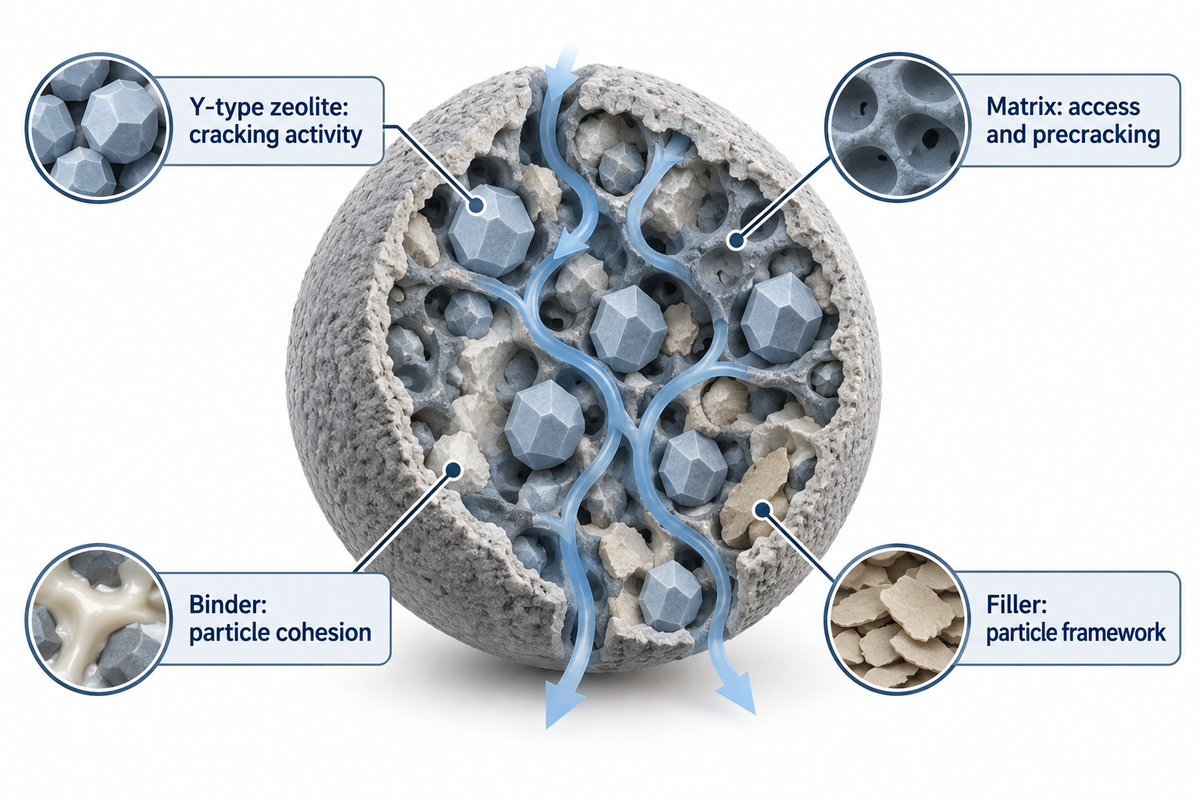
Most commercial FCC catalysts use a composite particle where Y-type zeolite is combined with a matrix, binder and filler to provide catalytic activity and particle integrity. These components provide catalytic sites, paths for molecules and a particle strong enough to circulate.
What is FCC catalyst made of?
Most traditional formulations use a Y-type zeolite within a composite particle with larger, more open passages and smaller internal spaces. Think of the porous particle as a building: large passages admit bulky molecules, while smaller internal spaces provide different reaction environments. The matrix can begin cracking molecules which can’t access the zeolite.
| コンポーネント | Main contribution | Useful comparison |
|---|---|---|
| Y-type zeolite | Acid sites for catalytic cracking and related reactions | Activity after representative aging, plus product selectivity |
| Matrix | Access and precracking for larger feed molecules | Pore accessibility and bottoms conversion with the intended feed |
| Binder | Particle cohesion; interactions with other components | Physical durability alongside retained catalytic properties |
| Filler, commonly clay | Particle framework and physical/thermal properties | Whole-particle performance rather than filler content alone |
の The Vogt and Weckhuysen review of FCC catalysis provides information on these aspects and the role of accessibility of the sites. Hydrocarbon molecules must be transported to a catalytic site to participate in conversion; a highly active interior is of little use when transport through the particle is restricted.
A 2020 study on matrix effects found that binder material and zeolite interacted with each other under the treatment conditions. Interactions like these should be considered when reviewing a composition sheet. A formulation is a composite. A mixture is more than the sum of its constituents. Commercial recipes differ, hence a model-catalyst mixing ratio shouldn’t be a purchase specification.
When considering heavy gas oils, evaluation of the zeolite loading of the fresh material may not be as useful as information on accessible porosity and retained catalyst activity after aging. This comparison should consider both the physical and chemical properties.
Fresh, Equilibrium and Regenerated Catalyst Compared
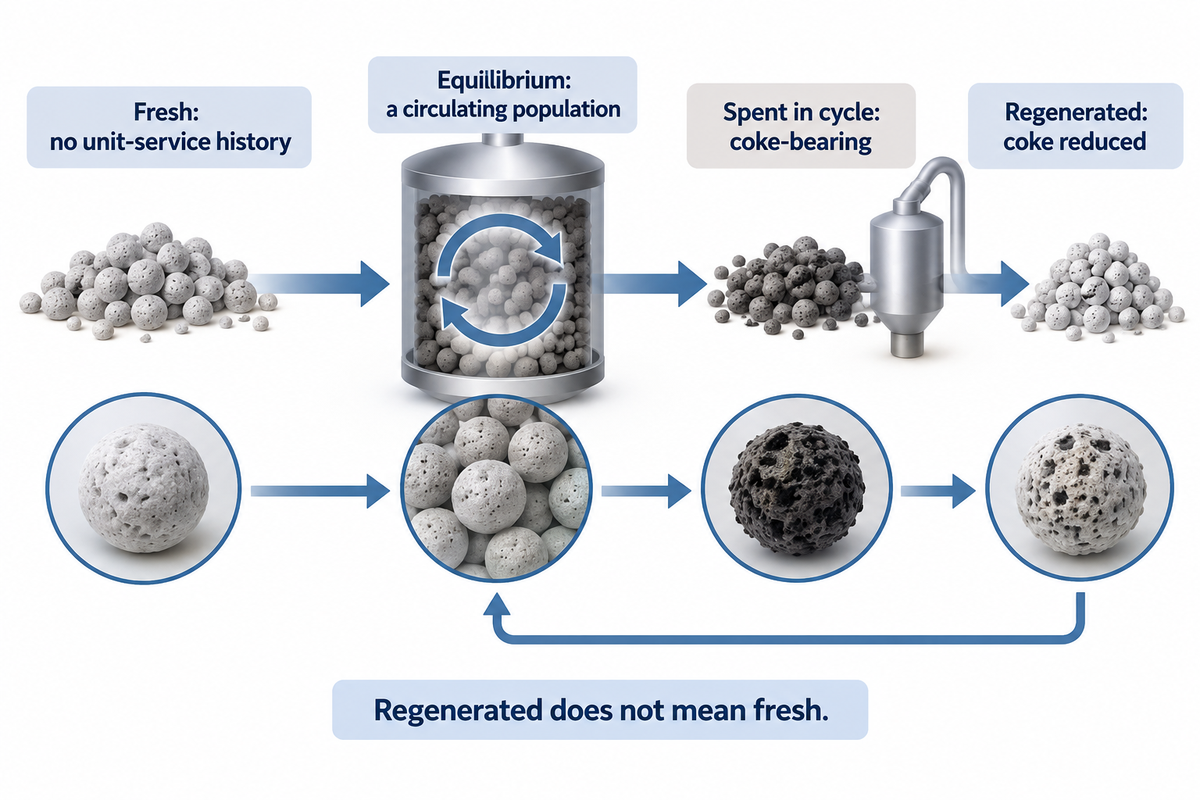
Fresh catalyst has no unit-service history, and equilibrium catalyst is the circulating mixture after repeated additions and withdrawals. Regenerated catalyst has passed through coke removal. An equilibrium particle can therefore also be regenerated; the labels describe separate dimensions rather than mutually exclusive products on a supplier’s price list.
How does FCC catalyst work?
Acid sites help to break down larger molecules into smaller molecules. During the cracking reaction, coke builds up on the solid and reduces access to the active sites. Catalyst regeneration burns the coke and provides the heat to the returning powder as described in the U.S. Energy Information Administration’s FCC overview.
| Label | What it describes | Interpretation |
|---|---|---|
| Fresh | Service history | New material before unit exposure |
| Laboratory-deactivated | Sample preparation | Artificial aging intended to model selected service effects |
| Equilibrium, or Ecat | Inventory population | Particles with a distribution of ages and accumulated damage |
| Spent, within the cycle | Post-reaction condition | Coke-bearing material headed toward regeneration |
| Regenerated | Post-regeneration condition | Coke reduced, with previous service damage still relevant |
| Withdrawn Ecat | Inventory destination | Material removed from the circulating system |
| Decoked laboratory sample | Test preparation | Carbon removal performed before a measurement |
| Base cracking catalyst | Formulation function | Main catalyst formulation in the inventory |
| Additive | Formulation function | Additional material used for a defined product or process objective |
“Spent catalyst” is particularly easy to misread. Within the FCC process it can mean material awaiting regeneration; in a disposal discussion it can mean withdrawn material. The context and where the sample is taken determine which meaning is used.
Ecat activity is an average over a population. A 2023 single-particle acidity study found significant variation in the population under study. Bulk analysis remains useful. However, an average or a subset of particles doesn’t describe the conditions of all particles.
It’s a misunderstanding to assume that fresh catalysts are free of all metal impurities. Fresh means that the catalysts haven’t accumulated that unit’s operating history. Supplier composition and the laboratory’s reporting limits establish the starting analytical baseline.
Zeolite, Matrix and Additives: What Changes the Yield?
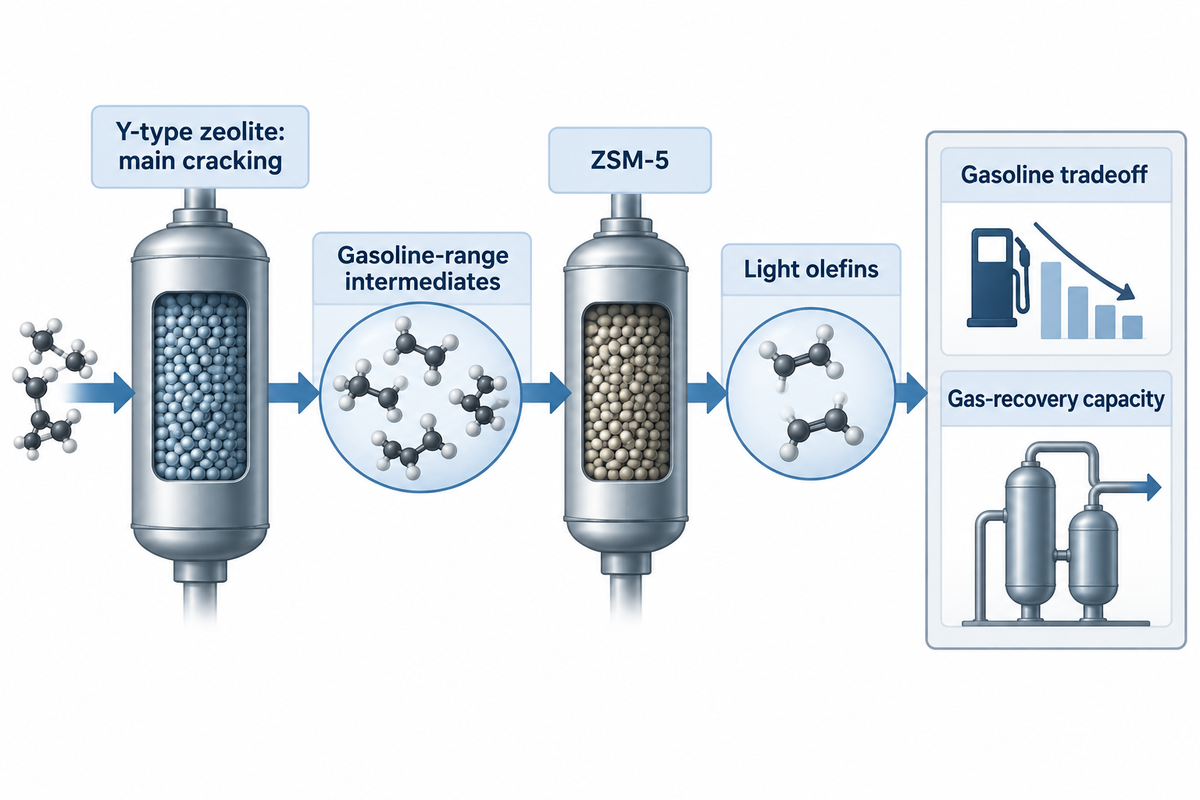
Not all feedstocks convert in the same way. Y-type zeolite supports the main cracking function, while ZSM-5 can shift gasoline-range olefins toward lighter olefins.
How does catalyst acidity influence selectivity in FCC?
Acidity is just one of several factors that determine the reaction and how far it proceeds. Feed molecules, pore structure and secondary reactions help determine gasoline composition, gas production and coke formation. Gas production and coke formation also depend on how far the reaction proceeds and which intermediates are formed.
ZSM-5 has a different pore structure from the Y-type zeolite in the base catalyst. ZSM-5 can convert gasoline-range molecules into light olefins. The additive acts on the available intermediate pool; it does not make every feed respond identically.
- For gasoline, compare yield and quality together, including the high-octane value of the resulting blend components.
- For propylene, include the value of LPG components and the capacity needed to recover them.
- For bottoms conversion, evaluate matrix accessibility with the heavier molecules in the proposed feed.
- For a coke constraint, consider the heat balance and regenerator burden alongside conversion.
It depends on what’s downstream as well. An olefin stream could have value as petrochemical feed or in refinery alkylation, but the available processing route decides the usable outlet. An aromatic compound remaining in gasoline contributes differently from a light olefin sent to another unit.
Consequently, catalyst optimization is a product-slate decision. The targeted liquid products and gas outlets must be priced using the same framework to set an economic target before an additive trial. An oversized propylene yield can be unattractive if the extra stream displaces a more valuable stream or exceeds the recovery capacity.
Catalyst Deactivation: What Regeneration Can Restore
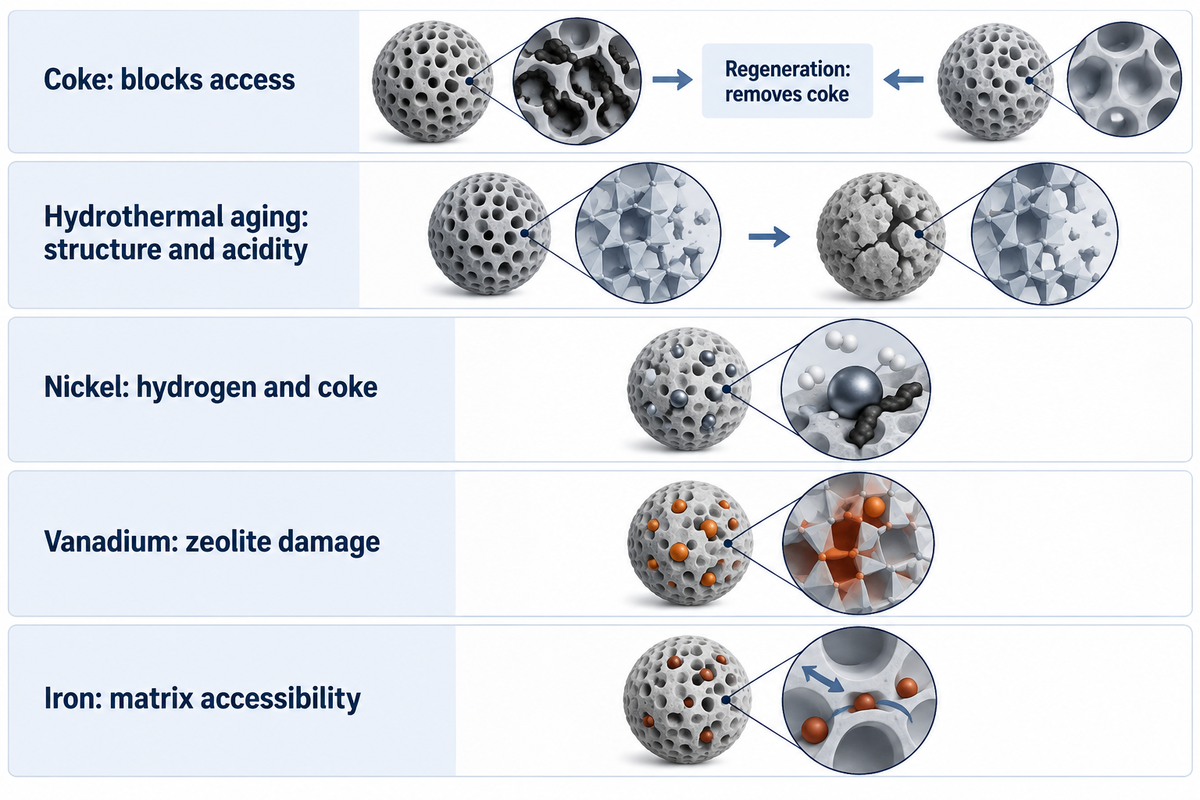
Regeneration recovers the lost access due to coke deposition; however, it doesn’t entirely restore an aged catalyst. Hydrothermal exposure can damage zeolite structure, while contaminant metals can alter reactions or obstruct access. Distinguishing these mechanisms explains why low activity may persist after a sample has been decoked.
| 機構 | Consequence | Useful evidence |
|---|---|---|
| Coke deposition | Blocks access to catalytic sites | Residual carbon and the sample’s decoking history |
| Hydrothermal aging | Changes zeolite structure and acidity | Retained structure and activity after representative treatment |
| Nickel contamination | Promotes dehydrogenation, hydrogen and coke | Metals analysis with matched-feed gas and coke results |
| Vanadium-related damage | Can damage zeolite under relevant conditions | Metals, structural characterization and service history |
| Iron-related accessibility loss | Restricts access through the matrix | Accessibility measurements and contaminant distribution |
Salgado’s discussion of metals in equilibrium catalyst differentiates between nickel’s effects on reactions and vanadium-related damage. Combining all contaminants into a single “total” can mask which mechanism is altering the product yield.
Artificial aging introduces a further distinction. Gambino and colleagues’ 2021 microscopy study indicated that reproducing industrial aging requires consideration of metal distributions and hydrothermal degradation. The authors indicated iron contamination is important for matrix accessibility.
A laboratory program that subjects two candidates to the same aging treatment improves consistency between the candidates. Relevance to the refinery is limited to the degree that treatment reproduces the important damage mechanisms. A steaming-only comparison can answer a narrower question than a comparison intended to represent contaminated Ecat.
Thermal cracking also occurs along with catalytically driven reactions during FCC. Changing reaction temperature to manipulate the catalyst’s apparent activity also changes the reaction environment. Altering the temperature of the unit belongs only within qualified process unit operations.
Catalyst Testing: Compare Results on the Same Basis
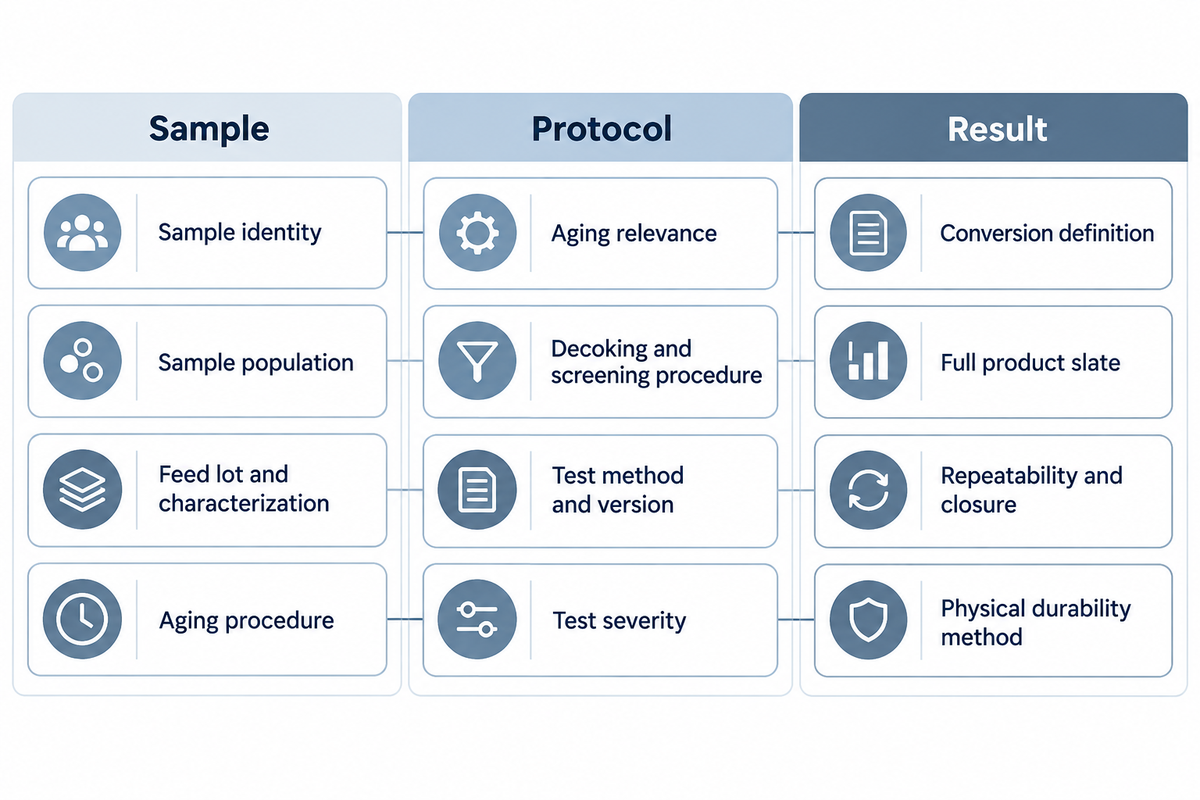
Meaningful comparisons of catalyst use representative samples and a defined test basis. Conversion and selectivity are affected by test and treatment conditions. Matching these variables separates candidate differences from procedural differences; validating the aging model and sample population then determines how far the result can inform a refinery decision.
“The microactivity test provides data to assess the relative performance of FCC catalysts.”
Microactivity testing as described by ASTM evaluates mass conversion of gas oil using equilibrium or laboratory-deactivated material. Public guidance advises that pretreatment, feed and equipment be part of the correct interpretation. A different method of evaluation is required to assess the physical durability of the catalyst. Physical durability requires a different measurement: ASTM D5757-22 addresses air-jet attrition resistance.
Same-Basis Catalyst Test Sheet
This comparison worksheet separates matched laboratory results from differences caused by sampling, aging and reporting.
| Comparison item | Record for each candidate | What a mismatch changes |
|---|---|---|
| Sample identity | Fresh, laboratory-aged or Ecat; sample date | Service history represented |
| Sample population | Collection location and representative preparation | Whether the result describes the intended inventory |
| Feed | Same feed lot and characterization | Crackability and contaminant exposure |
| Aging procedure | Steam and metal treatment; retained properties | Damage imposed before testing |
| Aging relevance | Comparison with relevant industrial Ecat behavior | How closely the model represents service |
| Carbon preparation | Decoking and screening procedure | Access to active sites during the test |
| Test method | MAT, ACE or pilot method and version | Contacting and reactor behavior |
| Severity | Temperature, catalyst-to-oil basis and contact conditions | Extent of primary and secondary reactions |
| Conversion definition | Mass or volume basis and product cut points | Meaning of the reported percentage |
| Product slate | Liquid fractions, gas components and coke | Value hidden by a conversion-only comparison |
| Repeatability and closure | Repeat results and material-balance closure | Whether a small difference is persuasive |
| Physical durability | Same attrition method and particle-size reporting | Meaning of a claimed strength advantage |
A buyer compares two reports. A supplier tests fresh material after steaming with the standard feed; another tests withdrawn Ecat with the refinery’s feed. The second report shows lower conversion. Selecting the first supplier would confuse sample history with formulation performance. The useful next comparison is to put both under an agreed test and evaluation program, and where appropriate, include an industry benchmarking sample. Even then, the plant prediction must consider the effect of feed and equipment. The original reports answer different questions and to maintain clarity, should be kept in separate rows of the evaluation.
BASF author Alexis Shackleford’s Ecat interpretation article describes laboratory decoking before activity testing. The operating unit may retain a different carbon condition. Similarly, the Grace-authored pilot-testing article states that unlike feeds and test systems complicate comparisons.
Selecting an FCC Catalyst for Your Feed and Product Target
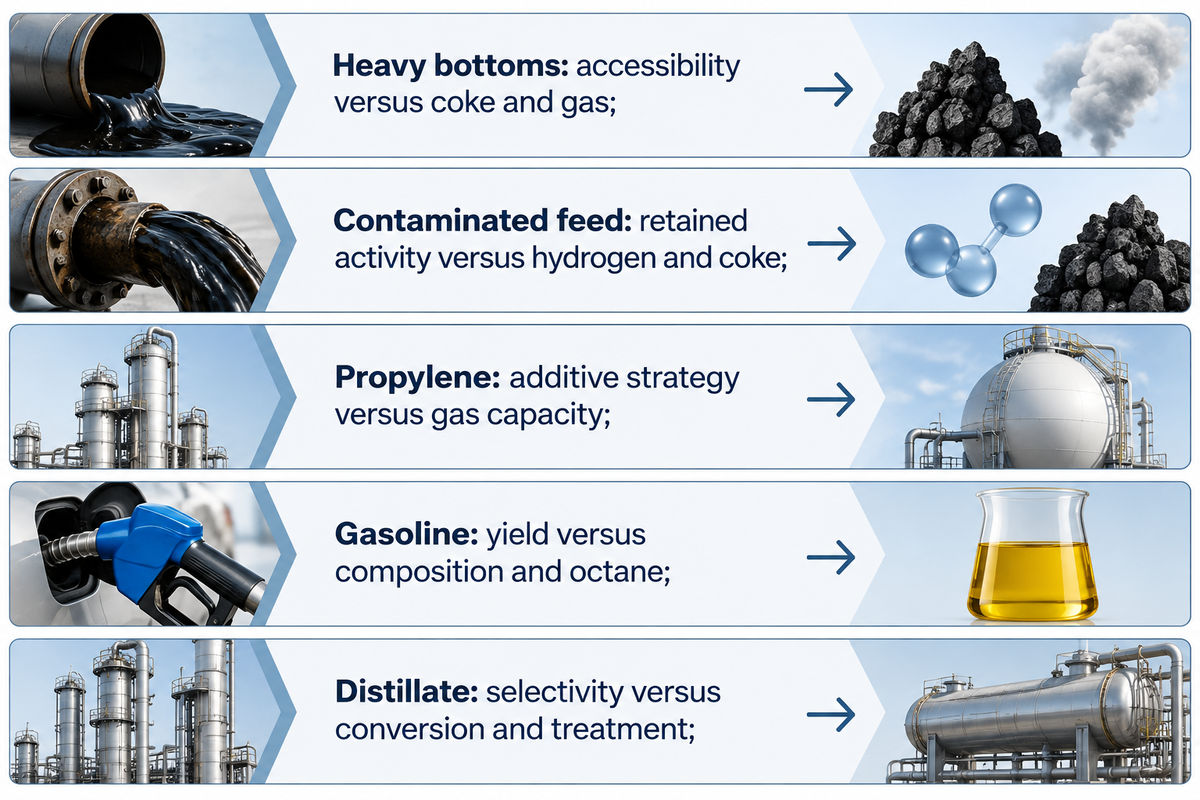
Start with the feed challenge and the product that creates value, then screen formulations against the limiting unit constraint. Heavily contaminated feeds and a propylene objective may require different properties. Supplier selection should compare a defined application and test program, rather than a single brochure activity number.
| Starting problem | Candidate emphasis | Tradeoff to evaluate |
|---|---|---|
| Heavy hydrocarbons remain in bottoms | Accessible matrix and bottoms-conversion capability | Extra coke and gas versus recovered liquid value |
| Higher contaminant burden | Retained activity and relevant metals tolerance | Hydrogen, coke and physical accessibility |
| More propylene is valuable | Base catalyst plus suitable additive strategy | Gasoline shift and gas-recovery capacity |
| Gasoline is the main objective | Gasoline selectivity and quality | Yield versus composition and octane requirements |
| Distillate objective | Relevant light-cycle-oil selectivity | Conversion and the quality/treatment needs of that fraction |
Which companies supply FCC catalysts?
Portfolios for catalysts are offered by Grace, BASF and Ketjen. Grace offers applications for propylene, butylene, resid conversion and light feeds. BASF offers catalysts and additives along with Ecat analysis. Ketjen offers application families such as gasoline, propylene, light cycle oil and feed contamination.
These portfolios enable a buyer to name concrete candidates for application discussion. A refiner needs the proposed formulation, support scope and matched evaluation results to compare the offers. The critical question is which candidate is a good fit for the specified feed, constraint and other criteria rather than which supplier is the broadest.
For example, consider a refinery seeking more propylene while its gas-recovery section has little spare capacity. A laboratory result showing a favorable olefin shift is encouraging, but the extra gas must pass through the existing recovery system. The selection team should compare the useful recovered product against any displaced gasoline and additional processing cost. A catalyst optimized for a less constrained unit can produce a different economic result here. Hence, candidates on the shortlist meet the product requirement and the capacity availability, and the trial acceptance criteria consider the relevant gas load.
- Define the reference. Establish the current feed and product-value basis.
- Screen candidates. Match formulation capabilities to the limiting constraint.
- Compare samples. Use the agreed test sheet and representative aging.
- Set trial criteria. Link acceptance to recovered product value and operating limits.
FCC Catalyst Cost: Purchase Price and Cost per Barrel
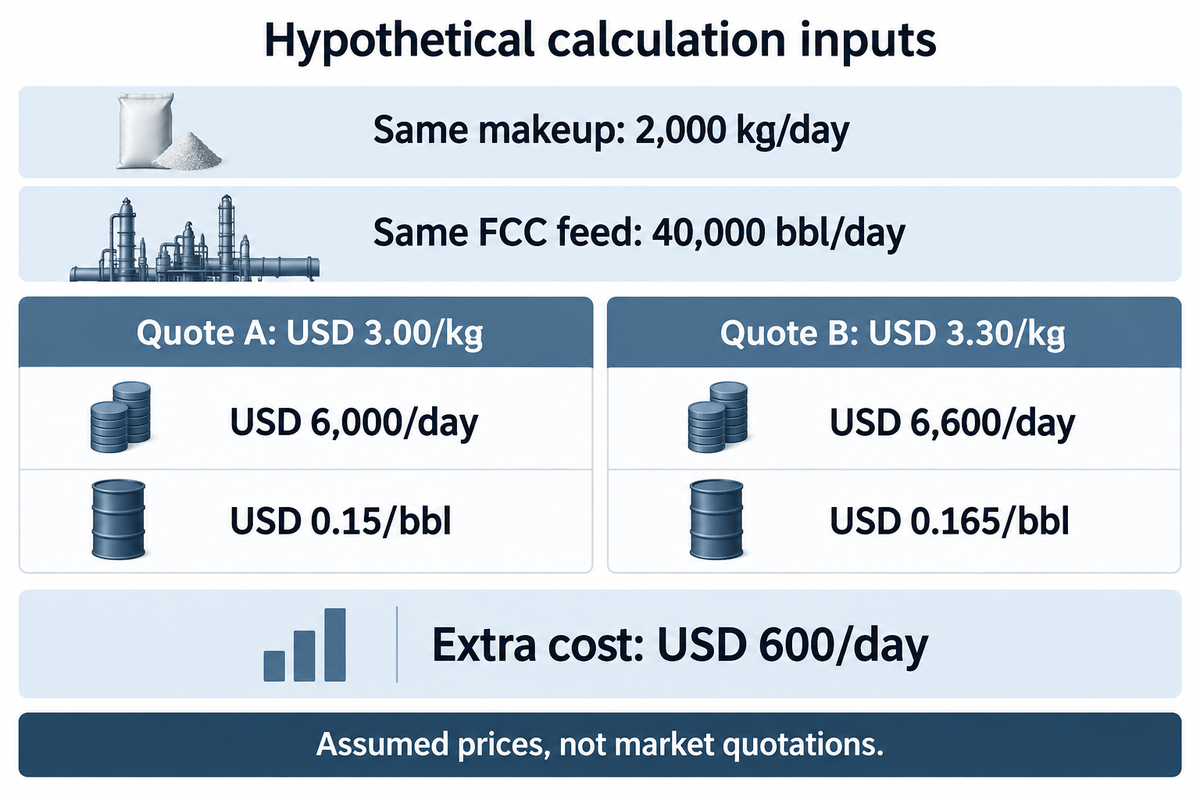
Fresh-makeup cost per barrel is equal to the daily makeup mass multiplied by the delivered price per unit mass, divided by the daily FCC feed throughput. This is used to compare the cost burden of catalyst purchases. The economic choice accounts for changes in product value, additives, and handling costs which the fresh-catalyst calculation ignores.
Assumed inputs: a unit processes 40,000 bbl/day of FCC feed and purchases 2,000 kg/day of fresh makeup at USD 3.00/kg. This example holds throughput constant and excludes additives, waste handling and changes in product revenue. These are calculation inputs, not a market quotation or a recommended addition rate.
Fresh-makeup expense: 2,000 kg/day × USD 3.00/kg = USD 6,000/day.
Expense per FCC-feed barrel: USD 6,000/day ÷ 40,000 bbl/day = USD 0.15/bbl.
Now suppose a second quotation is USD 3.30/kg and the evaluation assumes the same daily makeup mass. Its purchase burden is USD 6,600/day, or USD 0.165/bbl. The difference is USD 600/day. Under those assumptions, the second option needs more than that amount of net daily product-value benefit to overcome the added catalyst expense. A lower required makeup rate would change the comparison, as would extra additive expenditure. This arithmetic screens an economic case; the product benefit must come from the matched evaluation rather than being assumed from the higher price.
| Item | Keep consistent |
|---|---|
| Mass unit | Use kg or a defined tonne/ton conversion throughout |
| Daily quantity | Use fresh makeup, not circulating catalyst flow |
| Throughput denominator | Use FCC feed barrels, not total refinery crude barrels |
| Delivered cost | Include the same freight and commercial scope |
| Product value | Use the same product prices and recovery assumptions |
| Other costs | Account separately for additives, withdrawal and handling |
An inexpensive formulation may become costly if it shifts useful liquid into low-value gas or coke. Conversely, paying more per unit mass can be justified by a supported improvement in recovered product value. The purchase price and conversion efficiency belong in the same economic model. The byproduct streams should be valued explicitly.
Catalyst Change Planning: Unit Limits and Handling
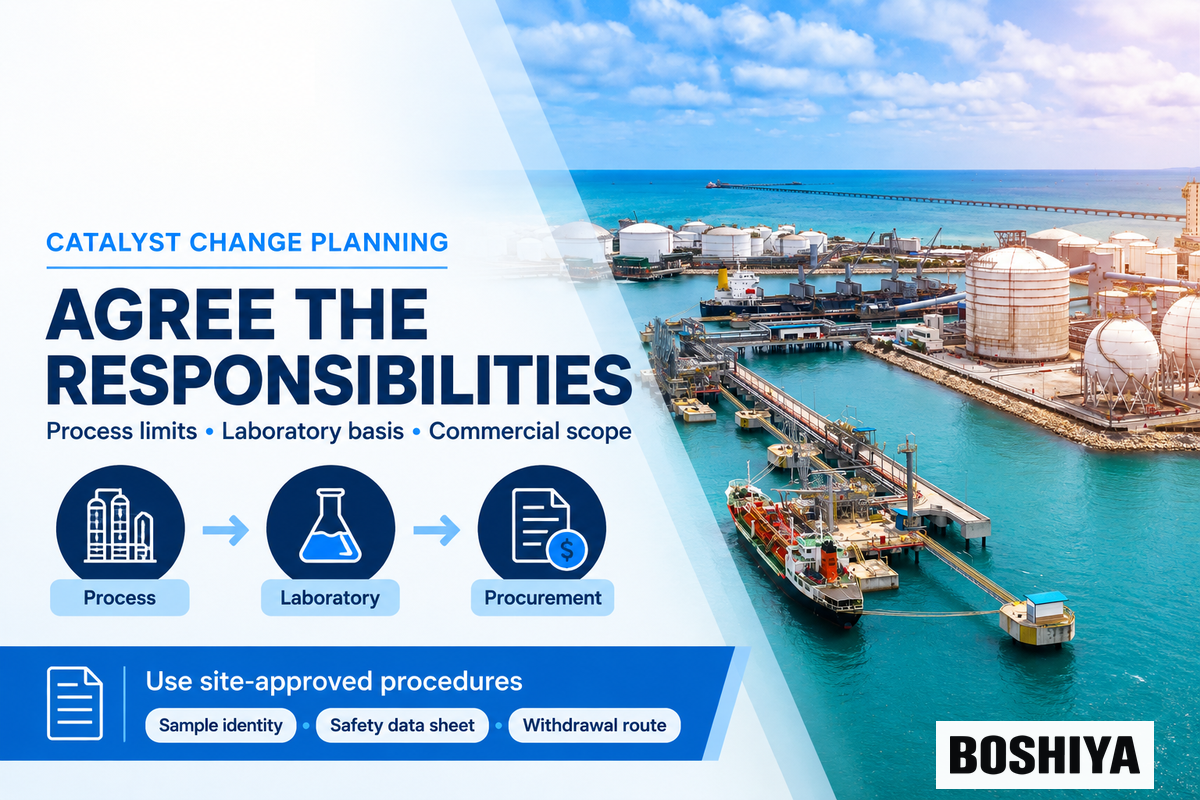
Catalyst change planning connects the proposed product shift to equipment capacity and inventory transition. Process engineers define acceptable operation, laboratory staff define comparison, and procurement staff define the commercial basis. Handling and withdrawal are in line with the material’s identity and site’s approved procedures rather than a general assumption about all FCC powder.
Fluid Catalytic Cracking Unit Limits
A fluid catalytic cracking unit, commonly known as an FCCU, must move and retain its catalyst while recovering products. The riser reactor provides contact while disengagement and cyclone separation remove particles from the product stream. Catalyst circulation, gas handling and regenerator performance connect a change of material to equipment.
More dry gas and coke can consume capacity that was available for other products. Physical catalyst losses can change inventory. A more extensive discussion of FCC unit operations and maintenance covers the catalytic cracker as a system. A formulation trial should be done to determine which constraints of the system would affect the proposed product.
する
- Record the inventory transition when interpreting trial samples.
- Separate laboratory limits from approved unit operating limits.
- Assign handling and withdrawal responsibilities before delivery.
しない
- Treat the first sample after a change as a wholly new inventory.
- Use an attrition index as a substitute for activity.
- Apply an unrelated unit’s additive dose as a plant instruction.
Information to include in the catalyst inquiry
- Feed and objective: send the feed characterization, intended product change and current comparison basis.
- Unit constraint: identify the relevant compressor, regenerator or retention limit through the process team.
- Test proposal: request the sample history, aging method, reporting basis and repeatability data.
- Commercial basis: specify mass units, delivered scope, additive costs and technical support.
- Handling documents: obtain the product-specific safety data sheet and agreed storage/transfer instructions.
- Withdrawal route: assign characterization and an authorized destination for removed material under the applicable local requirements.
Equipment inspection is part of the mechanical plan and includes the relevant vessel and separation internals. Real-time unit readings give operational context during a trial; they don’t replace sample identification or a controlled laboratory comparison.
よくある質問frequently Asked Questions
What is an FCC in refining?
Read the answer
FCC means fluid catalytic cracking, a refinery process that uses circulating solid catalyst to convert heavier petroleum fractions into lighter products. The powder contacts the feed, gains coke during reaction and passes through a regenerator before returning. A cat cracker is the operating unit; its catalyst is the material that circulates through it.
What are the three types of cracking?
Read the answer
The three broad categories commonly compared in refining are thermal cracking, catalytic cracking and hydrocracking. Thermal routes break molecules through heat, while catalytic routes use a catalyst; hydrocracking combines catalyst and hydrogen. A coker processes heavy residues thermally. Distillation separates fractions instead of cracking them, so it belongs to a different part of the refinery.
What is the purpose of a catalyst?
Read the answer
A catalyst changes the reaction pathway so a desired chemical conversion can proceed more readily. In FCC, acidic sites help break larger feed molecules into smaller products. The solid circulates and is regenerated, but service exposure still changes its properties. Fresh makeup replaces losses and helps maintain the useful characteristics of the circulating inventory.
Is regenerated catalyst the same as fresh catalyst?
Read the answer
No. Regenerated catalyst has undergone coke removal, while fresh catalyst hasn’t been used in the unit. Regeneration doesn’t erase every effect of hydrothermal aging or accumulated contaminants. A circulating equilibrium sample may therefore be both regenerated and service-aged at the same time.
Can spent FCC catalyst be reused?
Read the answer
Some withdrawn material can enter suitable recovery or reuse routes after characterization. Within the operating cycle, spent catalyst is normally sent for regeneration rather than disposal. Withdrawn material is a separate case: composition, contamination and the receiving process determine the available route. Reuse in another unit requires a separate application evaluation. The material owner needs an approved destination and the characterization required by that destination and local rules. Keeping circulating material and withdrawn material separate in the records prevents a regeneration decision from being mistaken for a waste-handling decision.
Read the answer
No. FCC certification usually concerns U.S. communications equipment and radio-frequency rules. Fluid catalytic cracking uses the same initials for a different subject. Refinery catalyst evaluation concerns formulation, performance testing and application requirements; communications certification doesn’t establish those material properties.
Does more ZSM-5 always mean more propylene?
Read the answer
No. ZSM-5 acts on suitable intermediates in the product mixture, so its effect changes with the base catalyst, feed and reaction conditions. A larger addition can alter gasoline as well as lighter olefins, and gas recovery may limit the useful product. A matched evaluation should therefore compare the whole recovered slate and its value. The useful comparison includes the starting formulation and the specific conditions under which the additive was evaluated. An additive percentage taken from an unrelated refinery isn’t a suitable starting instruction for changing a live unit.
Connect the catalyst decision to the equipment scope
For a refinery equipment project, define the feed and product objective alongside the required mechanical scope. BOSHIYA’s refinery equipment and project scope page is the starting point for that discussion. Keep catalyst formulation selection with the relevant supplier and process team so equipment requirements follow the agreed operating case.
Prepared using published catalyst research and test method guidance. Cost calculation reflects stated assumptions. Company background is available on the About BOSHIYA page.
参考文献と情報源
- Fluid catalytic cracking: recent developments on the grand old lady of zeolite catalysis, Vogt and Weckhuysen, Chemical Society Reviews, 2015; archived by the U.S. National Library of Medicine.
- Matrix effects in an FCC catalyst, peer-reviewed research, 2020; U.S. National Library of Medicine archive.
- Fluid catalytic cracking process overview, U.S. Energy Information Administration, 2012.
- Droplet microreactor for high-throughput fluorescence-based measurements of single catalyst particle acidity, Microsystems & Nanoengineering, 2023.
- Controlling the metals content of FCC equilibrium catalyst, Hernando Salgado, Digital Refining, 2018.
- Mimicking industrial aging in fluid catalytic cracking: A correlative microscopy approach to unravel inter-particle heterogeneities, Gambino and colleagues, Journal of Catalysis, 2021; Utrecht University abstract.
- D3907/D3907M-26: Testing FCC Catalysts by Microactivity Test, ASTM International, public scope and significance.
- D5757-22: Determination of Attrition of FCC Catalysts by Air Jets, ASTM International, public scope.
- Interpreting FCC equilibrium catalyst data, Alexis Shackleford, Digital Refining, 2018.
- The importance of using pilot plant testing for FCC catalyst selection, Grace authors, Digital Refining, 2013.