Póngase en contacto con BOSHIYA


Un intercambiador de calor de carcasa y tubos de acero inoxidable transfiere calor entre diferentes circuitos de fluido a través de las paredes del tubo. Elija uno que mejor se adapte a sus condiciones operativas, según el servicio nominal, los materiales humedecidos, los límites de presión y el acceso para la limpieza. Una unidad adecuada debe entregar la temperatura de salida requerida dentro de la caída de presión disponible y ajustarse al plan de mantenimiento.
Contenidos
mostrar
Comience con el programa de materiales. Los tubos de acero inoxidable dentro de una carcasa de acero al carbono crean un sistema húmedo diferente al de un conjunto totalmente inoxidable, especialmente si el fluido del lado de la carcasa es corrosivo.
Secuencia de selección
- Definir los casos de operación de procesos y servicios públicos.
- Aprobar materiales para cada circuito mojado.
- Comparar propuestas térmicas, hidráulicas y mecánicas.
- Resuelva el acceso de limpieza y el costo de instalación antes de realizar el pedido.
¿qué hace que un intercambiador de calor de carcasa y tubos de acero inoxidable sea adecuado?
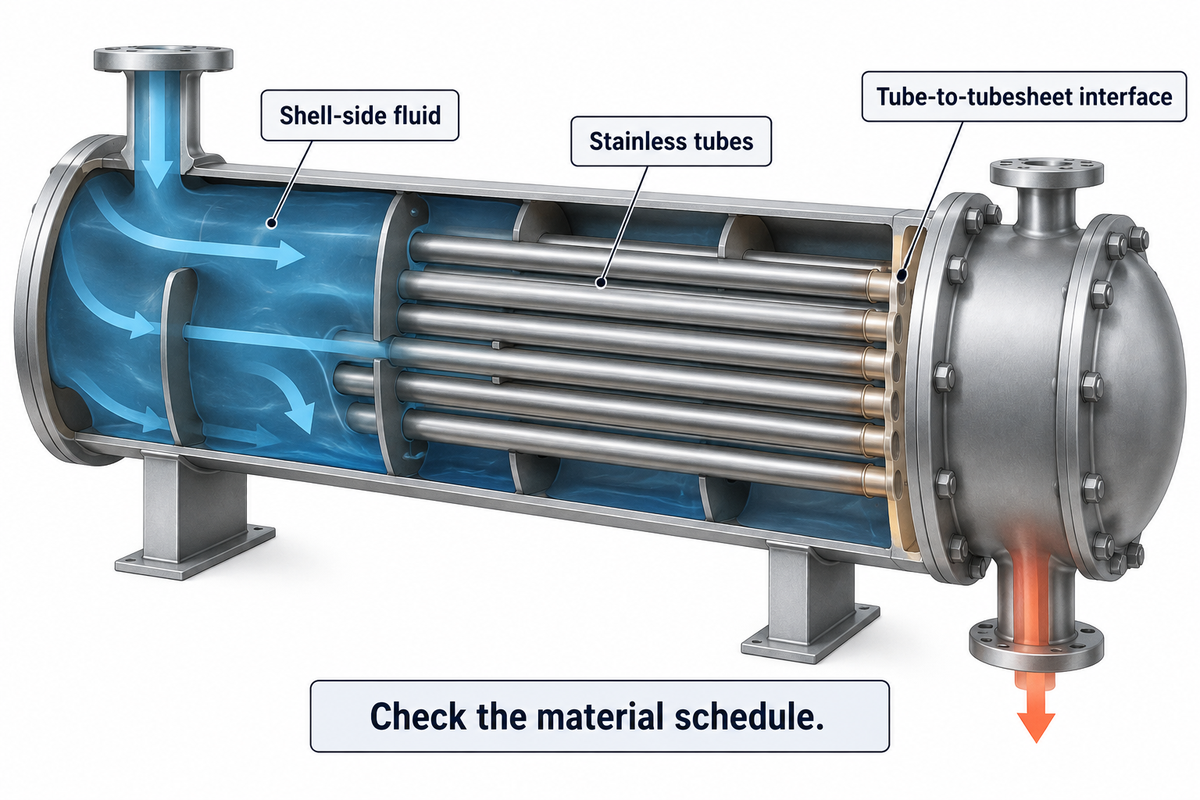
Utilice esta familia de componentes cuando las prácticas de construcción se ajusten a su química, presión y función de fluidos, así como al método de mantenimiento. El acero inoxidable describe una familia de materiales; no define todo el intercambiador. Evalúe los componentes que entran en contacto con cada uno de los circuitos de fluidos y luego verifique la disposición seleccionada con respecto a los casos de operación y limpieza.
La pared metálica separa los dos fluidos durante el funcionamiento normal, mientras que el calor pasa indirectamente a través de ella, un proceso llamado transferencia indirecta de calor. Para conocer el diseño al fondo, consulte nuestro principios operativos de carcasa y tubos.
“Las consideraciones clave incluyen la condición de los flujos de proceso y la huella disponible”
Como se describe en el Instituto de Intercambio de Calor, se pueden utilizar láminas tubulares revestidas para abordar las diferencias en los requisitos de material del circuito. Una capa compatible resistente a la corrosión puede proteger una lámina tubular mientras el respaldo proporciona espesor estructural. Registre por separado el revestimiento, el respaldo y la junta del tubo; el material de la carcasa por sí solo no describirá esa interfaz.
- Ingeniero de procesos: establece la función de calentamiento o enfriamiento y ambas composiciones fluidas.
- Planificador de mantenimiento: identifique qué superficies necesitan acceso y cómo se eliminarán los depósitos.
- Comprador: compare la construcción entregada con el cronograma de materiales aprobado.
Considere una combinación de carcasa y tubos sobre una alternativa de placa y marco con juntas, si su capacidad de presión o disposición de mantenimiento es más adecuada para el trabajo. Cuando dominan la compacidad y un enfoque de temperatura cercana, compare también las opciones de placa y marco. Ipieca cita la huella, la presión, la contaminación y la compatibilidad de las juntas como los factores principales; comparar construcciones para cada factor.
La drenabilidad y el acabado de la superficie, así como la compatibilidad de las juntas y los requisitos higiénicos, deberían formar parte de la especificación de un intercambiador sanitario. Un recipiente a presión industrial no se convierte en un intercambiador sanitario simplemente porque sus superficies visibles son de acero inoxidable.
Defina los casos operativos antes de solicitar una cotización
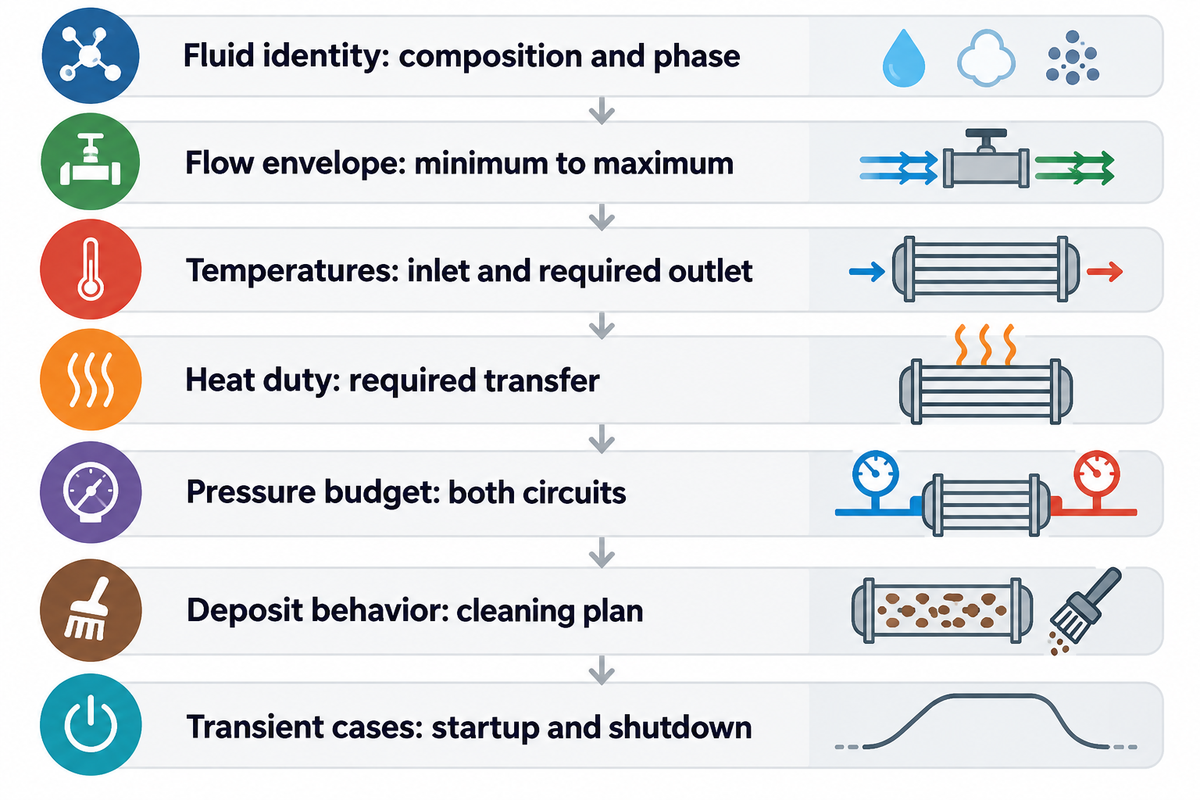
Proporcionar los mismos casos de proceso y servicios públicos para todos los postores, incluido el funcionamiento normal, las condiciones limitantes y la limpieza. Para cada circuito, indique las temperaturas de entrada y salida objetivo, los rangos de flujo y las propiedades del fluido. Distinguir entre la presión y temperatura del diseño mecánico y el rendimiento operativo requerido.
Un enfriador de agua puede suministrar agua más fría durante su prueba de aceptación de la que puede producir durante un día de producción caluroso. Calificar el intercambiador sólo a esa temperatura de entrada favorable deja a la planta sin un caso de enfriamiento de verano demostrado.
| Entrada | Especificar | Decisión cambia |
|---|---|---|
| Identidad fluida | Composición, contaminantes y fase de cada lado | Compatibilidad de materiales y base de propiedades |
| Sobre de flujo | Flujo de masa o volumen normal, mínimo y máximo | Capacidad, reducción y demanda hidráulica |
| Temperaturas | Entrada y salida requerida para cada caso clasificado | Fuerza impulsora de temperatura disponible |
| Servicio térmico | Transferencia de calor requerida en kW o BTU/h | Dimensionamiento térmico y base de aceptación |
| Presupuesto de presión | Caída de presión permitida en ambos circuitos | Compatibilidad de bombas y costo operativo |
| Comportamiento de los depósitos | Plan de sólidos, escalado, polimerización y limpieza | Subsidio por falta y acceso |
| Casos transitorios | Puesta en marcha, apagado, limpieza y pérdida de utilidad | Expansión térmica y revisión mecánica |
Indique si un galón está en unidades imperiales o estadounidenses y si un flujo se mide en condiciones operativas o de referencia. Para el servicio de vapor, indique las condiciones de presión y condensado; para un líquido, indique una viscosidad dependiente de la temperatura donde cambia sustancialmente.
Considere la falla del tubo interno durante la revisión de peligros del proceso. El ingeniero responsable debe evaluar la comunicación de presión entre circuitos y definir la base de protección. El Guía de diseño de plantas del Ejecutivo de Salud y Seguridad del Reino Unido enumera la ruptura y vibración del tubo como posibles peligros del intercambiador.
Seleccione Materiales para ambos circuitos fluidos
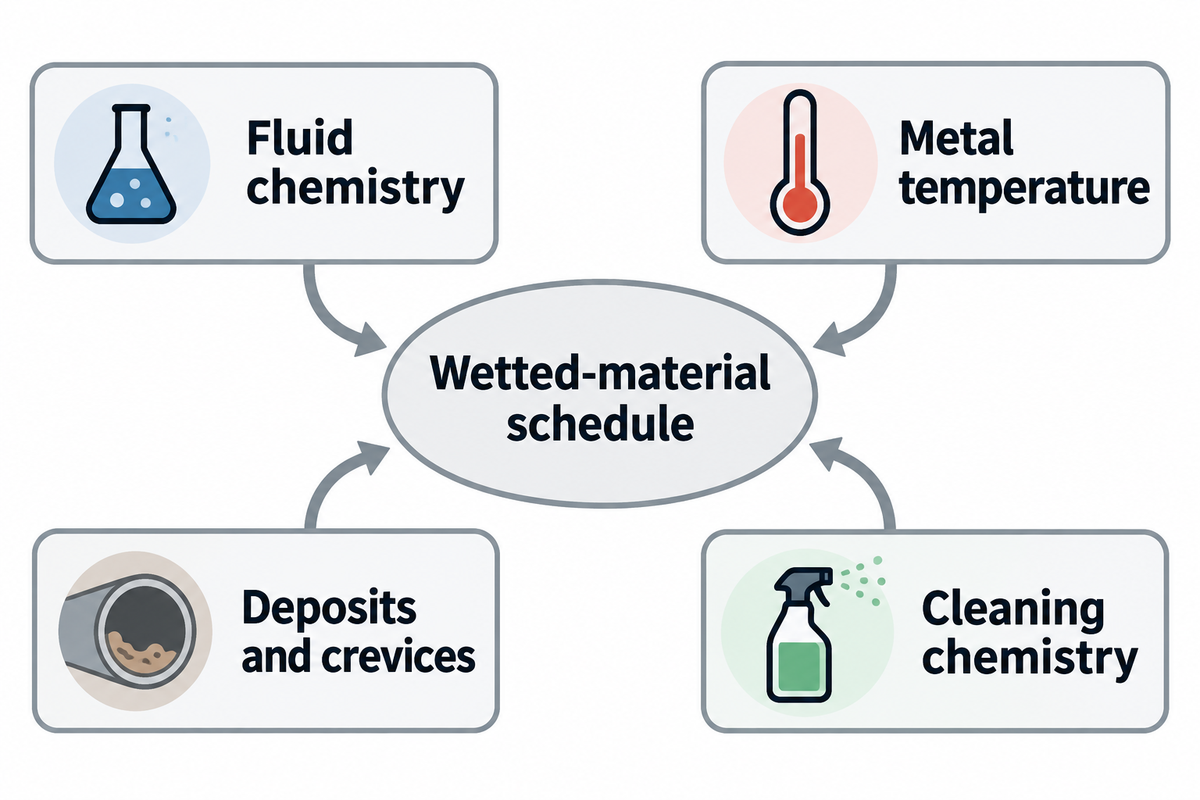
Al elegir acero inoxidable, considere el fluido, la temperatura del metal, los depósitos y la química de limpieza en cada lado. Para agua que contiene cloruro, evalúe 316L a la temperatura del metal esperada y las condiciones de depósito. Cree un programa de materiales húmedos que incluya tubos, láminas tubulares, canales, carcasa, sellos y sus interfaces, y luego compare los precios de compra.
| Información de servicio | Pregunta material | Acción de compra |
|---|---|---|
| Agua limpia y controlada | ¿los componentes especificados de acero inoxidable 304 o 316L son compatibles con el análisis completo del agua? | Adjunte límites de química y temperatura a la aprobación. |
| Agua de refrigeración que contiene cloruro | ¿cómo afectarán la temperatura, la concentración y los depósitos al ataque localizado? | Evaluar juntos el plan de gestión de aleaciones y agua. |
| Agua de mar o agua salada | ¿el dúplex u otra aleación propuesta se adapta a este servicio? | Revisar grietas, depósitos biológicos y condiciones de cierre. |
| Fluido de proceso ácido o alcalino | ¿Qué envoltura de concentración y temperatura está cubierta? | Incluye composiciones normales y alteradas. |
| Corriente portadora de sólidos | ¿Dónde se puede desarrollar la erosión o los depósitos? | Revise la geometría de la entrada y las rutas de limpieza accesibles. |
| Materiales mixtos de tubos y láminas tubulares | ¿se abordan los efectos articulares y galvánicos? | Especifique las superficies de contacto y cualquier revestimiento. |
| Piezas soldadas de acero inoxidable | ¿Qué requisitos de fabricación, limpieza e inspección se aplican? | Incluirlos en el ámbito de fabricación. |
| Limpieza química | ¿Son compatibles los materiales metálicos y de juntas con el método de limpieza? | Aprobar condiciones de concentración, temperatura y exposición. |
| Contacto con productos higiénicos | ¿Puede la asamblea completa cumplir con el plan de saneamiento? | Especifique los requisitos de acabado, drenaje y limpieza. |
Los aceros inoxidables 304L y 316L son candidatos, no una regla de selección completa. Considere la resistencia a la corrosión bajo las condiciones de fluido y superficie indicadas. La designación baja en carbono no elimina problemas de depósito, grietas o fabricación. Utilice las especificaciones precisas del material y la forma del producto en el pedido. Nuestro tube-sheet materials and joint design guide provides more information on this component.
Un grado dúplex todavía necesita control de depósitos
Ardy and others looked at a seawater-cooled exchanger made with UNS S31803 duplex tubes and tubesheets. After 28 months, 26 of its 270 tubes had leaked and scale had blocked another 76. The researchers attributed the corrosion to deposits and microbiological activity on the tube surfaces. The lesson for the purchaser is to examine the water treatment and cleaning processes and decide on an alloy accordingly. Increasing the alloy specification won’t remove deposits by itself. This case describes the history of this particular exchanger, and isn’t a reflection of expected duplex service life. The original Metals investigation describes the evidence of deterioration and exam methods.
Compare diseños de láminas de tubos fijos, tubos en U y cabezales flotantes
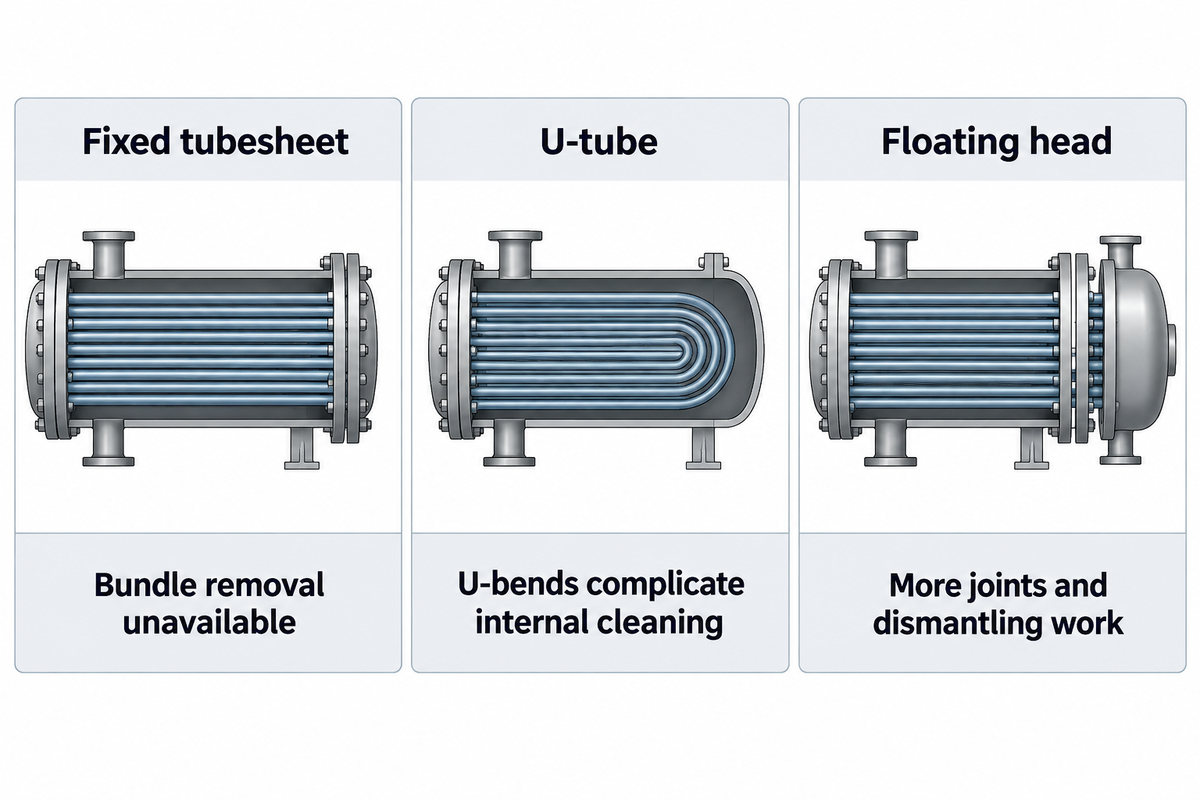
Choose the construction around the surfaces that must be cleaned and the expected differential thermal expansion. Fixed tubesheets are suitable where there’s an adequate shell-side cleaning strategy. Removable U-tubes and floating-head arrangements give access for maintenance with different degrees of ease, but complex geometries of tubes and joints change the nature of the maintenance work.
| Arreglo | Useful characteristic | Tradeoff to resolve | Shortlist when |
|---|---|---|---|
| Hoja de tubo fija | Straight tubes with fixed end connections | Bundle removal is unavailable; differential expansion needs assessment. | Shell-side fouling can be managed with the proposed cleaning method. |
| Tubo en U | Removable bundle with room for tube expansion | Internal U-bends complicate mechanical tube cleaning. | Shell-side access matters and the tube-side cleaning method suits the bends. |
| Cabeza flotante | Removable straight-tube bundle and expansion accommodation | Additional joints and dismantling work affect cost and maintenance. | Access to both tube interiors and external bundle surfaces is valuable. |
Bill Huffman of Ward Vessel and Exchanger explains these tradeoffs in his TEMA-type selection article. It also shows why the front head is important. Some covers allow access to tubes without disconnecting inlet and outlet piping.
Plan around the construction: Bill Huffman states that fixed tubesheets restrict shell-side cleaning, while removable U-tube bundles allow more complete shell-side cleaning. Indicate each opening operation and the bundle withdrawal path on the general arrangement with the maintenance planner. A nearby pipe rack can obstruct a removable bundle. It provides little value to pay for the removal capability if the plant plans to replace the entire unit, and there’s no practical bundle withdrawal path.
Choose by the cleaning route
- Do: identify which side fouls and show how its surfaces become accessible.
- Do: compare expansion behavior across the specified operating cases.
- Avoid: treating “removable” as a complete maintenance plan.
Verifique el rendimiento térmico junto con la caída de presión
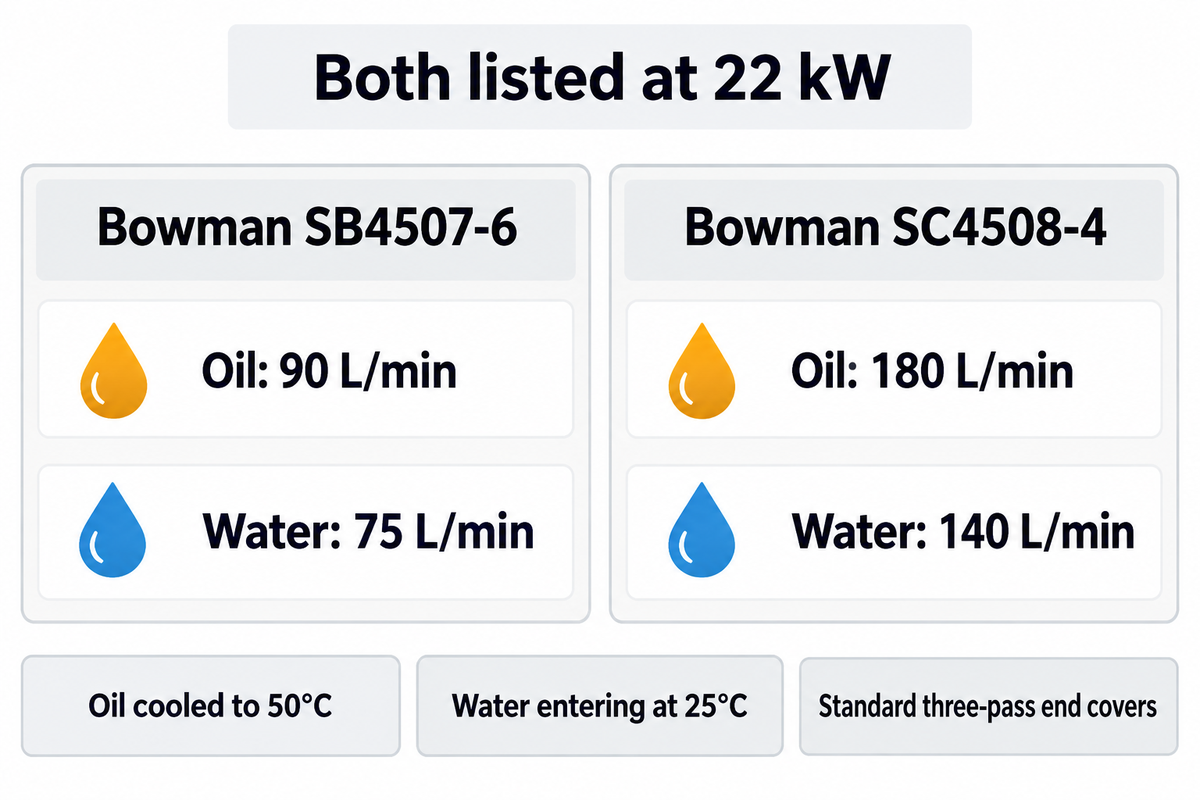
Accept a thermal rating only if the fluid conditions, flow rates and pressure drop are stated for both sides. Equal heat duty can require different hydraulic inputs and equipment dimensions. Consider the plant’s utility and pump capacity. Then review fouling and vibration for the chosen geometry.
Comparación de cotizaciones de igual deber
Bowman’s stainless steel catalogue lists the following two models at 22 kW. Its table uses oil cooled to 50°C, water entering at 25°C, and standard three-pass end covers.
| Manufacturer model | Heat dissipated | Oil flow | Water flow | Catalogue dimension A | Mass |
|---|---|---|---|---|---|
| Bowman SB4507-6 | 22 kW | 90 L/min | 75 L/min | 1114 mm | 20 kg |
| Bowman SC4508-4 | 22 kW | 180 L/min | 140 L/min | 764 mm | 21 kg |
Obtain a service-specific rating with fluid conditions and allowable pressure loss, before replacing either model. Catalogue dimension A is a drawing dimension, and not bundle withdrawal clearance.
In a shell and tube heat exchanger, baffle spacing, tube design and pass arrangement influence the flow path. More turbulence can support efficient heat transfer while consuming more pressure budget. Have the supplier state the thermal and hydraulic results, including the fouling basis.
- Thermal check: required outlet temperature at the limiting utility condition, with the stated fouling allowance.
- Hydraulic check: shell-side and tube-side pressure drop at each specified flow case.
- Mechanical check: flow-induced vibration assessment for the proposed supports and baffle geometry.
A multipass rating should be based on the actual flow arrangement. Assuming ideal counter-flow can hide the temperature relationships inside the selected unit. Ask how the proposal behaves at turndown as well as peak load; a favorable full-load result does not answer both cases.
Reserve espacio para limpieza y eliminación de paquetes
Reserve the working envelope shown by the exchanger and maintenance equipment drawings before committing to a final plant layout. Bundle withdrawal, cover removal, lifting access and laydown space are separate requirements. A construction that can be removed easily loses its value if it isn’t accessible.
Mapa de cuellos de botella de acceso de mantenimiento
| Verificar | If unavailable | Resolve through |
|---|---|---|
| Bundle withdrawal path | The bundle cannot leave the shell in the planned direction. | A dimensioned removal envelope and revised layout |
| Cover removal space | Tube ends remain inaccessible. | Head selection and local working clearance |
| Piping disconnection | Connected spools obstruct opening. | Removable spool and isolation planning |
| Puller approach | Maintenance equipment cannot align with the bundle. | Equipment approach and support drawings |
| Lifting route | The removed assembly cannot reach laydown. | An approved lifting and transfer plan |
| Laydown area | There is no supported location for inspection. | A designated support and work area |
| Drain and vent access | Preparation for opening is obstructed. | Accessible connections and isolation procedure |
| Cleaning containment | Wastewater or deposits cannot be handled as planned. | Containment, drainage and disposal arrangements |
| Return-to-service checks | Inspection and assembly work cannot be completed in place. | Access for the specified inspection and testing scope |
Reserve a clear withdrawal path and plan how the bundle will be handled. Assess the front-end design to determine how easily tube ends can be cleaned. In a hypothetical retrofit, a site chooses a removable bundle to reduce the duration of an outage, but a cable tray is placed in the bundle withdrawal path. The exchanger fits within the operating footprint of the site, but the means to perform maintenance doesn’t. The cost of changing the tray may be less than resolving the conflict after the exchanger is installed. Review the drawings to determine the maintenance method and identify the agreed access path in the documentation package.
When assessing tube bundle pullers for heat exchanger maintenance, include bundle dimensions and mass, pull direction, support arrangement and site access. Coordinate pulling plans with bundle cleaning planning.
¿Se puede reparar un intercambiador de calor de carcasa y tubos de acero inoxidable?
Yes, after inspection establishes the damage and an approved repair scope, the extent of repair will depend on the nature of the damage, inspection report, construction, condition and applicable pressure equipment code. Tube work, gasket replacement and bundle replacement have different access requirements that should be considered during the original selection.
For exchangers, identification records, repair history and reports should be requested. Have the responsible specialist assess whether the proposed work restores the required service capability. A thermal rerating may also be required in the case of changes to the flow arrangement or availability of heat-transfer surface. Access should be provided for required inspections and tests.
Compare cotizaciones sobre la misma base técnica y comercial
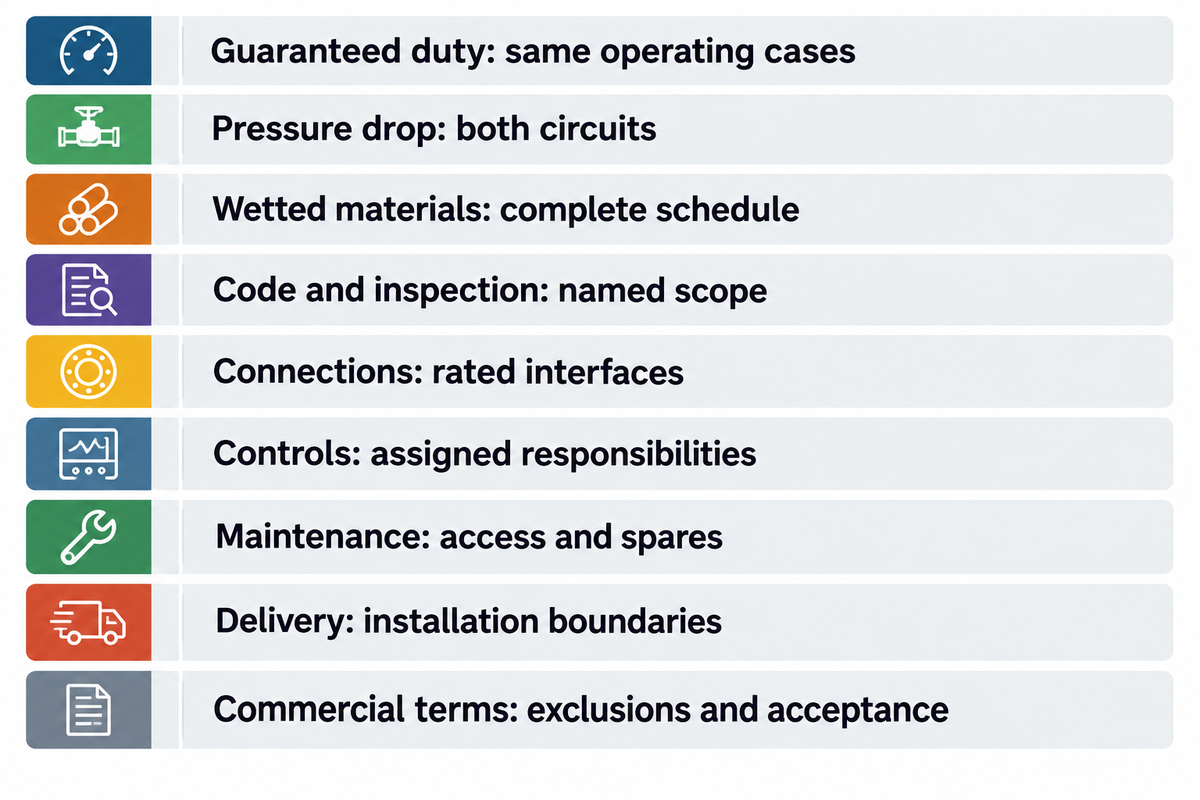
Quotations should be compared against one accepted duty sheet and one defined supply scope. Equipment prices should be separated from installation, utilities and maintenance costs. Any price advantage should be clear, and any price premium for the exchanger should be justified by operating or maintenance improvements.
| Comparison line | Require in every bid | Cost or risk exposed |
|---|---|---|
| Guaranteed duty | Same fluids, temperatures and flow cases | Undersized or differently rated equipment |
| Pressure drop | Both circuits at agreed conditions | Pump changes and electricity demand |
| Wetted materials | Complete component schedule | Unpriced metallurgy changes |
| Code and inspection | Named edition, scope and documents | Testing or certification exclusions |
| Connections | Port size, rating, orientation and interfaces | Piping adapters and field alterations |
| Controls and instruments | Valve, gauge, sensor and control responsibilities | Missing installation scope |
| Mantenimiento | Access drawings, spares and opening requirements | Shutdown work and handling equipment |
| Delivery | Packing, transport, installation and commissioning boundaries | Unbudgeted site work |
| Commercial terms | Lead time, warranty, exclusions and acceptance method | Schedule and performance disputes |
Ipieca’s exchanger guidance includes foundations, controls, connecting equipment and commissioning in the cost scope. That is a more useful baseline for comparison than a generic price per unit of heat duty.
Finance estimates that each avoided maintenance disruption would save USD 3,000 in recoverable labor and production costs. Assume a removable arrangement costs USD 12,000 more than the acceptable fixed-tubesheet alternative. Simple break-even is USD 12,000 divided by USD 3,000, or four avoided events. If the avoidable cost is only USD 1,500 per event, the requirement becomes eight events. These are assumed values, not market prices or promised savings. The calculation excludes financing and any additional handling costs. Finance has to check which costs are recoverable, and maintenance must explain which events the arrangement could actually avoid. If the arrangement doesn’t reduce the shutdown time for cleaning, then the benefit must also be reduced before the premium is granted.
Solicitar los Documentos que Resuelvan los Riesgos de Compra

The purchase package should combine rated cases, a material schedule, general arrangement, inspection records, and other pertinent information to trace the promised duties to construction and maintenance. Identify the applicable code sections and editions. State the required reviews for vibration, pressure-protection, and assembly.
- Performance: thermal rating, fluid-property basis, pressure drop and fouling allowance.
- Construction: materials, tube-to-tubesheet joints, gasket details and agreed examination scope.
- Mechanical suitability: design conditions, expansion assessment and relevant vibration review.
- Pressure protection: project assessment of internal leakage or tube rupture and the required protective provisions.
- Maintenance: opening sequence, access envelope, spare-parts identification and approved assembly information.
For an ASME-stamped vessel, identify the required Boiler and Pressure Vessel Code section and certification-mark scope in the order. Verify the delivered equipment documents are in compliance with the construction and certification basis of the jurisdiction of installation.
El API 660 scope brochure addresses shell-and-tube equipment for petroleum, petrochemical and natural-gas industries. Identify the project edition and exceptions in the inquiry. Our API 660 heat exchanger requirements article develops that standards topic separately.
A 2025 flange-assembly case by Daru and colleagues discussed leakage associated with an imposed assembly limit. The purchaser finally approved an engineering calculation for the joint. Agree on the compatible gasket and bolting, and assembly, before delivery; leave bolt-load calculations to the qualified designers and maintenance personnel.
¿debería aislarse un intercambiador de calor de carcasa y tubos de acero inoxidable?
Yes, insulate it if the thermal design or personnel protection assessment requires it. Hot service may require protected touch surfaces or reduced heat loss; cold service may require condensation control. Specify the complete insulation system, including weather protection and inspection access, against the equipment’s service and site conditions.
Keep removable covers, identification plates and required inspection points accessible in the insulation layout. Co-ordinate supports and removable sections with the maintenance plan. Losses in the connected piping, and the vessel, should be addressed, when evaluating heating efficiency. The supplier and site designer should agree on insulation scope, before installation. Removable sections should be included, where opening the exchanger is part of the planned maintenance work.
Utilice una matriz de decisión de selección final
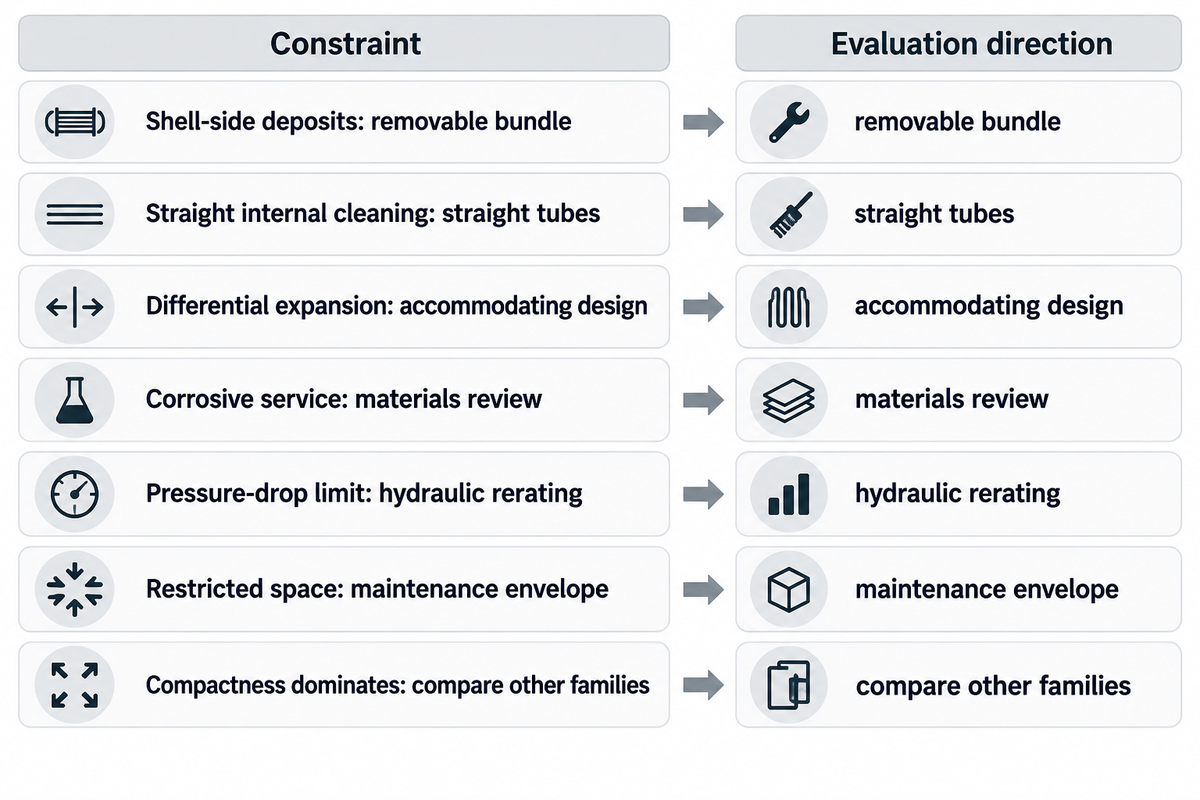
The arrangement which satisfies operating requirements and maintenance constraints should be shortlisted. Close any unresolved material, hydraulic or access issue before the award of the contract. If the proposed equipment family can’t satisfy a critical requirement, alternatives should be compared using the same process sheet rather than relaxing that requirement.
| Dominant constraint | Selection direction | Close before ordering |
|---|---|---|
| Shell-side deposits need direct access | Evaluate a removable bundle. | Withdrawal route and cleaning method |
| Tube interiors require straight mechanical access | Compare straight-tube arrangements. | Head access and tube-cleaning reach |
| Large differential expansion | Review an expansion-accommodating design. | Mechanical assessment across all cases |
| Uncertain corrosive service | Complete the materials review before fixing the alloy. | Fluid analysis and cleaning chemistry |
| Tight pressure-drop budget | Request a hydraulic rerating or alternate geometry. | Both circuit pressure losses |
| Restricted floor space | Compare operating and maintenance envelopes. | Access route, not just footprint |
| Close temperature approach or compactness dominates | Include another exchanger family in the comparison. | Materials, pressure duty and serviceability |
For an industrial process tied to boiler systems, furnace heat recovery or another heating source, consider surrounding system boundaries. An exchanger can transfer heat efficiently at its rated point while the complete heating and cooling system still loses energy due to control or utility mismatches. For hot water heating systems, consider return temperature and control strategy for the operating cases.
Perspectivas de la industria: especifique claramente la revisión de TEMA 2026
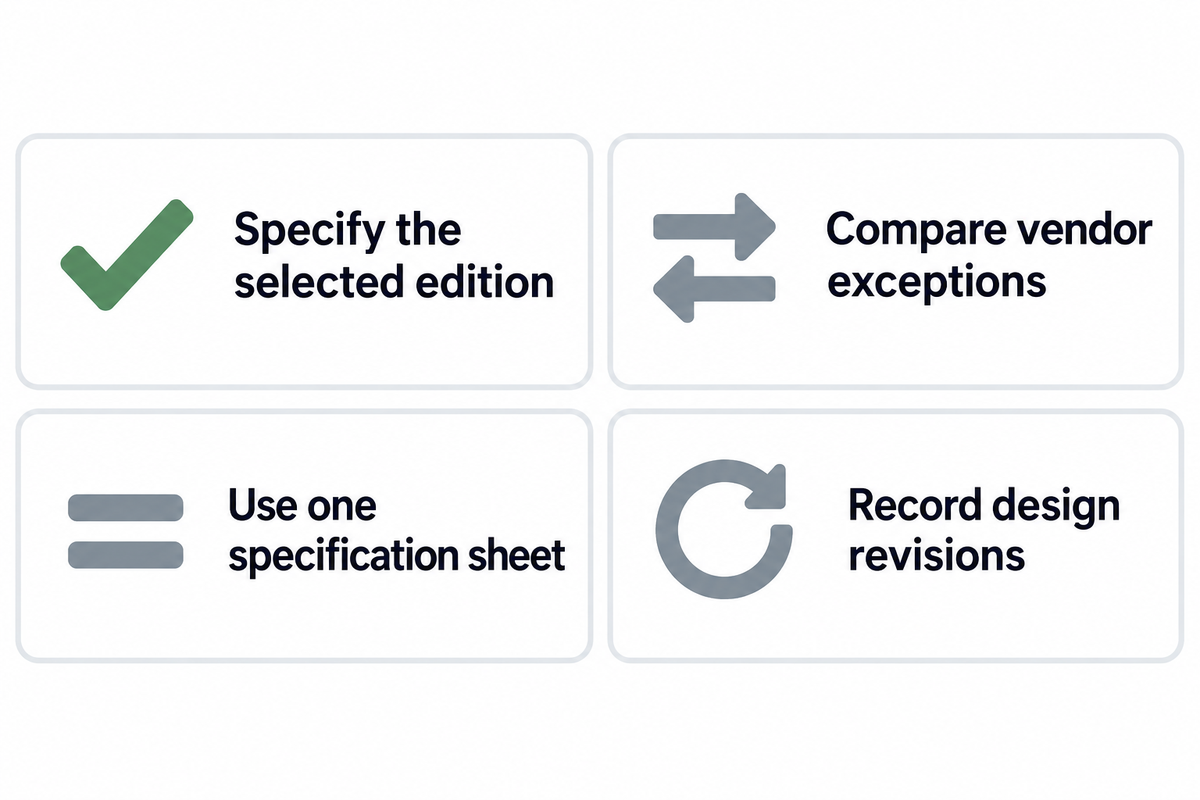
The announcement of the 2026 edition of TEMA’s guidance recognizes the need for an update of process specification information. Name the contract version in your queries and compare exceptions with it. Announcement of new equipment standards generally doesn’t make existing equipment obsolete.
TEMA’s publisher announcement identifies additions concerning weir plates, floating-head retaining rods, high-pressure channel pass partitions and U-bend supports. It also describes a rod-baffle appendix and an updated heat exchanger specification sheet.
Those updates relate to different pieces of equipment. A person evaluating a U-tube proposal is concerned with different issues than a person evaluating a kettle reboiler proposal. Ask the designer to indicate the provisions pertinent to the equipment in the proposed arrangement and list any exceptions.
TEMA also addresses changes in the treatment of SI-units and better alignment of stock material sizes. Decide on the governing unit system for drawings, material schedules and analyses. Converting a headline capacity into another unit does not resolve inconsistent dimensions or material requirements elsewhere in the purchase package.
- Put the selected edition on the inquiry and purchase order.
- Obtain the vendor’s exception list before comparing final prices.
- Use the agreed specification sheet for every bidder.
- Record how substitutions or design revisions affect the accepted documents.
Identify the existing shell and interfaces as well as the original documentation and the new supply scope when requesting a replacement bundle. The purchaser should define the requirements of the new contract, while the designer should address compatibility with the existing equipment rather than treating the replacement as an unrelated catalogue item.
Exceptions to the requirements should be resolved prior to starting fabrication.
Preguntas frecuentes
¿316L es siempre el grado de acero inoxidable adecuado?
No. Seleccione 316L frente al fluido del proceso, el medio de enfriamiento, la temperatura del metal y la química de limpieza. Los depósitos, grietas y condiciones de fabricación que contienen cloruro pueden afectar el riesgo de corrosión. Cuando se proponga acero inoxidable 316L, registre las piezas humedecidas exactas y evalúe sus condiciones de servicio. Registre los grados de tubos y láminas tubulares, así como las juntas y el método de limpieza aprobado.
¿Qué mantenimiento se requiere para un intercambiador de calor de acero inoxidable?
Se debe monitorear el rendimiento térmico y la caída de presión e inspeccionar el equipo en busca de fugas. Las incrustaciones deben limpiarse de acuerdo con el plan de mantenimiento aprobado. El acceso al lado del tubo y la carcasa del equipo está determinado por la construcción. Registre la línea base de operación limpia para investigar los cambios. También incluya juntas, requisitos de apertura, repuestos e inspección antes de volver al servicio.
¿Cuánto cuesta un intercambiador de calor de carcasa y tubos de acero inoxidable usado?
Los precios de compra de los intercambiadores de calor de carcasa y tubos de acero inoxidable usados se basan en el estado y evaluación de cada unidad. Compare los precios de compra con los costos de inspección, reparación, reración, transporte e instalación. Verifique la identidad, las condiciones de diseño, los materiales y el historial de mantenimiento de cada unidad antes de utilizar un intercambiador usado en el servicio.
¿dónde se utilizan los intercambiadores de calor de carcasa y tubos?
Las aplicaciones típicas incluyen enfriamiento de procesos, calefacción, recuperación de calor y servicios que condensan vapor o evaporan líquido. Las aplicaciones industriales tienen diferentes necesidades de confiabilidad y mecanismos de daño. El equipo utilizado para enfriar el aceite lubricante tiene diferentes entradas de selección de un condensador que maneja una corriente de proceso corrosiva.
¿Puede un intercambiador de calor de piscinas reemplazar un intercambiador de procesos industriales?
Sí, un intercambiador de calor para piscinas puede reemplazar un intercambiador de procesos industriales si su clasificación documentada, materiales y construcción satisfacen el deber industrial. Los intercambiadores de calor para piscinas a menudo se seleccionan para calentar agua de piscinas o spas a través de un circuito de agua de caldera separado. Si los operadores cloran el agua de la piscina, tenga en cuenta la exposición al cloro y la química del agua especificada. Un intercambiador de calor de titanio puede ser candidato para algunos servicios de piscinas; Eválelo también frente al deber industrial. El Heat Exchange Institute basa la selección de materiales en la resistencia a la erosión y la corrosión de la composición química del fluido circulante. Verifique la presión, la temperatura, la compatibilidad de fluidos, los controles y los requisitos de inspección junto con la capacidad de la piscina antes de la sustitución.
¿Cuánto durará un intercambiador de acero inoxidable?
Los mecanismos de daño real limitan la vida útil de un intercambiador de acero inoxidable y su historial de mantenimiento informa la evaluación de la vida útil restante. Determine los intervalos de inspección en función del riesgo de servicio y los hallazgos de condición. Realice un seguimiento de las tendencias de corrosión, fugas y incrustaciones para poder planificar la reparación o el reemplazo antes de que se pierda la capacidad operativa requerida.
¿Cómo debo comparar proveedores y modelos de equipos?
Emitir una hoja de tareas y requerir una comparación técnica y comercial completa para cada propuesta. Verifique los casos, materiales, pérdidas de presión y acceso para mantenimiento antes de comparar el precio final. Se debe pedir a cada proveedor que indique exclusiones y desviaciones. Luego evalúe la entrega, el estado de los documentos, la disponibilidad de repuestos y el método de aceptación. Un modelo de catálogo puede ser un punto de partida; sin embargo, la decisión de compra debe estar ligada a la configuración del equipo y las condiciones operativas ofrecidas para su sitio.
Referencias y fuentes
- Heat Exchange Institute: Tech Sheet 137, Heat Exchanger Cladding
- Ipieca: Heat Exchangers, Energy Efficiency Compendium
- Bill Huffman: Understanding TEMA Types for Shell-and-Tube Exchangers
- Ardy et al.: Failure Analysis of Duplex Stainless Steel Heat Exchanger Tubes in Seawater Service, Metals, 2023
- UK HSE: Design Codes, Plant
- ASME: Boiler and Pressure Vessel Certification
- API: Standard 660 Scope Brochure, Ninth Edition
- Daru et al.: Heat Exchanger Body Flange, the Gasket Is Not Always Tight Enough, 2025
- TEMA: 2026 Standards Edition Announcement