
BOSHIYAと連絡を取りましょう
Updated August 2026. Reviewed for petroleum-refinery scope, sourcing usefulness, and high-temperature safety boundaries.
Thermal cracking in petroleum refining is the use of heat to split large hydrocarbon molecules into smaller fractions. It belongs to the conversion side of a refinery, where operators are no longer only separating crude oil by boiling range. They are changing heavy molecules into lighter products, residue streams, gas oil, naphtha, gases, and, in severe cases, petroleum coke.
This article is about refinery thermal cracking. It is not about thermal cracks in concrete, asphalt, roof shingles, steel tooling, or heat-transfer fluid degradation. That distinction matters because the search term is noisy. A refinery buyer who searches for thermal cracking usually needs a practical process boundary: where visbreaking fits, how delayed coking differs, when catalytic cracking or steam cracking should be treated as a separate subject, and what equipment information belongs in an RFQ.
Quick answer: in petroleum refining, thermal cracking breaks heavy hydrocarbons through high temperature rather than a catalyst. The useful project question is not simply “Do we need thermal cracking?” It is “What feed, product target, coke risk, pressure boundary, heat-transfer duty, and downstream unit does this residue-conversion service require?”
What Thermal Cracking Does to Heavy Hydrocarbons

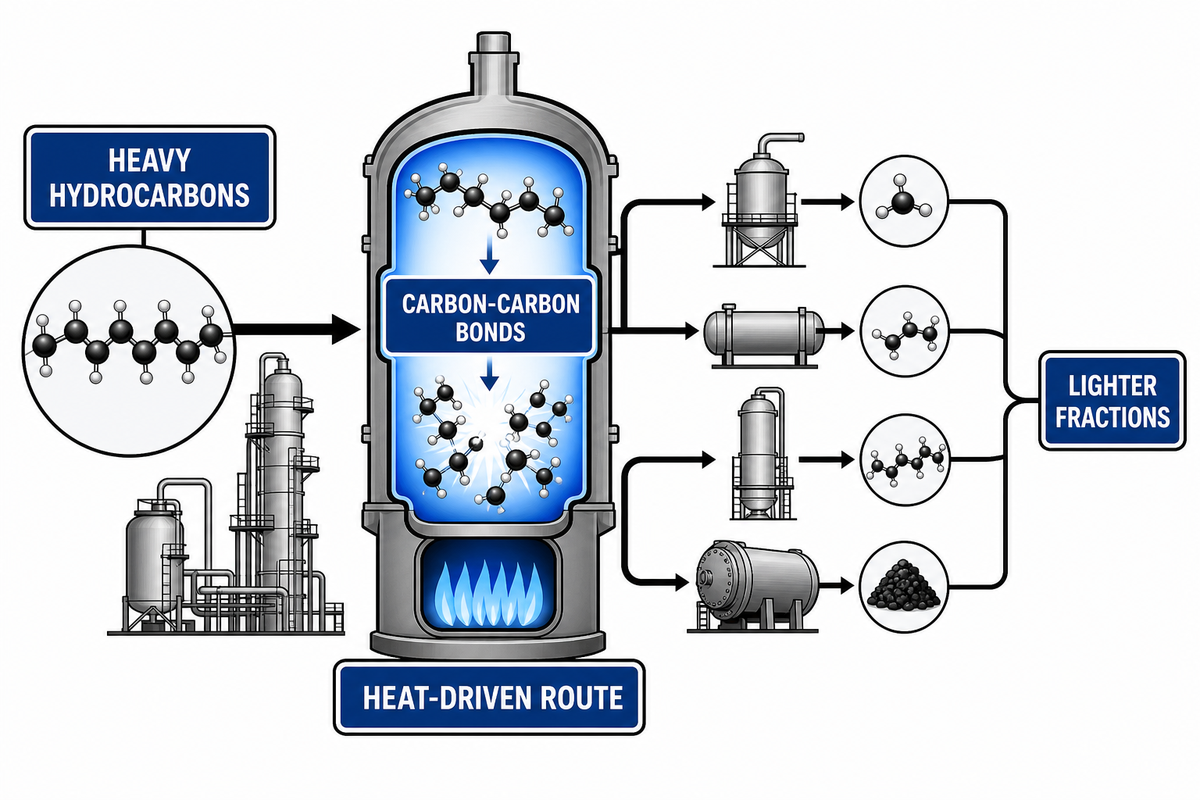
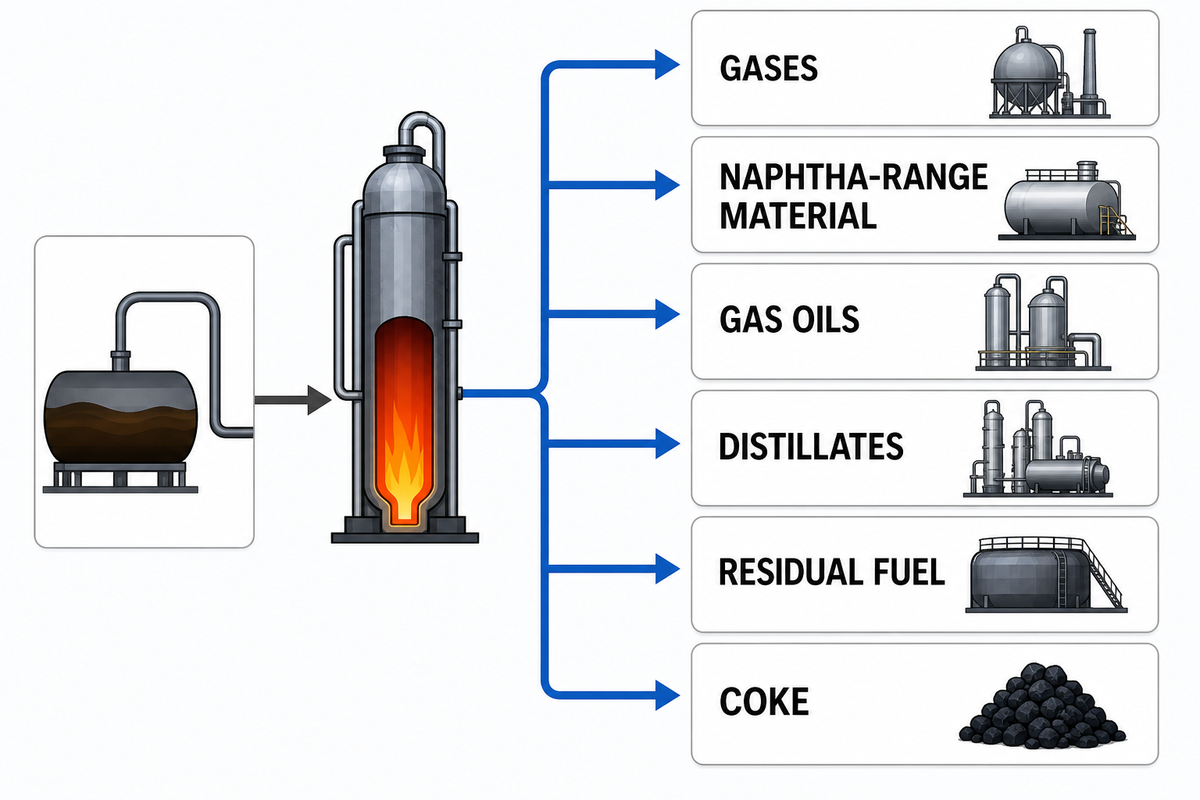
Heavy petroleum fractions contain long-chain and high-molecular-weight hydrocarbons that may be too viscous, too heavy, or too low in direct product value. Thermal cracking applies heat so carbon-carbon bonds break and smaller molecules form. Those products may include lighter distillates, naphtha-range material, gas oil, refinery gases, olefinic components, and coke depending on feedstock and severity.
Penn State’s petroleum-refining course describes thermal cracking as a heat-driven route that historically helped convert heavier hydrocarbons into lighter distillates, while modern refineries rely on different thermal routes for specific residue-upgrading duties. Britannica’s refining reference similarly separates visbreaking, thermal cracking, and coking by conversion severity and product outcome.
For engineering and procurement, the important point is that “thermal cracking” is a process family, not one universal equipment package. A mild viscosity-breaking service, a delayed coking unit, and an ethylene steam cracker may all involve heat and hydrocarbon cracking, but their business purpose, metallurgy, heater duty, cycle pattern, safety review, and product slate are not the same.
| Term | Refinery meaning | Buyer implication |
|---|---|---|
| Thermal cracking | Heat-driven cracking of larger hydrocarbons into smaller molecules. | Define feed, severity, product target, and safety envelope before asking for equipment. |
| Visbreaking | Mild thermal cracking of vacuum residue to reduce viscosity and make some lighter products. | Focus on residue stability, viscosity target, heater/reactor duty, and coke control. |
| Delayed coking | Severe residue conversion with coke drums and carbon rejection as petroleum coke. | Specify coke-drum cycle assumptions, decoking boundary, fractionator duty, and safety systems. |
| Catalytic cracking / steam cracking | Adjacent cracking routes with different chemistry and equipment goals. | Use them as comparisons, not substitutes, when the project is about residue thermal cracking. |
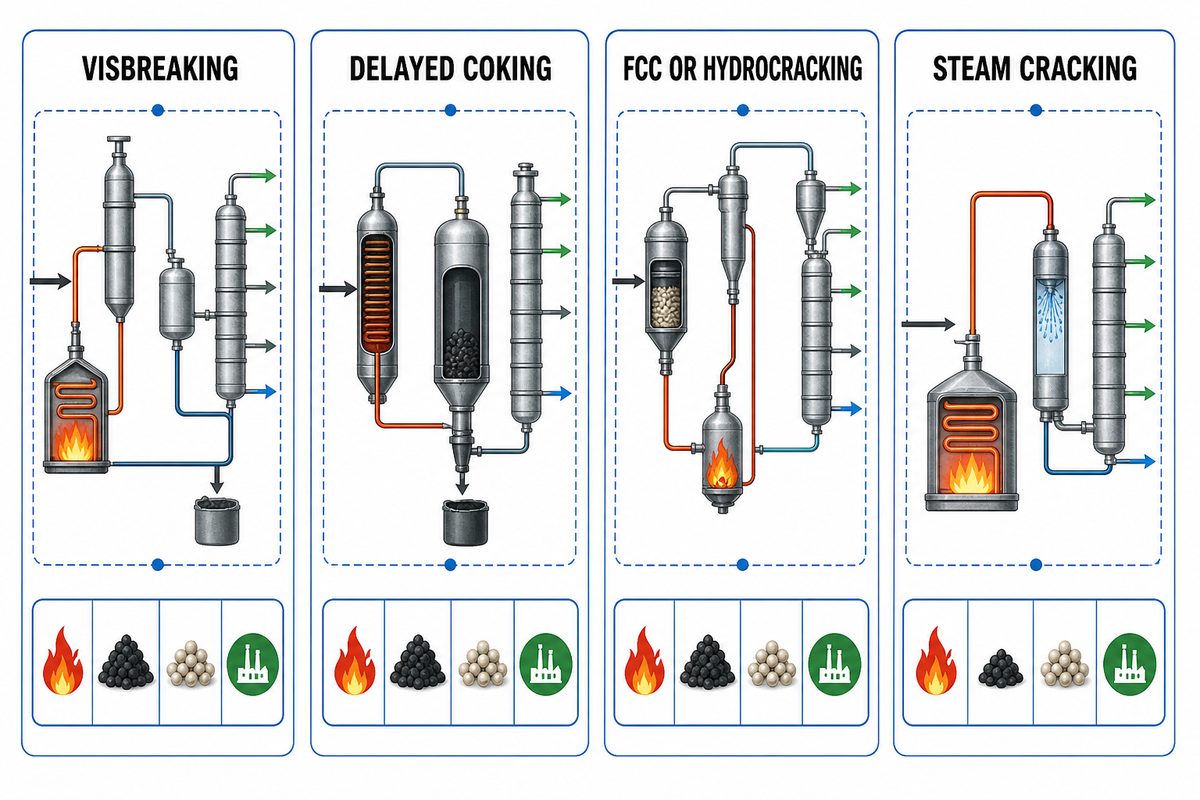
Where Thermal Cracking Fits: Visbreaking, Coking, FCC, and Steam Cracking

A refinery uses conversion processes after distillation has already separated crude oil into broad fractions. If a crude slate leaves too much heavy residue, the refinery has to decide whether to reduce viscosity, reject carbon, add hydrogen, or use catalytic cracking to upgrade gas oils. Thermal cracking sits inside that decision tree.
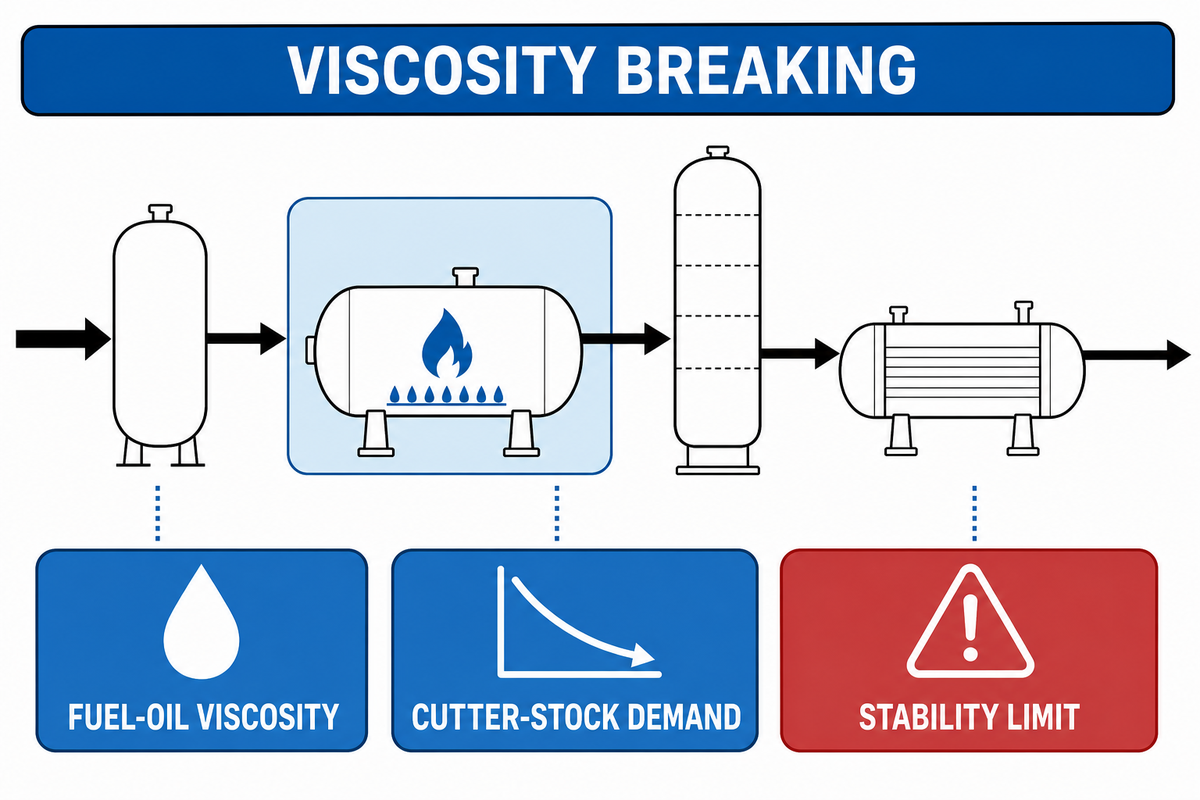
Visbreaking is usually the mildest thermal residue route. Its main commercial task is not to maximize gasoline. It is to reduce the viscosity of vacuum residue so less cutter stock is needed and some lighter products are recovered. Penn State notes a typical 10-25% conversion range for heavy ends in visbreaking, with the important caveat that feed stability and coke formation limit severity.
Delayed coking is more severe. The heated residue is routed to coke drums, lighter vapors are recovered to a fractionator, and carbon is rejected as petroleum coke. In a Penn State delayed-coking example, the feed is heated to about 475°C at low pressure before entering coke drums, with cycle and coke yield depending on feed properties and operating variables. Those numbers are source-specific examples, not universal design defaults.
Fluid catalytic cracking is different because a catalyst controls the cracking pathway and gasoline-quality objective. Steam cracking is also different because it is usually discussed in petrochemical olefin production rather than refinery residue viscosity or coke-drum operation. A strong thermal cracking article should make those distinctions early so it does not cannibalize FCC or steam-cracking content.
Severity Is the Control Lever, Not the Goal

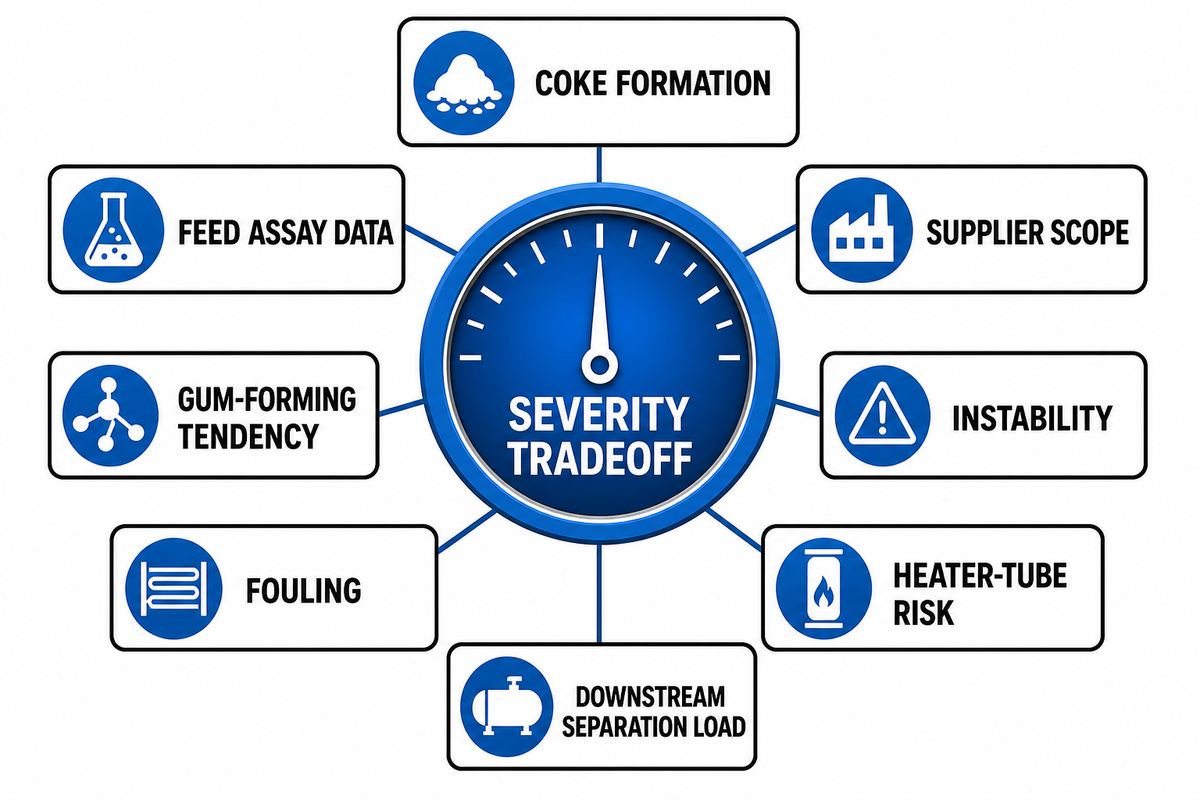
A common mistake is to think that more heat always means better cracking. In refinery practice, severity is a controlled tradeoff. Higher temperature or longer residence time can increase conversion, but it can also raise coke formation, gum-forming tendency, instability, fouling, heater-tube risk, and downstream separation load.
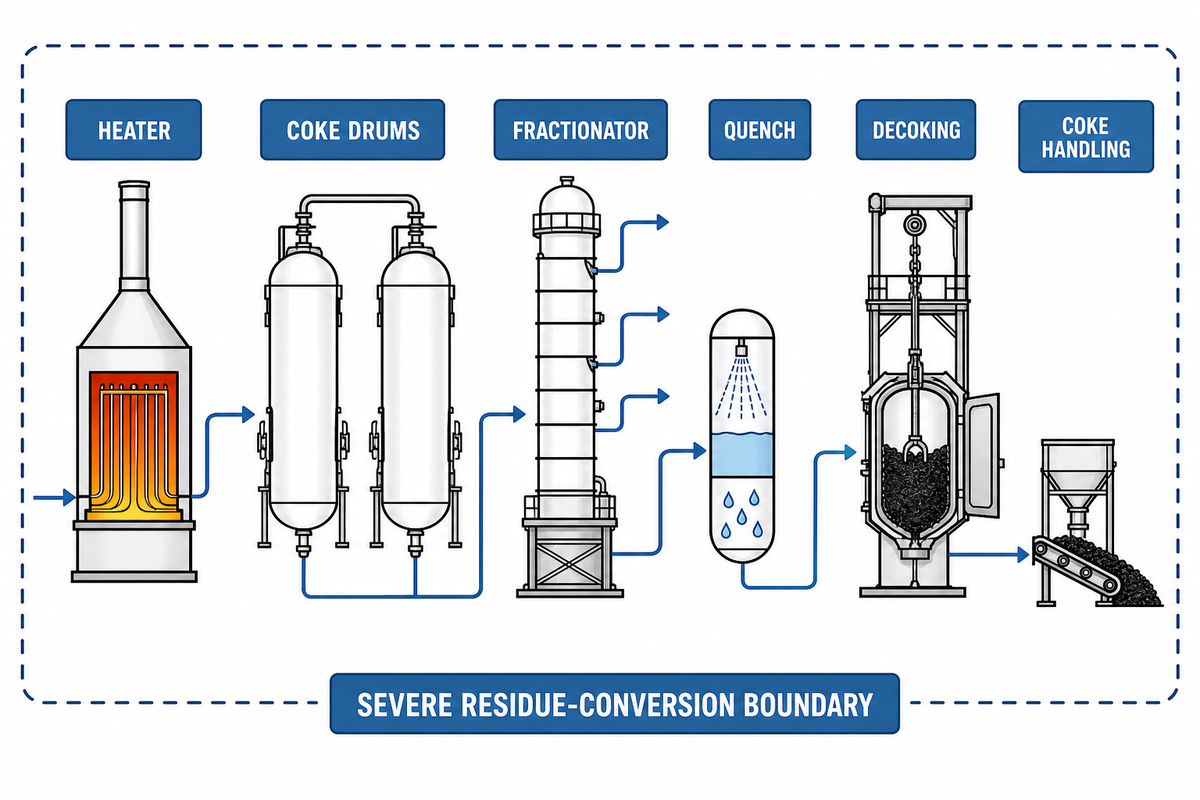
For visbreaking, the limit is often product stability. If the residue is pushed too far, asphaltenes and carbon residue can make the fuel oil unstable. For delayed coking, the process intentionally rejects carbon, but the project must still manage heater coking, coke-drum switching, quench, fractionator separation, coke handling, and safe decoking procedures.
That is why an RFQ should not ask only for a “thermal cracking unit.” It should state crude/residue characteristics, target product slate, viscosity target if relevant, coke yield expectations if relevant, desired material codes, corrosive service assumptions, inspection documentation, and the limits of the supplier scope.
| Control variable | What it affects | Risk if oversimplified |
|---|---|---|
| Feedstock quality | Crackability, sulfur/metals burden, coke tendency, product value. | Wrong metallurgy, wrong fouling assumptions, weak product forecast. |
| Temperature and residence time | Thermal severity, conversion, stability, and coke formation. | Treating a lab range as an operating instruction. |
| Pressure and vapor handling | Phase behavior, fractionation load, relief design, containment boundary. | Under-specified vessels, separators, piping, and safety devices. |
| Coke management | Heater fouling, drum cycle, decoking, maintenance access. | A unit that works on paper but fails during turnaround or decoking. |
Visbreaking: Mild Thermal Cracking for Residue Viscosity

Visbreaking is best understood as viscosity breaking. The refinery applies mild thermal cracking to vacuum residue or other heavy material so the final fuel-oil stream can meet viscosity limits with less dilution. The value may come from lower cutter-stock demand, modest distillate recovery, and better residue handling rather than from a headline gasoline yield.
The technical limit is stability. A feed with high asphaltenes or high Conradson carbon residue may be more prone to coke and unstable fuel-oil behavior. The project discussion should therefore include feed assays, desired viscosity, storage-stability expectations, heater duty, transfer-line conditions, and inspection/cleaning access.
For procurement teams, visbreaking belongs in a residue-upgrading conversation. It should not be mixed loosely with FCC, hydrocracking, or steam cracking. Each route can make lighter products, but the investment logic, hydrogen/catalyst requirements, residue boundary, and equipment package are different.
Delayed Coking: Severe Thermal Cracking and Coke Handling

Delayed coking is a severe thermal conversion route for the bottom of the barrel. Instead of trying to preserve a lower-viscosity residual fuel, the unit rejects carbon as petroleum coke and recovers lighter products for fractionation and downstream processing. The result is a different equipment and operating boundary from visbreaking.
A delayed coking project normally brings coke drums, heaters, a fractionator, quench systems, blowdown and recovery systems, coke cutting/handling interfaces, and a more visible mechanical-cycle problem. Coke drums fill, switch, cool, decoke, and return to service. That cycle makes layout, access, interlocks, inspection, and maintenance planning part of the front-end specification.
Source-specific delayed-coking examples often mention furnace outlet temperature, low pressure, drum cycles, and coke yield. Those values are useful for orientation, but they must not become copy-pasted design instructions. Feed properties and licensor design govern the real basis.
Products, Yields, and What Changes With Severity

Thermal cracking can produce gases, naphtha-range material, light and heavy gas oils, distillates, residual fuel components, and coke. The mix depends on feedstock and severity. Mild thermal cracking is often judged by viscosity reduction and stability. Severe coking is judged by residue conversion, liquid recovery, coke yield, and downstream processing value.
Britannica’s refining reference gives broad orientation: visbreaking units may convert about 15% of feedstock to naphtha and diesel oils; more severe thermal cracking can convert a larger share to light products; cokers can yield substantial petroleum coke. These figures help explain the process family, but a real project needs its own feed assay, product specification, and economic case.
For buyers, the product table should be tied to the equipment scope. If the inquiry is about pressure vessels, heat exchangers, columns, reactors, drums, or modular refinery packages, the supplier needs the stream basis and duty boundary. If the inquiry is about process licensing or operating severity, that should be separated from fabrication scope.
Safety Boundaries: High Temperature, Corrosion, and Coke Drum Risk

Thermal cracking content has a safety boundary. OSHA describes petroleum refining as processing flammable gases and liquids at high temperatures and pressures in vessels, equipment, and piping exposed to stress and corrosion. That is enough to make generic operating advice inappropriate for a public buying guide.
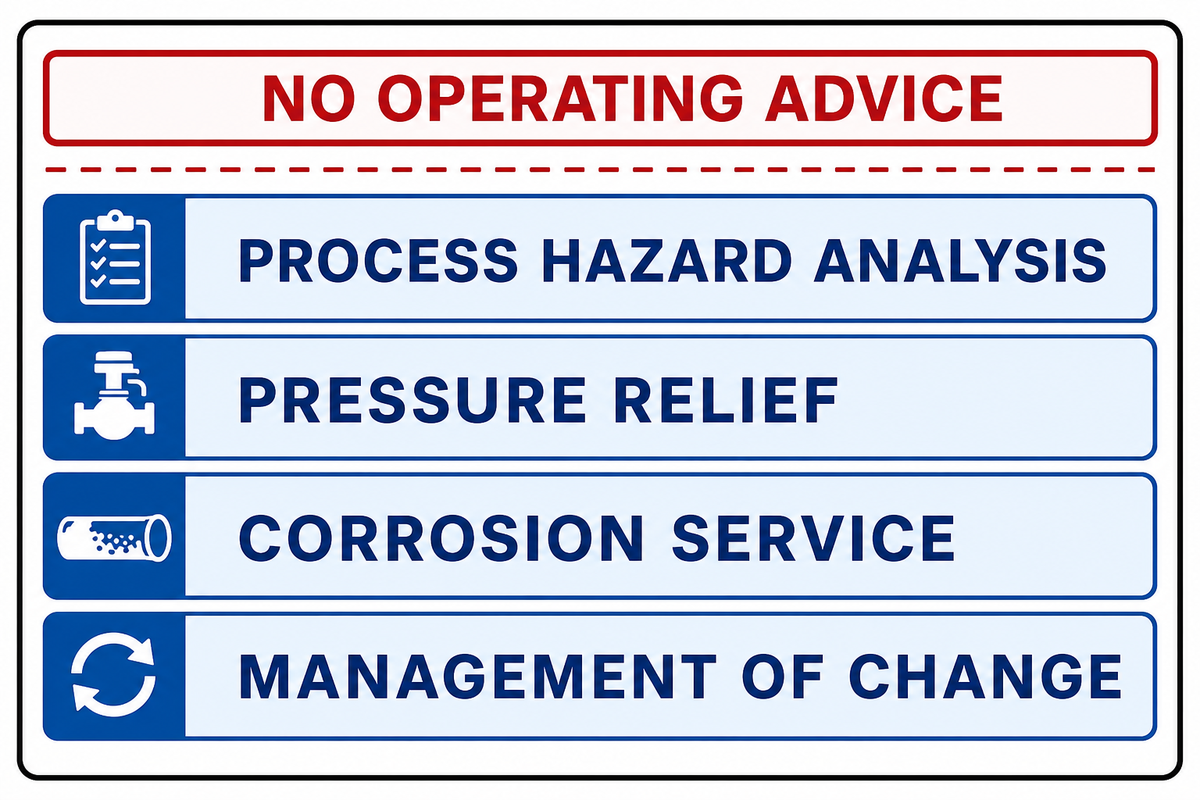
A useful article can explain what belongs in a safety review: process hazard analysis, pressure relief, isolation, corrosion service, hydrogen sulfide exposure, hot surfaces, coke-drum procedures, instrumentation, inspection access, emergency planning, and management of change. It should not tell a reader to change temperature, pressure, residence time, decoking sequence, or relief settings.
For equipment procurement, safety is not a paragraph added at the end. It affects material selection, design code, NDE, PWHT, cladding, refractory, platform access, drain/vent design, documentation, and inspection hold points. A low bid that ignores those items may create more risk than it removes.
Project Selection Matrix: Match Feed, Product Goal, and Equipment Scope

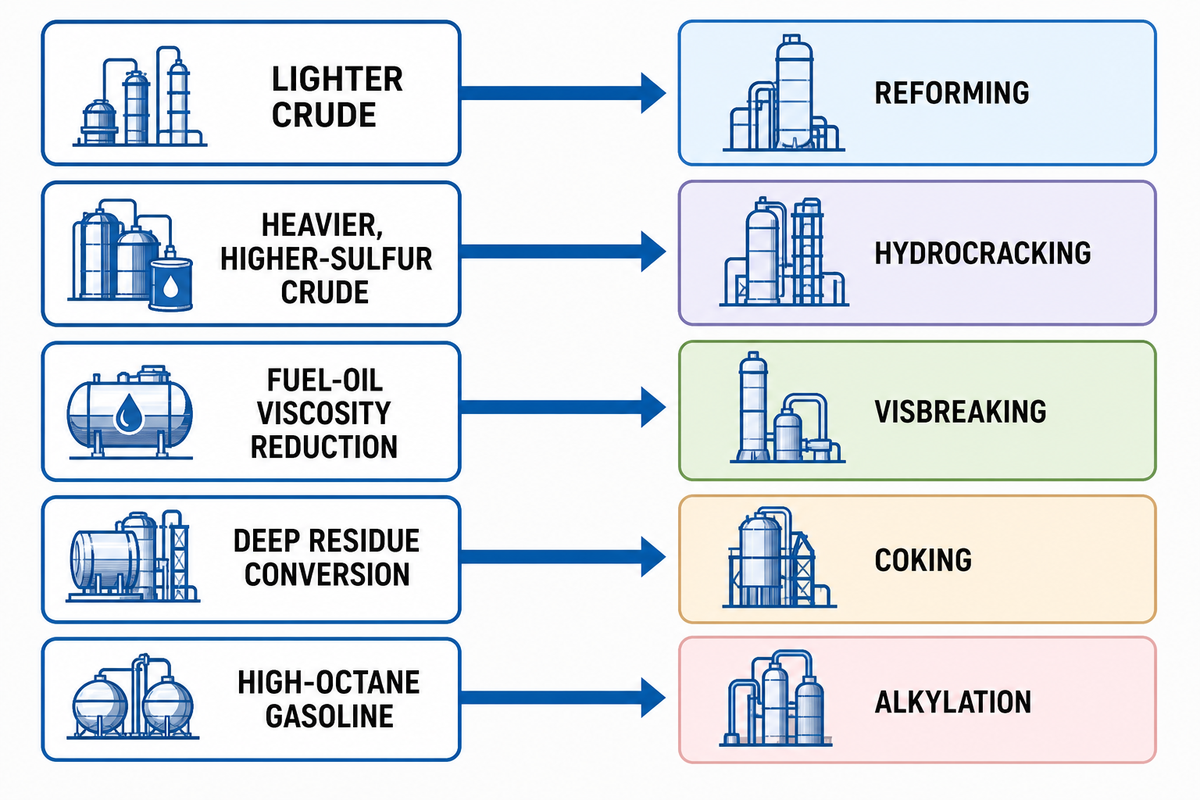
The practical selection question starts with the feed. A refinery processing lighter crude may not face the same residue-conversion challenge as one processing heavier, higher-sulfur crude. A refinery that needs fuel-oil viscosity reduction may look at visbreaking. A refinery that needs deep residue conversion may evaluate coking or other bottom-of-barrel routes. A refinery that needs high-octane gasoline components may be discussing FCC, reforming, alkylation, or hydrocracking instead.
That decision then becomes an equipment boundary. BOSHIYA’s refinery equipment portfolio includes crude and vacuum distillation equipment, FCC and hydrocracker equipment, shell-and-tube heat exchangers, pressure vessels and reactors, modular refinery packages, hydrotreating/desulfurization systems, catalytic reforming equipment, and storage/blending systems. For a commercial handoff, review the oil refinery equipment page after the process scope is clear.
The link between the educational guide and the supplier page should be a specification handoff, not a shortcut. The process basis still has to come from the refinery owner, licensor, EPC, and applicable codes.
| If the refinery needs… | Likely discussion | RFQ boundary |
|---|---|---|
| Lower viscosity residue or fuel oil | Visbreaking / mild thermal cracking | Feed assay, viscosity target, stability, heater/reactor duty, fouling allowance. |
| Deep residue conversion | Delayed coking or related coking route | Coke drums, fractionator, heater, quench, decoking interface, coke handling. |
| High-octane gasoline from gas oil | FCC or hydrocracking comparison | Catalyst/hydrogen/process-license boundaries, not generic thermal cracking. |
| Ethylene/propylene feedstock | Steam cracking / petrochemical unit | Separate petrochemical furnace, quench, and recovery scope. |
RFQ Checklist for Thermal Cracking and Residue-Conversion Equipment

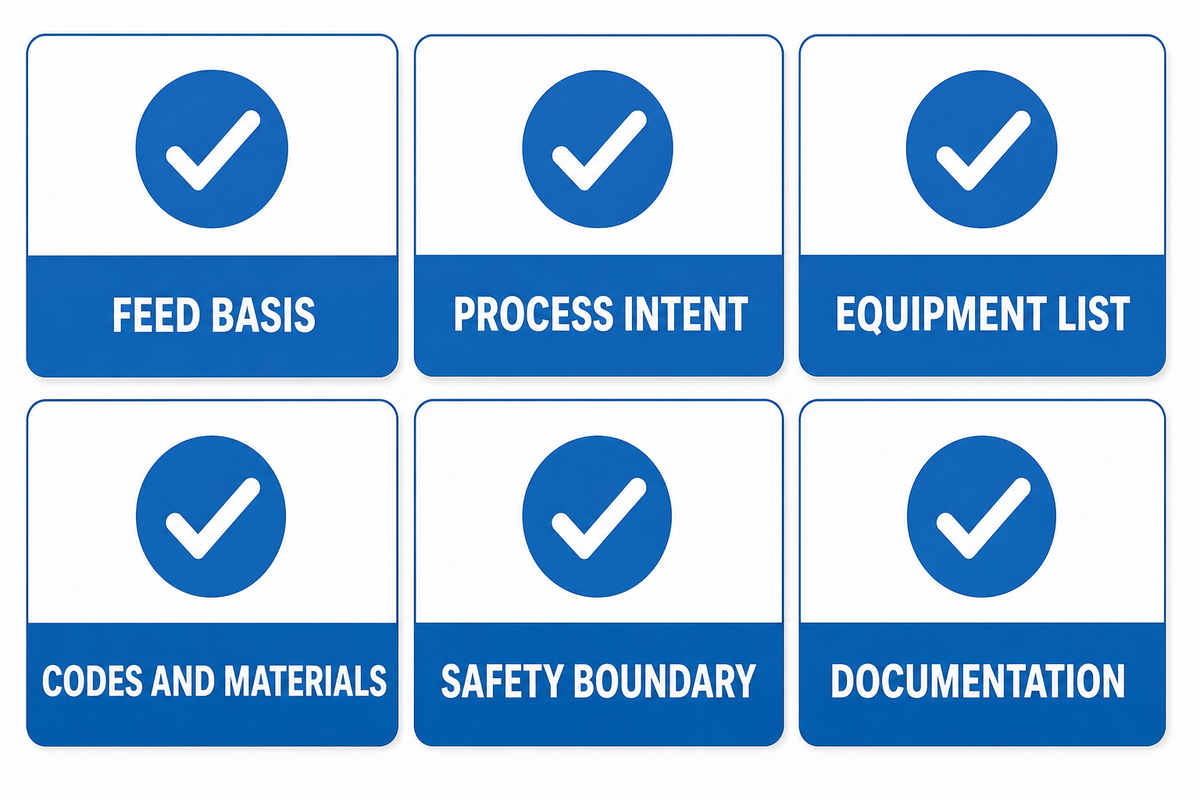
A refinery thermal cracking RFQ should be specific enough for an equipment supplier to price the right boundary and for an EPC to detect missing assumptions. The checklist below is not a process design manual. It is a conversation starter for the commercial and technical package.
- Feed basis: crude/residue source, assay summary, sulfur, metals, CCR/concarbon, asphaltenes, viscosity, expected variability.
- Process intent: viscosity reduction, residue conversion, liquid yield, coke management, downstream FCC/hydrocracker feed, or modular package requirement.
- Equipment list: heaters, transfer lines, reactors, drums, fractionator, exchangers, separators, pressure vessels, internals, piping, skids, controls.
- Codes and materials: ASME section, API/TEMA requirements, corrosion service, cladding, refractory, PWHT, NDE level, third-party inspection.
- Safety boundary: pressure relief, isolation, H2S, hot surfaces, coke handling, emergency shutdown, gas detection, access platforms, MOC expectations.
- Documentation: MDR, material certificates, welding procedure qualification, NDE reports, hydrotest records, inspection test plan, packing and shipping plan.
よくある質問
単純な製油所用語で熱分解とは何ですか?
熱分解は、高温を使用してより大きな炭化水素分子を小さな炭化水素分子に分解する製油所変換プロセスファミリーです。残留物サービスでは、この用語はビスブレーキングとコークス化に関連していることがよくあります。.
熱クラッキングとビスブレーキングの違いは何ですか?
ビスブレーキングは、主に重い残留物の粘度を下げ、一部の軽い製品を回収することに焦点を当てた穏やかな熱分解です。熱分解はより広範な熱駆動分解ファミリーであり、遅延コーキングはより深刻な残留物変換ルートです。.
遅延コークス化は熱分解と同じですか?
Delayed coking is a severe thermal cracking process, but it has its own equipment boundary: heater, coke drums, fractionator, quench, decoking, coke handling, and safety systems. It should not be specified with the same short description as visbreaking.
How hot is thermal cracking?
Published educational sources often describe refinery thermal cracking, visbreaking, or coking examples in high-temperature ranges, such as roughly 450-500°C for some residue thermal services and about 475°C in a delayed-coking lesson example. Those values are orientation only. Actual conditions depend on feed, process design, licensor requirements, metallurgy, pressure boundary, and safety review.
What should buyers ask before sourcing thermal cracking equipment?
Ask for the feed basis, product target, process boundary, safety and corrosion assumptions, design codes, equipment list, inspection requirements, documentation package, logistics limits, and whether the supplier is fabricating equipment only or also responsible for process design/licensing.

![ポリプロピレン樹脂: グレード、タイプ&選択ガイド [2026]](https://boshiya.com/wp-content/uploads/2026/05/0-150x150.webp)